Đề cương ôn tập học kì 1 môn Tiếng Anh lớp 11 nâng cao năm 2020 - 2021
Xem trước nội dung
Gia sư Thành Được www.daythem.edu.vn
1
THE 1ST TERM CONSOLIDATION
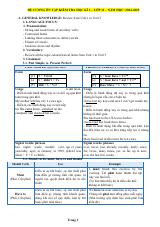
GRADE 11 A. VOCABULARY : I. Words related to the following topics : - Friendship; Party ; Volunteer work ; Competitions ; World population; Celebration. II. Word form B. WRITING : I. Mistake correction II. Choose the sentence that has the same meaning with the original one . C. GRAMMAR : I. Bare infinitive - To infinitive 1. Bare Infinitive: Eg: - My parents let me go to Nha Trang this holiday. - I can swim and sunbathe on the sand. a. S + let, make, help + O + Vo….. b. S + modal verbs + Vo….. c. Sau các động từ chỉ tri giác Eg : I saw him go out last night . d. Sau cấu trúc - S + had better + V(0 to) - S + would rather + V(0 to) 2. To infinitive Những động từ theo sau bởi to infinitive : a. Subject + verb + to infinitive decide : quyết định , hope : hy vọng , learn : học , mean : có ý định , plan : có kế hoạch , promise : hứa want : muốn , swear : thề , agree : đồng ý , refuse : từ chối , propose : đề nghị , attemp : cố gắng fail : thất bại , arrange : thu xếp , pretend : giả vờ Eg : -He decided to put off their journey because of the bad weather . - The police refused to provide the information for the jounalists . b. Subject + verb + object + to infinitive advise: khuyên ,tell: bảo, kể, permit: cho phép, remind: nhắc nhở, allow: cho phép, ask: yêu cầu , forbid: cấm, urge: thúc giục, recommend: đề nghị, order: ra lệnh, encourage: khuyến khích, warn: cảnh báo, invite: mời,beg: cầu xin, oblige: ép buộc, challenge: thách thức, persuade: thuyết phục, entreat: van nài , teach: dạy, promise: hứa Eg: - I teach my little daughter to learn English . - Our teacher often encourages us to speak English II. Tense revision 1. The Present Simple Tense 1. Form S + V1(s/es)…. 2. Use a. Diễn tả một hành động hoặc một thói quen ở hiện tại (always, usually, often, sometimes, occasionally, seldom, rarely, every…….) Eg: I usually go to school in the afternoon. b. Diễn tả một chân lí, một sự thật lúc nào cũng đúng. Eg: The earth moves around the sun. 3. Đối với ngôi thứ ba số ít: He, She, It. a.Thêm “S” vào sau động từ thường. Eg: Lan often gets up early in the morning. b.Thêm “ES” vào sau các động từ tận cùng là: ch, sh, s, x, o, z. Eg: He watches a lot of TV on Sundays. 2. The Present Progressive Tense 1. Form S + am/is/are + V-ing…
Gia sư Thành Được www.daythem.edu.vn
2
2. Use a. Diễn tả một hành động đang xảy ra trong lúc nói (now, at the moment, at this time, at present….) Eg: - I am looking for the latest newspaper now. - They are watching a sport game show at the moment. b. Diễn tả một hành động tương lai có sự sắp đặt trước . Eg : I have to go home early this afternoon because I’m visiting my grandparents this evening . c. Diễn đạt một sự đột biến . Eg : He usually goes to bed early but this night he is going to bed late . d. Diễn đạt một sự việc có tính chất tạm thời . Eg : We are staying in my uncle’s house because our house has been repainted . 3. Note: Một số động từ không dùng ở thì Present Progressive, mà chỉ dùng ở thì Present Simple: to be, to want, to need, to have (có), to know, to understand, to seem ….... Eg: - We are tenth-grade students now. - I understand the lesson at the moment. 3. The Present Perfect Tense 1. Form S + has/have +V3/ed… 2. Use : a. Diễn tả một hành động xảy ra trong quá khứ và kéo dài đến hiện tại (never, ever, not…yet, since, for, so far, until now, up to now, since then …….) Eg: We have learnt English for 5 years. b. Diễn tả một hành động vừa mới xảy ra (just, recently, lately). Eg: She has just gone out. c. Diễn tả một hành động xảy ra trong quá khứ không xác định rõ thời gian (already, before) Eg: Have you seen this movie before? 3. Notes: a. This is the …….. time + S + has/have + V3/ed…. Eg: This is the first time I have studied in this school. b. S + has/have +V3/ed…… since + S + V2/ed…. Eg: We have known each other since we worked in that factory. 4. The Past Simple Tense 1. Form S + V2/ed… 2. Use a. Diễn tả một hành động xảy ra …
Trên đây là phần đầu tài liệu — bấm Đọc sách để xem đầy đủ.