
Đề cương ôn tập HK1 tiếng Anh 12 english discovery có đáp án
Xem trước nội dung
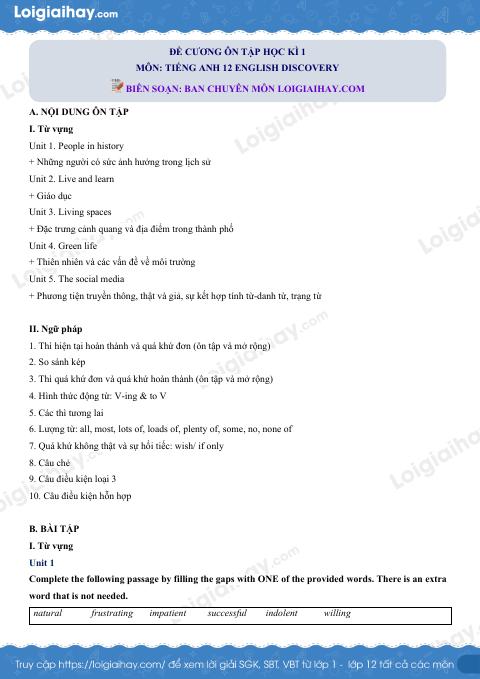
A. NỘI DUNG ÔN TẬP
I. Từ vựng
Unit 1. People in history
+ Những người có sức ảnh hưởng trong lịch sử
Unit 2. Live and learn
+ Giáo dục
Unit 3. Living spaces
+ Đặc trưng cảnh quang và địa điểm trong thành phố
Unit 4. Green life
+ Thiên nhiên và các vấn đề về môi trường
Unit 5. The social media
+ Phương tiện truyền thông, thật và giả, sự kết hợp tính từ-danh từ, trạng từ
II. Ngữ pháp
1. Thì hiện tại hoàn thành và quá khứ đơn (ôn tập và mở rộng)
2. So sánh kép
3. Thì quá khứ đơn và quá khứ hoàn thành (ôn tập và mở rộng)
4. Hình thức động từ: V-ing & to V
5. Các thì tương lai
6. Lượng từ: all, most, lots of, loads of, plenty of, some, no, none of
7. Quá khứ không thật và sự hối tiếc: wish/ if only
8. Câu chẻ
9. Câu điều kiện loại 3
10. Câu điều kiện hỗn hợp
B. BÀI TẬP
I. Từ vựng
Unit 1
Complete the following passage by filling the gaps with ONE of the provided words. There is an extra
word that is not needed.
natural frustrating impatient successful indolent willing
ĐỀ CƯƠNG ÔN TẬP HỌC KÌ 1
MÔN: TIẾNG ANH 12 ENGLISH DISCOVERY
BIÊN SOẠN: BAN CHUYÊN MÔN LOIGIAIHAY.COM
The brilliant but indolent physicist Albert Einstein once said that to become a 1_________ scientist, you have
to be both patient and 2_________. You need to be patient because experiments can take a long time, and you
need to be willing to wait for the results. However, you also need to be impatient because if something doesn't
work, you can't just keep doing the same thing over and over again. You need to be 3_________ to change
your approach and try something new.
There are also a few other traits that are important for scientists. First, they need to be curious. They should
have a 4_________ desire to learn about how the world works. Second, they need to be creative. They should
be able to think outside the box and come up with new ideas. Finally, they need to be persistent. They should
be willing to keep working on a problem even when it's difficult or 5_________. Not all scientists are the
same, and different people have different strengths and weaknesses. Nevertheless, these are some of the most
important qualities for success in science.
Đáp án:
1. successful 2. impatient 3. willing 4. natural 5. frustrating
Unit 2
Read the following passage and circle the letter A, B, C, or D to indicate the correct word that best fits
each of the numbered blanks.
In a changing job market
The world of work is changing rapidly. A lot of common jobs such as travel agents and cashiers are expected
to (1) ______ by the year 2050. At the same time, new jobs will be (2) ______. In such a rapidly changing job
market, it seems (3) ______ to teach or learn technical or vocational skills for jobs that don't exist yet. So,
what can we do to prepare for the job (4) ______ of the future? Researchers have suggested that both future
employers and employees will always need (5) ______ skills such as collaboration, organisation, and
communication skills. Some of the jobs or businesses that will exist in 30 years' time haven't been invented
yet. But we will probably still work in organisations that (6) ______ of people from different generations. We
will need to be open to different points of view and ways of thinking. Therefore, it is important for us to (7)
______ bias and be willing to take in new information and ideas. Having key soft skills and being (8) ______
about new things will help us prepare for the future world of work.
1. A. disappear B. create C. make D. receive
2. A. removed B. created C. replaced D. deleted
3. A. likely B. certain C. impossible D. positive
4. A. application B. employment C. positions D. opportunities
5. A. soft B. hard C. technical D. working
6. A. deny B. consist C. decide D. attack
7. A. develop B. accept C. overcome D. challenge
8. A. open-hearted B. close-minded C. minded D. open-minded
Trên đây là phần đầu tài liệu — bấm Đọc sách để xem đầy đủ.