
Đề cương ôn tập Giữa kì 1 Tiếng Anh 10 năm 2024–2025 trường THPT A Túc (Quảng Trị)
Xem trước nội dung
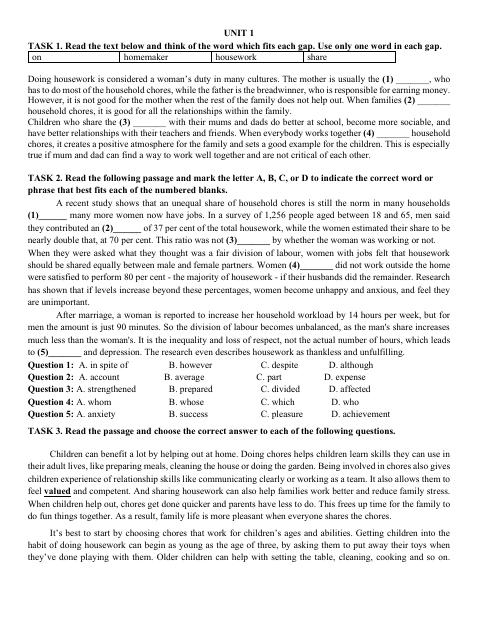
UNIT 1 TASK 1. Read the text below and think of the word which fits each gap. Use only one word in each gap.
on homemaker housework share Doing housework is considered a woman’s duty in many cultures. The mother is usually the (1) _______, who has to do most of the household chores, while the father is the breadwinner, who is responsible for earning money. However, it is not good for the mother when the rest of the family does not help out. When families (2) _______ household chores, it is good for all the relationships within the family. Children who share the (3) _______ with their mums and dads do better at school, become more sociable, and have better relationships with their teachers and friends. When everybody works together (4) _______ household chores, it creates a positive atmosphere for the family and sets a good example for the children. This is especially true if mum and dad can find a way to work well together and are not critical of each other. TASK 2. Read the following passage and mark the letter A, B, C, or D to indicate the correct word or phrase that best fits each of the numbered blanks.
A recent study shows that an unequal share of household chores is still the norm in many households (1)______ many more women now have jobs. In a survey of 1,256 people aged between 18 and 65, men said they contributed an (2)______ of 37 per cent of the total housework, while the women estimated their share to be nearly double that, at 70 per cent. This ratio was not (3)_______ by whether the woman was working or not. When they were asked what they thought was a fair division of labour, women with jobs felt that housework should be shared equally between male and female partners. Women (4)_______ did not work outside the home were satisfied to perform 80 per cent - the majority of housework - if their husbands did the remainder. Research has shown that if levels increase beyond these percentages, women become unhappy and anxious, and feel they are unimportant.
After marriage, a woman is reported to increase her household workload by 14 hours per week, but for men the amount is just 90 minutes. So the division of labour becomes unbalanced, as the man's share increases much less than the woman's. It is the inequality and loss of respect, not the actual number of hours, which leads to (5)_______ and depression. The research even describes housework as thankless and unfulfilling. Question 1: A. in spite of B. however C. despite D. although Question 2: A. account B. average C. part D. expense Question 3: A. strengthened B. prepared C. divided D. affected Question 4: A. whom B. whose C. which D. who Question 5: A. anxiety B. success C. pleasure D. achievement
TASK 3. Read the passage and choose the correct answer to each of the following questions.
Children can benefit a lot by helping out at home. Doing chores helps children learn skills they can use in their adult lives, like preparing meals, cleaning the house or doing the garden. Being involved in chores also gives children experience of relationship skills like communicating clearly or working as a team. It also allows them to feel valued and competent. And sharing housework can also help families work better and reduce family stress. When children help out, chores get done quicker and parents have less to do. This frees up time for the family to do fun things together. As a result, family life is more pleasant when everyone shares the chores.
It’s best to start by choosing chores that work for children’s ages and abilities. Getting children into the habit of doing housework can begin as young as the age of three, by asking them to put away their toys when they’ve done playing with them. Older children can help with setting the table, cleaning, cooking and so on.
Trên đây là phần đầu tài liệu — bấm Đọc sách để xem đầy đủ.