
Đề cương ôn tập Học kì 1 Tiếng Anh 10 năm 2023–2024 trường THPT Dân tộc Nội trú Sơn Động (Bắc Ninh)
Xem trước nội dung
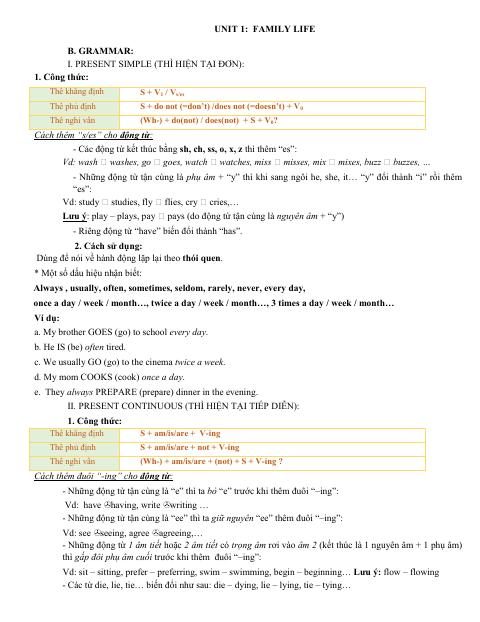
UNIT 1: FAMILY LIFE
B. GRAMMAR: I. PRESENT SIMPLE (THÌ HIỆN TẠI ĐƠN): 1. Công thức:
Thể khẳng định S + V1 / Vs/es Thể phủ định S + do not (=don’t) /does not (=doesn’t) + V0
Thể nghi vấn (Wh-) + do(not) / does(not) + S + V0?
Cách thêm “s/es” cho động từ:
- Các động từ kết thúc bằng sh, ch, ss, o, x, z thì thêm ―es‖: Vd: wash � washes, go � goes, watch � watches, miss � misses, mix � mixes, buzz � buzzes, …
- Những động từ tận cùng là phụ âm + ―y‖ thì khi sang ngôi he, she, it… ―y‖ đổi thành ―i‖ rồi thêm ―es‖: Vd: study � studies, fly � flies, cry � cries,…
Lƣu ý: play – plays, pay � pays (do động từ tận cùng là nguyên âm + ―y‖)
- Riêng động từ ―have‖ biến đổi thành ―has‖.
2. Cách sử dụng: Dùng để nói về hành động lặp lại theo thói quen.
* Một số dấu hiệu nhận biết:
Always , usually, often, sometimes, seldom, rarely, never, every day,
once a day / week / month…, twice a day / week / month…, 3 times a day / week / month…
Ví dụ:
a. My brother GOES (go) to school every day.
b. He IS (be) often tired.
c. We usually GO (go) to the cinema twice a week.
d. My mom COOKS (cook) once a day.
e. They always PREPARE (prepare) dinner in the evening.
II. PRESENT CONTINUOUS (THÌ HIỆN TẠI TIẾP DIỄN):
1. Công thức: Thể khẳng định S + am/is/are + V-ing Thể phủ định S + am/is/are + not + V-ing
Thể nghi vấn (Wh-) + am/is/are + (not) + S + V-ing ?
Cách thêm đuôi “-ing” cho động từ:
- Những động từ tận cùng là ―e‖ thì ta bỏ ―e‖ trƣớc khi thêm đuôi ―–ing‖:
Vd: have having, write writing … - Những động từ tận cùng là ―ee‖ thì ta giữ nguyên ―ee‖ thêm đuôi ―–ing‖:
Vd: see seeing, agree agreeing,… - Những động từ 1 âm tiết hoặc 2 âm tiết có trọng âm rơi vào âm 2 (kết thúc là 1 nguyên âm + 1 phụ âm) thì gấp đôi phụ âm cuối trƣớc khi thêm đuôi ―–ing‖:
Vd: sit – sitting, prefer – preferring, swim – swimming, begin – beginning… Lƣu ý: flow – flowing - Các từ die, lie, tie… biến đổi nhƣ sau: die – dying, lie – lying, tie – tying…
2. Cách sử dụng:
Để diễn tả hành động đang diễn ra ở hiện tại ngay lúc nói. * Một số dấu hiệu nhận biết: now, at the moment, at present, Look!, Listen!, Be careful!, Be quiet!, today, this term, this month,…
Lƣu ý: Ta KHÔNG sử dụng thì hiện tại tiếp diễn với động từ chỉ trạng thái (stative verb): like, love, hate, need, want, know, agree, understand, feel, seem, smell, hear, see, want, … Ví dụ: a. I AM WAITING (wait) for the bus at the moment.
b. Where ARE you GOING (go) now?
c. Listen! Someone IS SINGING (sing).
d. I AM FACING (face) difficulties in learning English this term.
e. She IS LEARNING (learn) English at present.
C. EXCERCISES: I-PRONUNCIATION: E1: Mark the letter A, B, C or D to indicate the word whose underlined part differs from the other three in pronunciation in each of the following questions.
Question 1: A. grocery B. homemaker C. together D. promotion
Question 2: A. gratitude B. character C. activate D. agreement
Question 3: A. prepare B. strengthen C. respect D. special
Question 4: A. husband B. rubbish C. contribute D. vulnerable
Question 5: A. benefit B. routine C. children D. finance
Question 6: A. playtime B. value C. grateful D. table
Question 7: A. generation B. grateful C. educate D. grandparents
E2: Mark the letter A, B, C, or D to indicate the word that differs from the other three in the position of the primary stress in each of the following questions.
Question 1: A. grocery B. character C. develop D. homemaker
Question 2: A. spotlessly B. experience C. society D. responsible
Question 3: A. routine B. laundry C. household D. picnic
Question 4: A. similar B. important C. atmosphere D. breadwinner
II-VOCABULARY AND GRAMMAR E3: Mark the letter A, B, C or D to indicate the correct answer to each of the following questions.
Question 1: Family___________ are important because they teach children what is right or wrong in life.
A. bonds B. values C. holidays D. connections
Question 2: ____ the rubbish in the early morning is a part of my daily …
Trên đây là phần đầu tài liệu — bấm Đọc sách để xem đầy đủ.