
Đề cương ôn tập Học kì 1 Tiếng Anh 9 năm 2025–2026 trường THCS Lê Quý Đôn (Hòa Bình)
Xem trước nội dung
TRƯỜNG THCS LÊ QÚY ĐÔN TỔKHOA HỌC XÃ HỘI
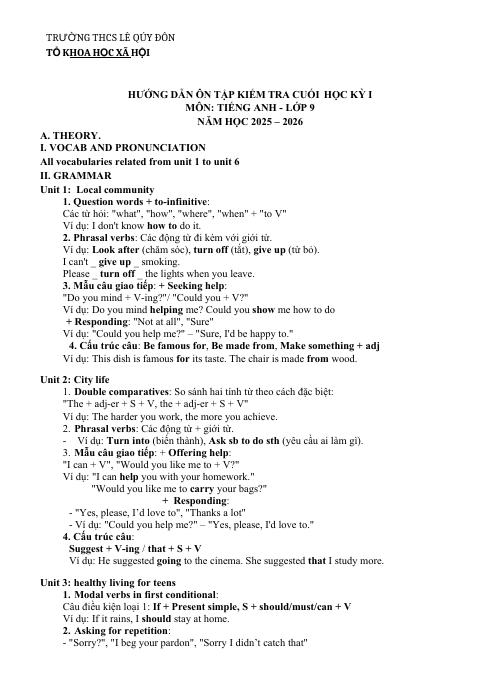
HƯỚNG DẪN ÔN TẬP KIỂM TRA CUỐI HỌC KỲI MÔN: TIẾNG ANH - LỚP 9 NĂM HỌC 2025 – 2026 A. THEORY. I. VOCAB AND PRONUNCIATION All vocabularies related from unit 1 to unit 6 II. GRAMMAR Unit 1: Local community 1. Question words + to-infinitive: Các từhỏi: "what", "how", "where", "when" + "to V" Ví dụ: I don't know how to do it. 2. Phrasal verbs: Các động từđi kèm với giới từ. Ví dụ: Look after (chăm sóc), turn off (tắt), give up (từbỏ). I can't _ give up _ smoking. Please _ turn off _ the lights when you leave. 3. Mẫu câu giao tiếp: + Seeking help: "Do you mind + V-ing?"/ "Could you + V?" Ví dụ: Do you mind helping me? Could you show me how to do + Responding: "Not at all", "Sure" Ví dụ: "Could you help me?" – "Sure, I'd be happy to." 4. Cấu trúc câu: Be famous for, Be made from, Make something + adj Ví dụ: This dish is famous for its taste. The chair is made from wood.
Unit 2: City life 1. Double comparatives: So sánh hai tính từtheo cách đặc biệt: "The + adj-er + S + V, the + adj-er + S + V" Ví dụ: The harder you work, the more you achieve. 2. Phrasal verbs: Các động từ+ giới từ. - Ví dụ: Turn into (biến thành), Ask sb to do sth (yêu cầu ai làm gì). 3. Mẫu câu giao tiếp: + Offering help: "I can + V", "Would you like me to + V?" Ví dụ: "I can help you with your homework." "Would you like me to carry your bags?" + Responding: - "Yes, please, I’d love to", "Thanks a lot" - Ví dụ: "Could you help me?" – "Yes, please, I'd love to." 4. Cấu trúc câu: Suggest + V-ing / that + S + V Ví dụ: He suggested going to the cinema. She suggested that I study more.
Unit 3: healthy living for teens 1. Modal verbs in first conditional: Câu điều kiện loại 1: If + Present simple, S + should/must/can + V Ví dụ: If it rains, I should stay at home. 2. Asking for repetition: - "Sorry?", "I beg your pardon", "Sorry I didn’t catch that"
3. Mẫu câu giao tiếp: a. In order to (đểlàm gì) Ví dụ: She studied hard in order to pass the exam. b. Helping someone: "Help sb do sth", "Try + to V" Ví dụ: Can you help me finish this homework? c. Cấu trúc câu: If + Present simple, S + should/must/can + V Ví dụ: If you study harder, you can pass the test.
Unit 4: Remembering the past 1. Past continuous: S + was/were + V-ing Ví dụ: I was studying at 8 p.m. yesterday. 2. Wish + Past simple:Sửdụng với ước muốn không có thật trong quá khứ. Ví dụ: I wish I had a car. 3. Mẫu câu giao tiếp: - Thanking:"Thank you very much for + N/V-ing" Ví dụ: Thank you very much for helping me. - Responding:"You’re welcome", "It’s my pleasure" Ví dụ: "Thanks for your help!" – "You're welcome." 4. Cấu trúc câu: To be proud to + V Ví dụ: I am proud to help my family.
Unit 5: Our experiences 1. Present perfect: S + have/has + V3/ed Ví dụ: I have visited this place before. 2. Apologising: "I’m really sorry", "Oops, my mistake" 3. Mẫu câu giao tiếp: Apologising:"I’m really sorry" – "That’s okay." Responding:"That’s alright", "No problem" Ví dụ: "Sorry for the mistake" – "No problem."
Unit 6: Vietnamese lifestyle: Then and Now 1. Verbs + To-infinitive: Một sốđộng từyêu cầu theo sau là to-infinitive: decide, want, hope. Ví dụ: I decided to leave early. 2. Verbs + V-ing: Một sốđộng từyêu cầu theo sau là V-ing: enjoy, suggest, avoid. Ví dụ: I enjoy swimming in the sea. 3. Mẫu câu giao tiếp: Making promises: "I will (not) + To V", "I promise (not) + To V" Ví dụ: "I promise to help you." Responding: "I will", "I promise" Ví dụ: "I will help you with your homework." 4. Cấu trúc câu: Provide sb with sth, Allow sb to do sth Ví dụ: The teacher provided us with all the materials.
III- SPEAKING: Talk about one of these topics 1.Talking about local activities
Trên đây là phần đầu tài liệu — bấm Đọc sách để xem đầy đủ.