
Đề cương ôn tập Giữa kì 2 Tiếng Anh 8 năm 2024–2025 trường THCS Trần Văn Ơn (TP Hồ Chí Minh)
Xem trước nội dung
1 | F r i e n d s P l u s 8 – 2 n d m i d t e r m
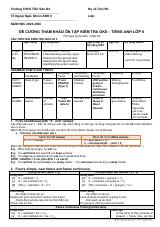
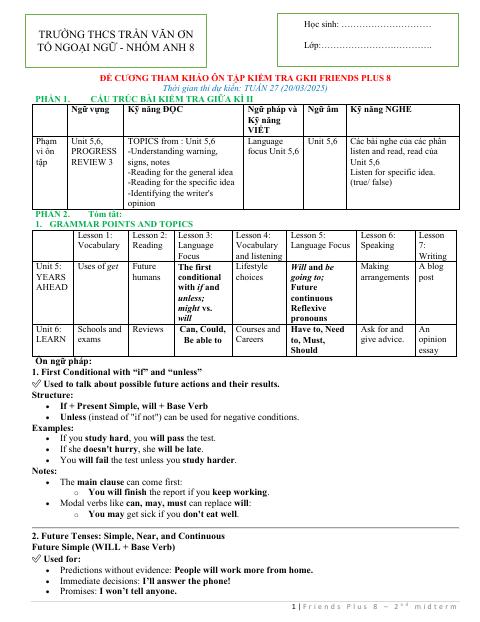
ĐỀ CƯƠNG THAM KHẢO ÔN TẬP KIỂM TRA GKII FRIENDS PLUS 8
Thời gian thi dự kiến: TUẦN 27 (20/03/2025) PHẦN 1. CẤU TRÚC BÀI KIỂM TRA GIỮA KÌ II Ngữ vựng Kỹ năng ĐỌC Ngữ pháp và Kỹ năng VIẾT
Ngữ âm Kỹ năng NGHE
Phạm vi ôn tập
Unit 5,6, PROGRESS REVIEW 3
TOPICS from : Unit 5,6 -Understanding warning, signs, notes -Reading for the general idea -Reading for the specific idea -Identifying the writer's opinion
Language focus Unit 5,6
Unit 5,6 Các bài nghe của các phần listen and read, read của Unit 5,6 Listen for specific idea. (true/ false)
PHẦN 2. Tóm tắt: 1. GRAMMAR POINTS AND TOPICS
Lesson 1: Vocabulary
Lesson 2: Reading
Lesson 3: Language Focus
Lesson 4: Vocabulary and listening
Lesson 5: Language Focus
Lesson 6: Speaking
Lesson 7: Writing Unit 5: YEARS AHEAD
Uses of get Future humans
The first conditional with if and unless; might vs. will
Lifestyle choices
Will and be going to; Future continuous Reflexive pronouns
Making arrangements
A blog post
Unit 6: LEARN
Schools and exams
Reviews Can, Could,
Be able to
Courses and Careers
Have to, Need to, Must, Should
Ask for and give advice.
An opinion essay Ôn ngữ pháp: 1. First Conditional with “if” and “unless” ✅ Used to talk about possible future actions and their results. Structure:
If + Present Simple, will + Base Verb Unless (instead of "if not") can be used for negative conditions. Examples:
If you study hard, you will pass the test. If she doesn't hurry, she will be late. You will fail the test unless you study harder. Notes:
The main clause can come first:
o You will finish the report if you keep working. Modal verbs like can, may, must can replace will:
o You may get sick if you don't eat well.
2. Future Tenses: Simple, Near, and Continuous Future Simple (WILL + Base Verb) ✅ Used for:
Predictions without evidence: People will work more from home. Immediate decisions: I’ll answer the phone! Promises: I won’t tell anyone.
TRƯỜNG THCS TRẦN VĂN ƠN TỔ NGOẠI NGỮ - NHÓM ANH 8
Học sinh: …………………………
Lớp:……………………………….
2 | F r i e n d s P l u s 8 – 2 n d m i d t e r m
Structure:
(+) S + will + V (-) S + will not (won’t) + V (?) Will + S + V?
Near Future (BE GOING TO + Base Verb) ✅ Used for:
Predictions based on evidence: Look at the clouds! It’s going to rain. Planned actions: I’m going to visit my aunt next month. Structure:
(+) S + am/is/are + going to + V (-) S + am/is/are + not going to + V (?) Am/Is/Are + S + going to + V?
Future Continuous (WILL BE + V-ing) ✅ Used for:
Actions happening at a specific future time: This time next week, I’ll be lying on the beach. Future plans: The government will be making a statement later today. Asking politely: Will you be working this weekend? Structure:
(+) S + will be + V-ing (-) S + will not (won’t) be + V-ing (?) Will + S + be + V-ing?
3. Can, Could, Be Able To
Can Could Be Able To Used for present/future ability: I can swim.
Used for past ability: He could read at age 3.
Used when "can" isn't possible: She will be able to drive next year. Used for requests: Can you help me?
More polite requests: Could you help me?
Used for effort-based actions: Despite the rain, we were able to finish the game.
4. Have To / Need To / Must / Should
Must Have To Need To Should / Ought To Strong obligation (personal decision): I must call my mom.
External obligation (rules/laws): Students have to wear uniforms.
Necessity: You need to drink water every day.
Advice: You should eat more vegetables.
Mustn’t = Prohibition: You mustn’t park here.
Don’t have to = Not necessary: You don’t have to bring food.
Needn’t = Not necessary: You needn’t wake up early tomorrow.
Stronger than "should": You ought to apologize.
5. To-Infinitive to Express Purpose ✅ Used to explain why something is done.
Shorter version of "in order to" or "so as to". Examples:
I’m calling to inform you about your order. (= I’m calling …
Trên đây là phần đầu tài liệu — bấm Đọc sách để xem đầy đủ.