
Đề cương ôn tập Giữa kì 2 Tiếng Anh 8 năm 2025–2026 trường THCS Trần Văn Ơn (TP Hồ Chí Minh)
Xem trước nội dung
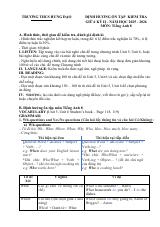
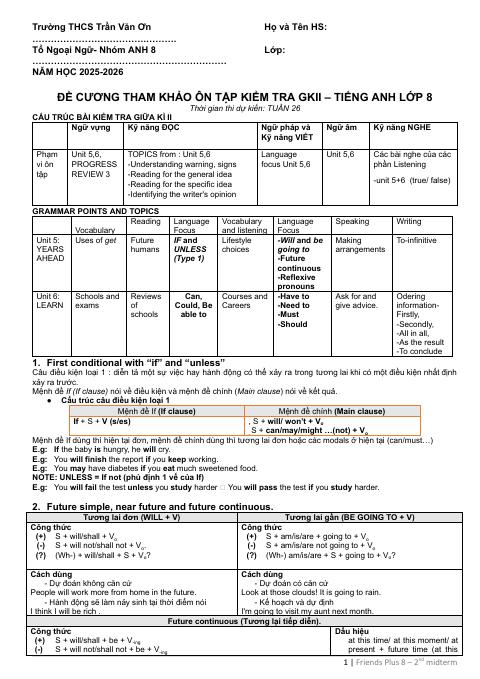
Trường THCS Trần Văn Ơn Họ và Tên HS: ……………………………….………. Tổ Ngoại Ngữ- Nhóm ANH 8 Lớp: ……………………………………………………… NĂM HỌC 2025-2026 ĐỀ CƯƠNG THAM KHẢO ÔN TẬP KIỂM TRA GKII – TIẾNG ANH LỚP 8
Thời gian thi dự kiến: TUẦN 26 CẤU TRÚC BÀI KIỂM TRA GIỮA KÌ II
Ngữ vựng Kỹ năng ĐỌC Ngữ pháp và Kỹ năng VIẾT
Ngữ âm Kỹ năng NGHE
Phạm vi ôn tập
Unit 5,6, PROGRESS REVIEW 3
TOPICS from : Unit 5,6 -Understanding warning, signs -Reading for the general idea -Reading for the specific idea -Identifying the writer's opinion
Language focus Unit 5,6
Unit 5,6 Các bài nghe của các phần Listening
-unit 5+6 (true/ false)
GRAMMAR POINTS AND TOPICS
Vocabulary
Reading Language Focus
Vocabulary and listening
Language Focus
Speaking Writing
Unit 5: YEARS AHEAD
Uses of get Future humans
IF and UNLESS (Type 1)
Lifestyle choices
-Will and be going to -Future continuous -Reflexive pronouns
Making arrangements
To-infinitive
Unit 6: LEARN
Schools and exams
Reviews of schools
Can, Could, Be
able to
Courses and Careers
-Have to -Need to -Must -Should
Ask for and give advice.
Odering information- Firstly, -Secondly, -All in all, -As the result -To conclude 1. First conditional with “if” and “unless” Câu điều kiện loại 1 : diễn tả một sự việc hay hành động có thể xảy ra trong tương lai khi có một điều kiện nhất định xảy ra trước. Mệnh đề If (If clause) nói về điều kiện và mệnh đề chính (Main clause) nói về kết quả.
● Cấu trúc câu điều kiện loại 1
Mệnh đề If (If clause) Mệnh đề chính (Main clause) If + S + V (s/es) , S + will/ won’t + Vo
, S + can/may/might …(not) + Vo Mệnh đề If dùng thì hiện tại đơn, mệnh đề chính dùng thì tương lai đơn hoặc các modals ở hiện tại (can/must…) E.g: If the baby is hungry, he will cry. E.g: You will finish the report if you keep working. E.g: You may have diabetes if you eat much sweetened food. NOTE: UNLESS = If not (phủ định 1 vế của If) E.g: You will fail the test unless you study harder You will pass the test if you study harder.
2. Future simple, near future and future continuous.
Tương lai đơn (WILL + V) Tương lai gần (BE GOING TO + V) Công thức
(+) S + will/shall + Vo (-) S + will not/shall not + Vo. (?) (Wh-) + will/shall + S + Vo?
Công thức
(+) S + am/is/are + going to + Vo (-) S + am/is/are not going to + Vo (?) (Wh-) am/is/are + S + going to + Vo? Cách dùng
- Dự đoán không căn cứ People will work more from home in the future.
- Hành động sẽ làm nảy sinh tại thời điểm nói I think I will be rich .
Cách dùng
- Dự đoán có căn cứ Look at those clouds! It is going to rain.
- Kế hoạch và dự định I'm going to visit my aunt next month. Future continuous (Tương lại tiếp diễn). Công thức
(+) S + will/shall + be + V-ing (-) S + will not/shall not + be + V-ing
Dấu hiệu
at this time/ at this moment/ at present + future time (at this 1 | Friends Plus 8 – 2nd midterm
(?) Will/ Shall + S + be + V-ing? Cách dùng
- Hành động đang xảy ra tại một thời điểm cụ thể trong tương lai This time next week I'll be lying on the beach.
time tomorrow/ at this moment next year...), at 5 p.m tomorrow... 3. ABILITY: Can, could, be able to
● Can/ could
CAN COULD
“can” và “could” được dùng trong câu hỏi đề nghị, xin phép, yêu cầu.
Diễn tả khả năng hiện tại hoặc tương lai I can swim./ It can rain.
Diễn tả khả năng xảy ra trong quá khứ. My brother could speak English when he was five. ● Can/ Could = be able to
CAN BE ABLE TO
“be able to” :diễn tả một khả năng . He will be able to have a good performance. I can swim = I am able to swim In spite of his broken leg, he was able to get out of the burning house. 4. OBLIGATION: have to/ need to / must / should
● Must/ have to/ need to : cần phải… I must phone my sister Students have to go to school on time. She needs to get up early = She has to get up early She doesn’t need to get up early = She doesn’t have to get up early
● Mustn’t/ needn’t
MUSTN’T NEEDN’T
MUSTN’T (không được phép) cấm đoán. You mustn’t drink it. It is poisonous.
NEEDN’T …
Trên đây là phần đầu tài liệu — bấm Đọc sách để xem đầy đủ.