
Đề cương ôn tập Học kì 2 Tiếng Anh 8 năm 2025–2026 trường THCS Phúc Xuân (Thái Nguyên)
Xem trước nội dung
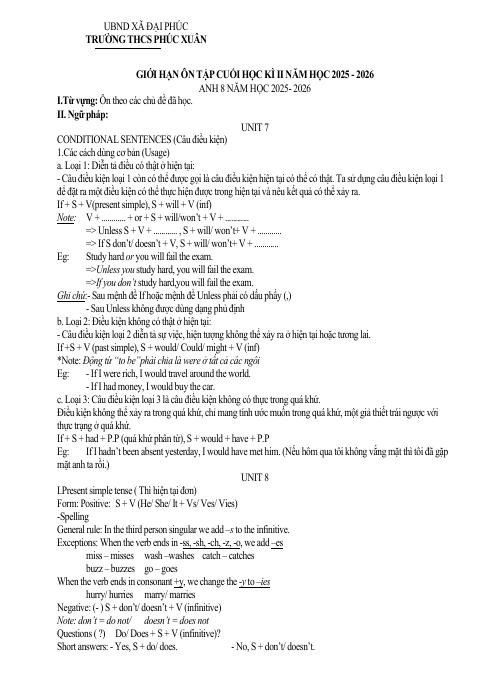
GIỚI HẠN ÔN TẬP CUỐI HỌC KÌ II NĂM HỌC 2025 - 2026
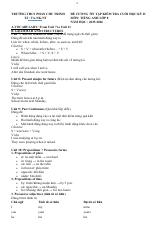
ANH 8 NĂM HỌC 2025- 2026 I.Từ vựng: Ôn theo các chủ đề đã học. II. Ngữ pháp:
UNIT 7 CONDITIONAL SENTENCES (Câu điều kiện) 1.Các cách dùng cơ bản (Usage) a. Loại 1: Diễn tả điều có thật ở hiện tại: - Câu điều kiện loại 1 còn có thể được gọi là câu điều kiện hiện tại có thể có thật. Ta sử dụng câu điều kiện loại 1 để đặt ra một điều kiện có thể thực hiện được trong hiện tại và nêu kết quả có thể xảy ra. If + S + V(present simple), S + will + V (inf) Note: V + ............ + or + S + will/won’t + V + ............ => Unless S + V + ............ , S + will/ won’t+ V + ............ => If S don’t/ doesn’t + V, S + will/ won’t+ V + ............ Eg: Study hard or you will fail the exam. =>Unless you study hard, you will fail the exam. =>If you don’t study hard,you will fail the exam. Ghi chú:- Sau mệnh đề If hoặc mệnh đề Unless phải có dấu phẩy (,) - Sau Unless không được dùng dạng phủ định b. Loại 2: Điều kiện không có thật ở hiện tại: - Câu điều kiện loại 2 diễn tả sự việc, hiện tượng không thể xảy ra ở hiện tại hoặc tương lai. If +S + V (past simple), S + would/ Could/ might + V (inf) *Note: Động từ “to be”phải chia là were ở tất cả các ngôi Eg: - If I were rich, I would travel around the world. - If I had money, I would buy the car. c. Loại 3: Câu điều kiện loại 3 là câu điều kiện không có thực trong quá khứ. Điều kiện không thể xảy ra trong quá khứ, chỉ mang tính ước muốn trong quá khứ, một giả thiết trái ngược với thực trạng ở quá khứ. If + S + had + P.P (quá khứ phân từ), S + would + have + P.P Eg: If I hadn’t been absent yesterday, I would have met him. (Nếu hôm qua tôi không vắng mặt thì tôi đã gặp mặt anh ta rồi.)
UNIT 8 I.Present simple tense ( Thì hiện tại đơn) Form: Positive: S + V (He/ She/ It + Vs/ Ves/ Vies) -Spelling General rule: In the third person singular we add –s to the infinitive. Exceptions: When the verb ends in -ss, -sh, -ch, -z, -o, we add –es miss – misses wash –washes catch – catches buzz – buzzes go – goes When the verb ends in consonant +y, we change the -y to –ies hurry/ hurries marry/ marries Negative: (- ) S + don’t/ doesn’t + V (infinitive) Note: don’t = do not/ doesn’t = does not Questions ( ?) Do/ Does + S + V (infinitive)? Short answers: - Yes, S + do/ does. - No, S + don’t/ doesn’t.
UBND XÃ ĐẠI PHÚC TRƯỜNG THCS PHÚC XUÂN
Note: In negatives and questions we use the infinitive forms of the verb. She doesn’t like wine. NOTShe doesn’t likes wine. Does he play football? NOTDoes he plays football? Use: We use present simple tense to: -Describe regular events. Ex: I get up at seven o’clock (everyday). -Describe regular truths and states. Ex: The Earth goes around the Sun. -Describe future events; something considered as a fact, an agreement or a plan Ex:Tet holiday this year lasts up to 9 days. II. Present continuous tense ( Thì hiện tại tiếp diễn) (+) S + am/ is/ are + V-ing (-) S + am/ is/ are + not + V-ing (?) Am/ Is/ Are + S + V-ing? ➔Yes, S + am/ is/ are. ➔No, S + am/ is/ are + not. Usage + To talk about the temporary situations: Ex: My cousin is living in America at the moment. Adverbs of time are often used: at the moment; currently; now; this week/ month/ year + To talk about actions happening at the moment of speaking Ex: I am waiting for my friends. + To talk about trends or changing situations Ex: The internet is making it easier for people to stay in touch with each other. III.Present perfect tense + Talk about an action that happened at an unspecified time in the past. We don’t state when it happened. + Talk about an action that has just or already happened. (The results related to present or in the future) Adverbs of time are often used: just; already; for; since; ever; never; not.. yet. Ex: I’ve collected plenty of information.
UNIT 9 I. Passive voice (Câu bị động)
Trên đây là phần đầu tài liệu — bấm Đọc sách để xem đầy đủ.