
Đề cương ôn tập Học kì 2 Tiếng Anh 8 năm 2025–2026 trường THCS Minh Đức (TP Hồ Chí Minh)
Xem trước nội dung
NAME: ___________________________ CLASS: 8/____
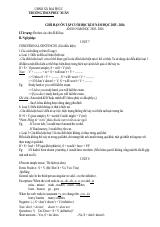
CỘNG HÒA XÃ HỘI CHỦNGHĨA VIỆT NAM TRƯỜNG TRUNG HỌC CƠ SỞ Độc lập - Tựdo - Hạnh phúc MINH ĐỨC
TRỌNG TÂM ÔN TẬP KIỂM TRA CUỐI KỲHỌC KỲ2
FRIENDS PLUS 8 UNIT 5 - UNIT 6 - UNIT 7 - UNIT 8
A - GRAMMAR 1. THE FIRST CONDITIONAL WITH IF AND UNLESS We use the first conditional to predict the result of an action. We use it to talk about things we think might happen in the future and things we think are possible. We make the first conditional with two clauses: the action clause (If clause) with the present simple and the result clause (main clause) with will. E.g.: If it (not rain) doesn't rain tomorrow, we (go) will go to the beach. Arsenal (be) will be top of the league if they (win) win. Conditional sentences can start with the action: E.g.: If you light a fire, you will feel warmer.
or with the result: E.g.: You’ll feel warmer if you light a fire. We can use the negative form in the action, the result, or both parts of the sentence. E.g.: We won’t win the challenge if we get lost in the trees. If he doesn’t have a compass, he’ll get lost. = Unless he has a compass, he’ll get lost. If we don’t make a big noise, we won’t find help. = Unless we make a big noise, we won’t find help. It is also common to use this structure with UNLESS instead of IF … NOT / DON’T / DOESN’T
E. g.: I won’t stay in London unless I get a well-paid job. = I won’t stay in London if I don’t get a well-paid job.
2. WILL vs MIGHT We use might / might not to make predictions, for future situations that are possible but not definite / when we aren’t certain. We use will / won’t to make predictions / situations when we are certain will be true in the future.
3. REFLEXIVE PRONOUNS The reflexive pronouns are:
singular: myself yourself himself herself itself
plural: ourselves yourselves themselves
We often use reflexive pronouns when the subject and the object of the verb refer to the same person or thing:
He cut himself on the broken glass. We can use reflexive pronouns to emphasize the person or thing we are referring to
Kendal itself is quite a small town. Sir Paul McCartney himself sang the final song. We often put the reflexive pronouns at the end of the clause when we are using it intensively for emphasis:
I baked the bread myself. She mended the car herself. We use reflexives with the preposition by:
to show that someone did something without any help: The children got dressed by themselves. I prepared the whole meal by myself. to show that someone was alone: He lived by himself in an enormous house. She walked home by herself.
4. WILL & BE GOING TO We use “be going to” for definite plans and intentions E.g.: I’m going to meet my friends at the concert. We use “will” for general predictions E.g.: I think the concert will be exciting.
5. FUTURE CONTINUOUS We use will + be + the -ing form of the verb. We use the future continuous to refer to temporary actions and events that will be in progress at a particular time in the future: This time next week, I’ll be taking photographs with my new camera.
6. TO-INFINITIVE: TO EXPRESS PURPOSES We use to-infinitive to express the purpose of an action (why or for what purpose an action is done) E. g.: They apply for a speaking course. They want to speak good English.
They apply for a speaking course to speak good English. To speak / So as to speak / In order to speak good English, they apply for a speaking course.
7. CAN VÀ BE ABLE TO: (Ở“HIỆN TẠI” HOẶC “TƯƠNG LAI”) - Đểchỉmột việc gì đó là khảdĩ. E.g: You can see the sea from our bedroom window. - Có khảnăng làm một việc gì đó E.g: Can you speak any foreign language?
I’m afraid I can’t come to your party next Friday. - “Be able to” có thểthay thếđược cho “can”, nhưng “can” thì thường gặp hơn. E.g: Are you able to speak any foreign languages? * Cách dùng riêng: - “can” chỉcó hai thể: “can” (hiện tại) và “could” (quá khứ) =>Vì vậy đôi khi phải sửdụng “be able to”: E.g: I haven’t been able to sleep recently. …
Trên đây là phần đầu tài liệu — bấm Đọc sách để xem đầy đủ.