
Đề cương ôn tập Học kì 2 Tiếng Anh 8 năm 2025–2026 trường THCS Lê Quang Cường (Bà Rịa Vũng Tàu)
Xem trước nội dung
1
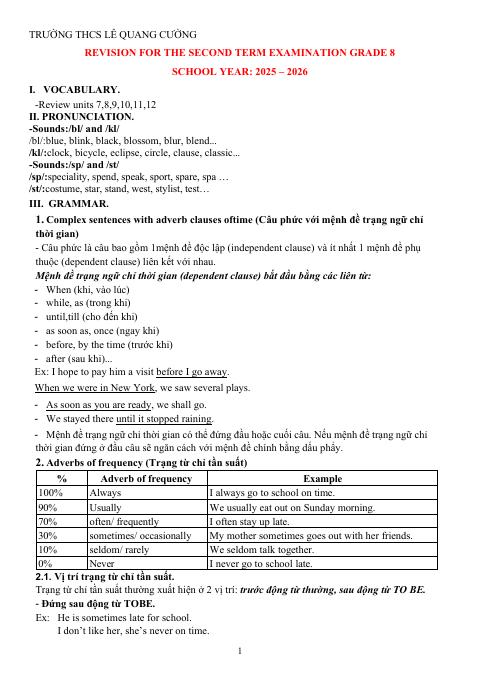
TRƯỜNG THCS LÊ QUANG CƯỜNG
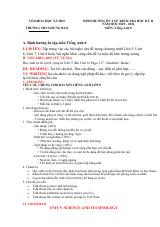
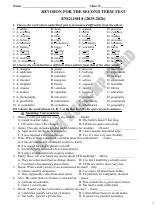
REVISION FOR THE SECOND TERM EXAMINATION GRADE 8
SCHOOL YEAR: 2025 – 2026
I. VOCABULARY.
-Review units 7,8,9,10,11,12 II. PRONUNCIATION. -Sounds:/bl/ and /kl/ /bl/:blue, blink, black, blossom, blur, blend... /kl/:clock, bicycle, eclipse, circle, clause, classic... -Sounds:/sp/ and /st/ /sp/:speciality, spend, speak, sport, spare, spa … /st/:costume, star, stand, west, stylist, test… III. GRAMMAR.
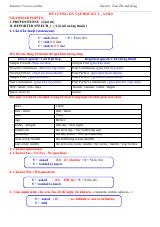
1. Complex sentences with adverb clauses oftime (Câu phức với mệnh đề trạng ngữ chỉ thời gian) - Câu phức là câu bao gồm 1mệnh đề độc lập (independent clause) và ít nhất 1 mệnh đề phụ thuộc (dependent clause) liên kết với nhau. Mệnh đề trạng ngữ chỉ thời gian (dependent clause) bắt đầu bằng các liên từ: - When (khi, vào lúc) - while, as (trong khi) - until,till (cho đến khi) - as soon as, once (ngay khi) - before, by the time (trước khi) - after (sau khi)... Ex: I hope to pay him a visit before I go away.
When we were in New York, we saw several plays.
- As soon as you are ready, we shall go. - We stayed there until it stopped raining. - Mệnh đề trạng ngữ chỉ thời gian có thể đứng đầu hoặc cuối câu. Nếu mệnh đề trạng ngữ chỉ
thời gian đứng ở đầu câu sẽ ngăn cách với mệnh đề chính bằng dấu phẩy. 2. Adverbs of frequency (Trạng từ chỉ tần suất)
% Adverb of frequency Example 100% Always I always go to school on time. 90% Usually We usually eat out on Sunday morning. 70% often/ frequently I often stay up late. 30% sometimes/ occasionally My mother sometimes goes out with her friends. 10% seldom/ rarely We seldom talk together. 0% Never I never go to school late. 2.1. Vị trí trạng từ chỉ tần suất. Trạng từ chỉ tần suất thường xuất hiện ở 2 vị trí: trước động từ thường, sau động từ TO BE. - Đứng sau động từ TOBE. Ex: He is sometimes late for school.
I don’t like her, she’s never on time.
2
-Đứng trước động từ thường. Ex: I often go to the movie with my friends. I rarely see her even though we live in the
same building. 3. Present simple for future events.(Thì hiện tại đơn dùng cho các sự kiện ở tương lai)
Be (+) S + am/is/ are + …
(-) S + am/is/ are + not + …
(?) Am/Is/ Are + S + …?
Ordinalverbs (+) S + V(s/es) + …
(-) S + don’t/ doesn’t + V(inf)…
(?) Do/ Does + S + V(inf)…?
-Thì hiện tại đơn diễn tả một việc sẽ xảy ra trong tương lai có lịch trình cụ thể (lịch chiếu phim, tàu xe, thời gian biểu, sự kiện...) Ex: The football match starts at 8 o’clock. -Our flight takes off at 9.30p.m, so we have to go early at least 1 hour. 4. Past continuous. (Qúa khứ tiếp diễn)
Khẳng định S + was/were + V-ing Phủ định S + was/were + not + V-ing Yes/ No question Was/Were + S + V-ing? Wh-question Wh + was/ were + S + V-ing?
a. Thì quá khứ tiếp diễn dùng để diễn tả 1 hành động đang diễn ra tại một thời điểm xác
định trong quá khứ. Ex: At seven o’clock yesterday, I was studying with my daddy. b. Dùng thì quá khứ tiếp diễn để diễn tả 1 hành động đang diễn ra thì một hành động khác xen
vào. Hành động đang diễn ra chúng ta chia ở quá khứ tiếp diễn, hành động xen vào ta chia ở quá khứ đơn. Thường dùng với when/ while. Ex: I was talking to my mom when you called me last night. c. Thì quá khứ tiếp diễn dùng để diễn tả 2 hành động xảy ra cùng lúc trong quá khứ. (Thường dùng
với while). Ex: I was reading mybook while my friend was watching TV.
5. Prepositions of place and time.(Giới từ chỉ nơi chốn và thời gian) *Prepositions of place. (Các giới từ chỉ nơi chốn): in, on, at, between, under, in front of, next to,
opposite. *Prepositions of time.(Các giới từ chỉ thời gian): in, on, at, by, for 6. Đại từ sở hữu (Possessive pronouns)
Subject pronouns (Đại từ
nhân xưng chủ ngữ)
Possessive adjective
(Tính từ sở hữu)
Possessive pronouns
(Đại từ sở hữu)
I my mine You your yours We our ours They their theirs He his his She her hers It its its
Trên đây là phần đầu tài liệu — bấm Đọc sách để xem đầy đủ.