
Đề thi giữa kì 1 Tiếng Anh 7 English Discovery - Đề số 5
Xem trước nội dung
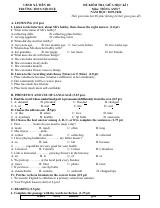
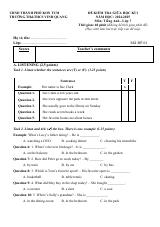
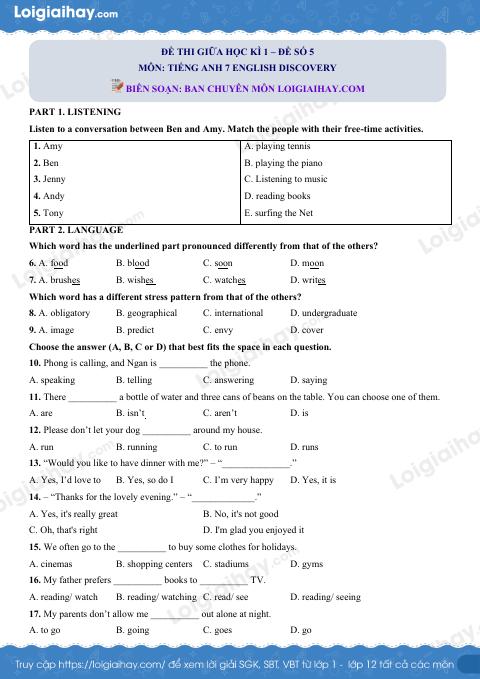
PART 1. LISTENING
Listen to a conversation between Ben and Amy. Match the people with their free-time activities.
1. Amy
2. Ben
3. Jenny
4. Andy
5. Tony
A. playing tennis
B. playing the piano
C. Listening to music
D. reading books
E. surfing the Net
PART 2. LANGUAGE
Which word has the underlined part pronounced differently from that of the others?
6. A. food B. blood C. soon D. moon
7. A. brushes B. wishes C. watches D. writes
Which word has a different stress pattern from that of the others?
8. A. obligatory B. geographical C. international D. undergraduate
9. A. image B. predict C. envy D. cover
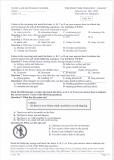
Choose the answer (A, B, C or D) that best fits the space in each question.
10. Phong is calling, and Ngan is __________ the phone.
A. speaking B. telling C. answering D. saying
11. There __________ a bottle of water and three cans of beans on the table. You can choose one of them.
A. are B. isn’t C. aren’t D. is
12. Please don’t let your dog __________ around my house.
A. run B. running C. to run D. runs
13. “Would you like to have dinner with me?” – “______________.”
A. Yes, I’d love to B. Yes, so do I C. I’m very happy D. Yes, it is
14. – “Thanks for the lovely evening.” – “_____________.”
A. Yes, it's really great B. No, it's not good
C. Oh, that's right D. I'm glad you enjoyed it
15. We often go to the __________ to buy some clothes for holidays.
A. cinemas B. shopping centers C. stadiums D. gyms
16. My father prefers __________ books to __________ TV.
A. reading/ watch B. reading/ watching C. read/ see D. reading/ seeing
17. My parents don’t allow me __________ out alone at night.
A. to go B. going C. goes D. go
ĐỀ THI GIỮA HỌC KÌ 1 – ĐỀ SỐ 5
MÔN: TIẾNG ANH 7 ENGLISH DISCOVERY
BIÊN SOẠN: BAN CHUYÊN MÔN LOIGIAIHAY.COM
18. I’m not mad __________ your behaviour.
A. about B. at C. in D. on
19. Lan usually __________ to school by bike; but today, she __________ to school on foot.
A. goes/ goes B. goes/ will go C. goes/ go D. goes/ is going
Supply the correct form of the word given in each sentence.
20. The novel is about a family who can't __________ with each other. (communication)
21. Visitors to the country have been asked to fill in a detailed __________. (question)
22. The kids are having an __________ time at the movies. (enjoy)
PART 3. READING
Read the following passage and do as direct.
Do you ever think about what schools will be like in the future? Many people think that students will study
most regular classes such as Maths, Science and History online. Students will probably learn these subjects
anywhere using a computer. What will happen if students have problems with a subject? They might connect
with a teacher through live video conferencing. Expert teachers from learning centres will give students help
wherever they live.
Students will still take classes in a school, too. Schools will become places for learning social skills. Teachers
will guide students in learning how to work together in getting along with each other. They will help students
with group projects both in and out of the classroom.
Volunteer work and working at local businesses will teach students important life skills about the world they
live in. This will help students become an important part of their communities. Some experts say it will take
five years for changes to begin in schools. Some say it will take longer. Most people agree, though, that
computers will change education the way TVs and telephones changed life for people all over the world years
before.
23. All classes will be taught online in the future.
A. False B. True
24. Computers will change education in the future.
A. True B. False
25. Teachers will help students from home in the future.
A. False B. True
26. Computers can’t help students study social skills.
A. True B. False
27. The main role of teachers in the future will be __________.
A. providing students with knowledge B. guiding students to learn …
Trên đây là phần đầu tài liệu — bấm Đọc sách để xem đầy đủ.