
Đề số 4 - Đề kiểm tra giữa kì 2 - Tiếng Anh 12 mới
Xem trước nội dung
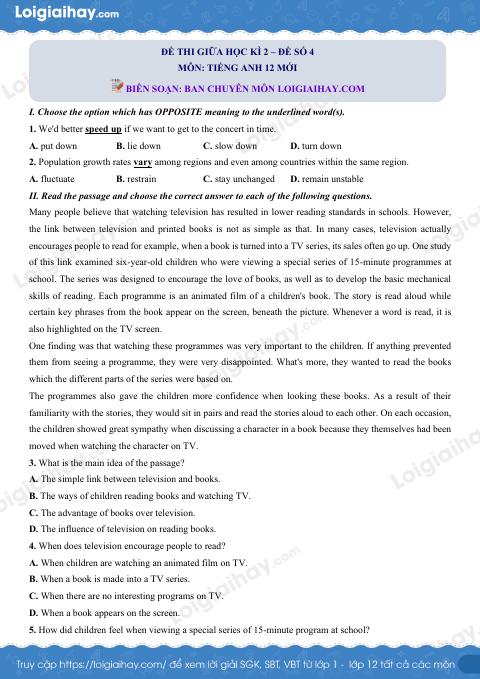
I. Choose the option which has OPPOSITE meaning to the underlined word(s).
1. We'd better speed up if we want to get to the concert in time.
A. put down B. lie down C. slow down D. turn down
2. Population growth rates vary among regions and even among countries within the same region.
A. fluctuate B. restrain C. stay unchanged D. remain unstable
II. Read the passage and choose the correct answer to each of the following questions.
Many people believe that watching television has resulted in lower reading standards in schools. However,
the link between television and printed books is not as simple as that. In many cases, television actually
encourages people to read for example, when a book is turned into a TV series, its sales often go up. One study
of this link examined six-year-old children who were viewing a special series of 15-minute programmes at
school. The series was designed to encourage the love of books, as well as to develop the basic mechanical
skills of reading. Each programme is an animated film of a children's book. The story is read aloud while
certain key phrases from the book appear on the screen, beneath the picture. Whenever a word is read, it is
also highlighted on the TV screen.
One finding was that watching these programmes was very important to the children. If anything prevented
them from seeing a programme, they were very disappointed. What's more, they wanted to read the books
which the different parts of the series were based on.
The programmes also gave the children more confidence when looking these books. As a result of their
familiarity with the stories, they would sit in pairs and read the stories aloud to each other. On each occasion,
the children showed great sympathy when discussing a character in a book because they themselves had been
moved when watching the character on TV.
3. What is the main idea of the passage?
A. The simple link between television and books.
B. The ways of children reading books and watching TV.
C. The advantage of books over television.
D. The influence of television on reading books.
4. When does television encourage people to read?
A. When children are watching an animated film on TV.
B. When a book is made into a TV series.
C. When there are no interesting programs on TV.
D. When a book appears on the screen.
5. How did children feel when viewing a special series of 15-minute program at school?
ĐỀ THI GIỮA HỌC KÌ 2 – ĐỀ SỐ 4
MÔN: TIẾNG ANH 12 MỚI
BIÊN SOẠN: BAN CHUYÊN MÔN LOIGIAIHAY.COM
A. They felt bored. B. They felt confident.
C. They felt disappointed. D. They felt excited.
6. What kind of film is each program?
A. An educational film. B. A story film of a children's book.
C. An animated film of a children's book. D. A documentary film of children's life.
7. What advantage did children have from this program?
A. They became more sympathetic.
B. They made more friends.
C. They read books with more interest and confidence.
D. They became more interested in watching TV.
II. Read the passage and choose correct word or phrase that best fits each of the numbered blanks.
BOOKS
Nearly all the discoveries that have been (8)_______ through the ages can be found in books. The invention
of the book is one of humankind's (9)_______ achievements, the importance of (10)_______ cannot be
overestimated. Books are very adaptable, (11)_______ us with both entertainment and information. The
production of books (12)_______ in Ancient Egypt, though not in a form that is recognised to us today. The
books read by the Romans, however, have some similarities to the ones we read now. Until the middle of the
15th century, in Europe, all books were written by hand. They were often beautifully illustrated and always
rare and expensive. With printing came the possibility of cheap, large-scale publication and distribution of
books, making knowledge more widespread and accessible.
8. A. done B. made C. achieved D. attained
9. A. giant …
Trên đây là phần đầu tài liệu — bấm Đọc sách để xem đầy đủ.