
Đề số 4 - Đề thi cuối học kì 2 - Tiếng Anh 11 mới
Xem trước nội dung
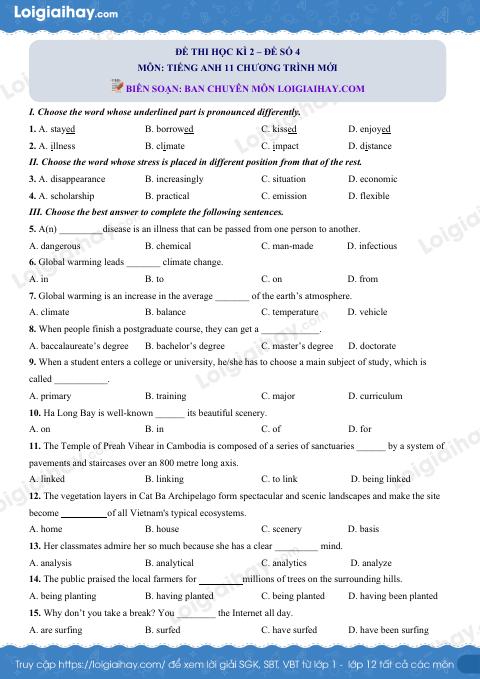
I. Choose the word whose underlined part is pronounced differently.
1. A. stayed B. borrowed C. kissed D. enjoyed
2. A. illness B. climate C. impact D. distance
II. Choose the word whose stress is placed in different position from that of the rest.
3. A. disappearance B. increasingly C. situation D. economic
4. A. scholarship B. practical C. emission D. flexible
III. Choose the best answer to complete the following sentences.
5. A(n) _________disease is an illness that can be passed from one person to another.
A. dangerous B. chemical C. man-made D. infectious
6. Global warming leads _______ climate change.
A. in B. to C. on D. from
7. Global warming is an increase in the average _______ of the earth’s atmosphere.
A. climate B. balance C. temperature D. vehicle
8. When people finish a postgraduate course, they can get a ____________.
A. baccalaureate’s degree B. bachelor’s degree C. master’s degree D. doctorate
9. When a student enters a college or university, he/she has to choose a main subject of study, which is
called ___________.
A. primary B. training C. major D. curriculum
10. Ha Long Bay is well-known ______ its beautiful scenery.
A. on B. in C. of D. for
11. The Temple of Preah Vihear in Cambodia is composed of a series of sanctuaries ______ by a system of
pavements and staircases over an 800 metre long axis.
A. linked B. linking C. to link D. being linked
12. The vegetation layers in Cat Ba Archipelago form spectacular and scenic landscapes and make the site
become of all Vietnam's typical ecosystems.
A. home B. house C. scenery D. basis
13. Her classmates admire her so much because she has a clear _________ mind.
A. analysis B. analytical C. analytics D. analyze
14. The public praised the local farmers for millions of trees on the surrounding hills.
A. being planting B. having planted C. being planted D. having been planted
15. Why don’t you take a break? You ________ the Internet all day.
A. are surfing B. surfed C. have surfed D. have been surfing
ĐỀ THI HỌC KÌ 2 – ĐỀ SỐ 4
MÔN: TIẾNG ANH 11 CHƯƠNG TRÌNH MỚI
BIÊN SOẠN: BAN CHUYÊN MÔN LOIGIAIHAY.COM
IV. Give the correct form of the words in the brackets.
16. The lecture is about the ……………….. of the world heritage sites. (preserve)
17. The tour of cave system is the main ………. for tourists in Phong Nha Ke Bang National Park.
(attract)
18. Scholars believe that there are still relics buried under the tomb and awaiting ……… (excavate)
19. New York city is facing with the problem of …………… electricity network. (age)
20. Cities will be ………………… and traffic will be heavy. (population)
V. Read the following passage and choose the correct answer to each of the questions.
Though called by sweet-sounding names like Firinga or Katrina, tropical cyclones are huge rotating storms
200 to 2,000 kilometers wide with winds that blow at speeds of more than 100 kilometers per hour (kph).
Weather professionals know them as tropical cyclones, but they are called hurricanes in the Caribbean Sea,
typhoons in the Pacific Ocean, and cyclones in the Indian Ocean. They occur in both the northern and southern
hemispheres. Large ones have destroyed cities and killed hundreds of thousands of people.
Tropical cyclones begin over water that is warmer than 27 degrees Celsius (80 degrees Fahrenheit) slightly
north or south of the earth’s equator. Warm, humid air full of water vapor moves upward. The earth’s rotation
causes the growing storm to start to rotate around its center (called the eye). At a certain height, the water
vapor condenses, changing to liquid and releasing heat. The heat draws more air and water vapor upward,
creating a cycle as air and water vapor rise and liquid water falls. If the cycle speeds up until winds reach 118
kilometers per hour, the storm qualifies as a tropical cyclone.
Most deaths in tropical cyclones are caused by storm surge. This is a rise in sea level, sometimes seven meters
or more, caused by the storm pushing …
Trên đây là phần đầu tài liệu — bấm Đọc sách để xem đầy đủ.