
Đề thi học kì 2 Tiếng Anh 11 Global Success - Đề số 2
Xem trước nội dung
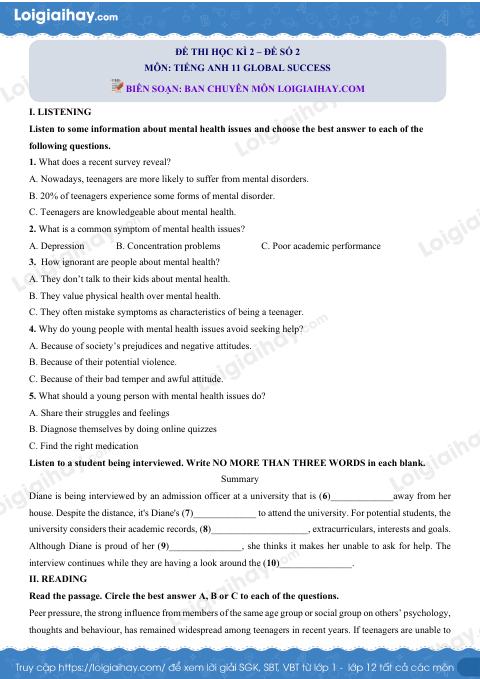
I. LISTENING
Listen to some information about mental health issues and choose the best answer to each of the
following questions.
1. What does a recent survey reveal?
A. Nowadays, teenagers are more likely to suffer from mental disorders.
B. 20% of teenagers experience some forms of mental disorder.
C. Teenagers are knowledgeable about mental health.
2. What is a common symptom of mental health issues?
A. Depression B. Concentration problems C. Poor academic performance
3. How ignorant are people about mental health?
A. They don’t talk to their kids about mental health.
B. They value physical health over mental health.
C. They often mistake symptoms as characteristics of being a teenager.
4. Why do young people with mental health issues avoid seeking help?
A. Because of society’s prejudices and negative attitudes.
B. Because of their potential violence.
C. Because of their bad temper and awful attitude.
5. What should a young person with mental health issues do?
A. Share their struggles and feelings
B. Diagnose themselves by doing online quizzes
C. Find the right medication
Listen to a student being interviewed. Write NO MORE THAN THREE WORDS in each blank.
Summary
Diane is being interviewed by an admission officer at a university that is (6)_____________away from her
house. Despite the distance, it's Diane's (7)_____________ to attend the university. For potential students, the
university considers their academic records, (8)____________________, extracurriculars, interests and goals.
Although Diane is proud of her (9)_______________, she thinks it makes her unable to ask for help. The
interview continues while they are having a look around the (10)_______________.
II. READING
Read the passage. Circle the best answer A, B or C to each of the questions.
Peer pressure, the strong influence from members of the same age group or social group on others’ psychology,
thoughts and behaviour, has remained widespread among teenagers in recent years. If teenagers are unable to
ĐỀ THI HỌC KÌ 2 – ĐỀ SỐ 2
MÔN: TIẾNG ANH 11 GLOBAL SUCCESS
BIÊN SOẠN: BAN CHUYÊN MÔN LOIGIAIHAY.COM
tackle it, they will wilt under the pressure of low self-esteem and depression. In the digital age, young students
are overwhelmed with tremendous online articles about admirable achievements of ‘someone else’s child’ or
‘a prodigy next door’. Consequently, reality is replete with teens who seem reserved and like to hide in their
own room for fear of being asked about exam results or tolerating unfavourable comparisons from their
relatives and acquaintances. In addition, many teens nowadays tend to make friends with those who study well
or have good looks, so many young students have to change who they are so as to fit in with their peers. In
other words, weak-minded and average individuals become worn out in an attempt to get flying colours, look
slim and fit as well as possess cool tech gadgets. To handle negative peer pressure, students need to alter their
opinions, care for their own feelings more than others’ thoughts and trusting in their own abilities. Accepting
one’s imperfections is another way to stop pushing themselves beyond the limits of their mental endurance.
Besides, if teenagers’ parents are one of the factors that make them stressed about peer pressure, they should
spend more time talking frankly with them to get sympathy and mutual understanding.
11. What is the passage mainly about?
A. Peer pressure – a very unsettling situation
B. Teenagers’ ways to deal with peer pressure
C. How to combat teenagers’ inferiority complex
D. Various kinds of peer pressure in today’s society
12. What does the word it in line 4 mean?
A. A troublesome issue B. A feeling C. An expectation D. A sense of empathy
13. What is the consequence of frequent comparison remarks of parents?
A. Children become rebellious and talk back to their parents.
B. Children hang out with their bad friends more often.
C. Children …
Trên đây là phần đầu tài liệu — bấm Đọc sách để xem đầy đủ.