
Đề thi học kì 2 Tiếng Anh 11 Global Success - Đề số 1
Xem trước nội dung
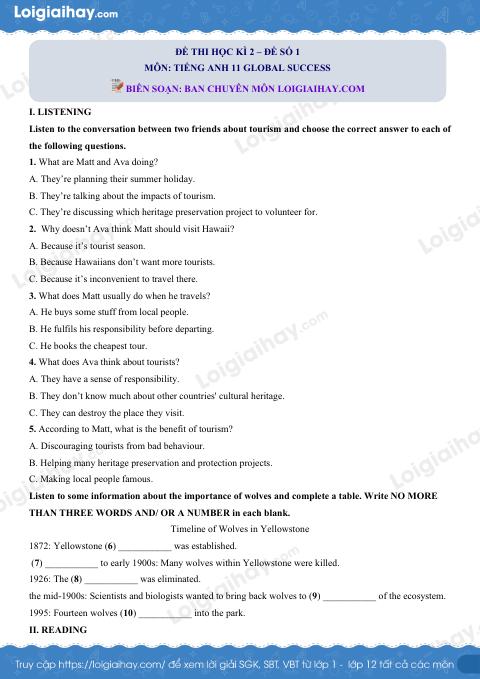
I. LISTENING
Listen to the conversation between two friends about tourism and choose the correct answer to each of
the following questions.
1. What are Matt and Ava doing?
A. They’re planning their summer holiday.
B. They’re talking about the impacts of tourism.
C. They’re discussing which heritage preservation project to volunteer for.
2. Why doesn’t Ava think Matt should visit Hawaii?
A. Because it’s tourist season.
B. Because Hawaiians don’t want more tourists.
C. Because it’s inconvenient to travel there.
3. What does Matt usually do when he travels?
A. He buys some stuff from local people.
B. He fulfils his responsibility before departing.
C. He books the cheapest tour.
4. What does Ava think about tourists?
A. They have a sense of responsibility.
B. They don’t know much about other countries' cultural heritage.
C. They can destroy the place they visit.
5. According to Matt, what is the benefit of tourism?
A. Discouraging tourists from bad behaviour.
B. Helping many heritage preservation and protection projects.
C. Making local people famous.
Listen to some information about the importance of wolves and complete a table. Write NO MORE
THAN THREE WORDS AND/ OR A NUMBER in each blank.
Timeline of Wolves in Yellowstone
1872: Yellowstone (6) ___________ was established.
(7) ___________ to early 1900s: Many wolves within Yellowstone were killed.
1926: The (8) ___________ was eliminated.
the mid-1900s: Scientists and biologists wanted to bring back wolves to (9) ___________ of the ecosystem.
1995: Fourteen wolves (10) ___________ into the park.
II. READING
ĐỀ THI HỌC KÌ 2 – ĐỀ SỐ 1
MÔN: TIẾNG ANH 11 GLOBAL SUCCESS
BIÊN SOẠN: BAN CHUYÊN MÔN LOIGIAIHAY.COM
Read the passage. Circle the best answer to each of the questions.
When it comes to preparations for studying abroad, the very first challenge for students is how to live
independently. Stepping out of their comfort zone to live and study in a faraway country often ingrains an
obscure fear of loneliness and helplessness. Therefore, if you have a plan to earn a degree in a foreign country,
you need to equip yourselves with essential skills to start a truly independent life as soon as possible. First and
foremost, you do not need to be an excellent cook but should know basic cooking skills to feed yourselves.
Suppose that you experienced a pandemic period, you would have to cook at home due to social distancing
and most restaurant closures. Second, clean-up and household skills are of equal importance. To lower
accommodation costs, many students often choose to share apartments with other mates. Definitely, no one
wants to stay with those who are untidy and do not know how to do simple household tasks, so make sure that
you can do daily housework well enough. Third, money management is a challenging task for most overseas
students. Some students are often flat broke at the end of the month because they cannot handle their budget.
It’s advisable to be a smart shopper by making a suitable shopping list and keeping an accurate record of your
daily expenses to avoid pointless debt. In short, the pieces of advice will hopefully make your independent
life easier when you go to university in another country.
11. What is the passage mainly about?
A. How to face loneliness and helplessness at home
B. Ways to gain independence while studying abroad
C. Overseas students and problems with additional expenses
D. Young students’ adjustment to sharing an apartment
12. What does the word those in the passage mean?
A. flatmates B. acquaintances C. housekeepers D. instructors
13. According to the passage, which of the following is NOT given in the list of advice to live
independently?
A. Cooking skills B. Clean-up skills
C. Communication skills D. Budget management skills
14. According to the passage, who might be short of money at the end of the month?
A. Students who buy a lot of learning materials and clothes
B. Students who live …
Trên đây là phần đầu tài liệu — bấm Đọc sách để xem đầy đủ.