
Đề thi giữa kì 2 Tiếng Anh 6 English Discovery - Đề số 6
Xem trước nội dung
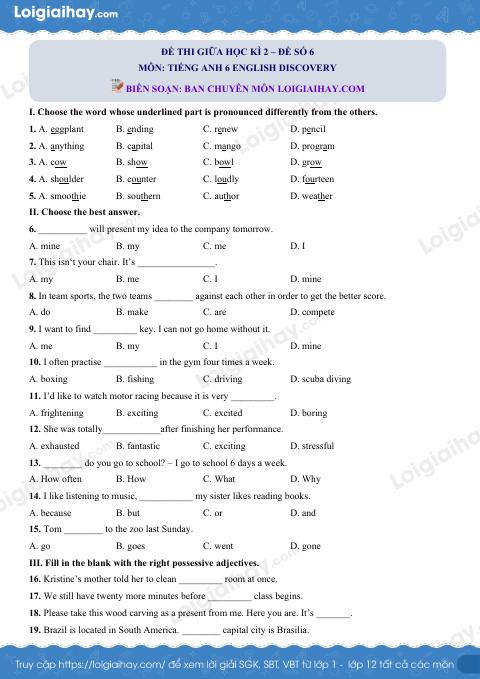
I. Choose the word whose underlined part is pronounced differently from the others.
1. A. eggplant B. ending C. renew D. pencil
2. A. anything B. capital C. mango D. program
3. A. cow B. show C. bowl D. grow
4. A. shoulder B. counter C. loudly D. fourteen
5. A. smoothie B. southern C. author D. weather
II. Choose the best answer.
6. __________ will present my idea to the company tomorrow.
A. mine B. my C. me D. I
7. This isn‘t your chair. It’s ________________.
A. my B. me C. I D. mine
8. In team sports, the two teams ________ against each other in order to get the better score.
A. do B. make C. are D. compete
9. I want to find _________ key. I can not go home without it.
A. me B. my C. I D. mine
10. I often practise ___________ in the gym four times a week.
A. boxing B. fishing C. driving D. scuba diving
11. I’d like to watch motor racing because it is very _________.
A. frightening B. exciting C. excited D. boring
12. She was totally____________after finishing her performance.
A. exhausted B. fantastic C. exciting D. stressful
13. ________ do you go to school? – I go to school 6 days a week.
A. How often B. How C. What D. Why
14. I like listening to music, ___________ my sister likes reading books.
A. because B. but C. or D. and
15. Tom ________ to the zoo last Sunday.
A. go B. goes C. went D. gone
III. Fill in the blank with the right possessive adjectives.
16. Kristine’s mother told her to clean _________ room at once.
17. We still have twenty more minutes before _________ class begins.
18. Please take this wood carving as a present from me. Here you are. It’s _______.
19. Brazil is located in South America. ________ capital city is Brasilia.
ĐỀ THI GIỮA HỌC KÌ 2 – ĐỀ SỐ 6
MÔN: TIẾNG ANH 6 ENGLISH DISCOVERY
BIÊN SOẠN: BAN CHUYÊN MÔN LOIGIAIHAY.COM
20. A: Is that the Smiths’ car? That one over there - the blue one. - B: No, that’s not ________. _________
car is dark blue.
IV. Listen and choose True or False.
21. Sumo is not the national sport of Japan.
22. Its popularity is increasing.
23. Sumo is misunderstood around the world.
24. People also say the guys who battle against each other are wrestlers.
25. Sumo is incredibly exciting and skillful.
V. Read the passage carefully and choose the correct answer.
At the beginning of TV history, there were several types of TV technology. One system was a mechanical
model based on a rotating disc. (Rotating discs are discs that spin like CDs.) The other system was an electronic
model. In 1906, Boris Rosing built the first working mechanical TV in Russia. In the 1920s, John Logie Baird
in England and Charles Francis Jenkins in the United States demonstrated improved mechanical systems.
Philo Taylor Farnsworth also showed an electronic system in San Francisco in 1927. His TV was the
forerunner of today's TV, which is an electronic system based on his ideas.
Now TV is everywhere. Before 1947, there were only a few thousand televisions in the U.S. By the 1990s,
there were televisions in 98% of American homes.
26. Rotating means ____________.
A. going up and down B. going back and forth
C. spinning D. staying still
27. Who invented the mechanical TV model?
A. Boris Rosing B. John Logie Baird
C. Charles Francis D. Philo Taylor Farnsworth
28. Which of the following statements is wrong?
A. More than one TV technology was developed in the history.
B. Nowadays TV is a popular household equipment.
C. John Logie Baird and Charles Francis Jenkins invented an electronic TV based on the previous
mechanical one.
D. No inventors mentioned in the passage came from Asia.
29. Whose invention is the current TV mostly based on?
A. Boris Rosing B. John Logie Baird
C. Charles Francis Jenkins D. Philo Taylor Farnsworth
30. How many TVs were in the US in 1945?
A. A few hundred B. A few thousand.
C. A few million. D. A few billion.
VII. Choose the best answer to complete the passage.
Trên đây là phần đầu tài liệu — bấm Đọc sách để xem đầy đủ.