
Đề thi học kì 1 Tiếng Anh 12 English Discovery - Đề số 4
Xem trước nội dung
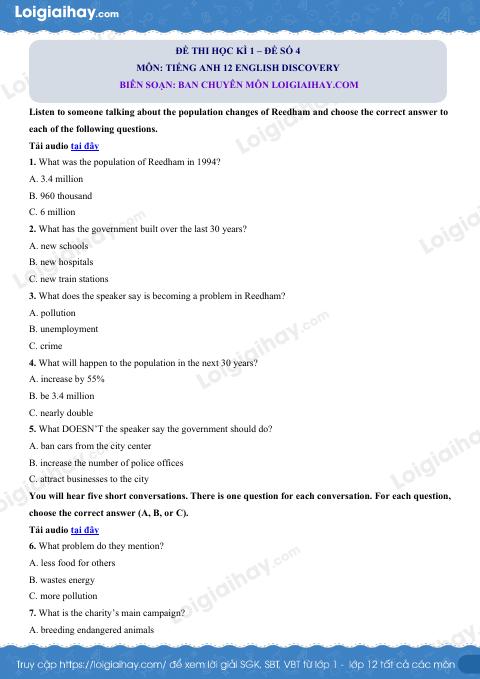
Listen to someone talking about the population changes of Reedham and choose the correct answer to
each of the following questions.
Tải audio tại đây
1. What was the population of Reedham in 1994?
A. 3.4 million
B. 960 thousand
C. 6 million
2. What has the government built over the last 30 years?
A. new schools
B. new hospitals
C. new train stations
3. What does the speaker say is becoming a problem in Reedham?
A. pollution
B. unemployment
C. crime
4. What will happen to the population in the next 30 years?
A. increase by 55%
B. be 3.4 million
C. nearly double
5. What DOESN’T the speaker say the government should do?
A. ban cars from the city center
B. increase the number of police offices
C. attract businesses to the city
You will hear five short conversations. There is one question for each conversation. For each question,
choose the correct answer (A, B, or C).
Tải audio tại đây
6. What problem do they mention?
A. less food for others
B. wastes energy
C. more pollution
7. What is the charity’s main campaign?
A. breeding endangered animals
ĐỀ THI HỌC KÌ 1 – ĐỀ SỐ 4
MÔN: TIẾNG ANH 12 ENGLISH DISCOVERY
BIÊN SOẠN: BAN CHUYÊN MÔN LOIGIAIHAY.COM
B. stopping people from hunting endangered animals
C. rescuing and reintroducing endangered animals
8. What will happen if they don’t clean up the river?
A. fewer people will visit the area
B. fish populations will fail
C. people won’t have clean water to drink
9. What will there be more of if the government offers more incentives?
A. good publicity
B. electric cars
C. eco-friendly companies
10. What does the speaker say people should do more?
A. use bicycles
B. do exercise
C. use public transportation
Read the following passage and circle the letter A, B, C, or D to indicate the correct word or phrase
that best fits each of the numbered blanks.
Brazil - A Diverse Ethnic & Cultural Heritage
Brazil is (11) ______ to the largest population in Latin America, of more than 215 million people. Most of
them live in the south-central area, (12) _____ includes the industrial cities of Sao Paulo, Rio de Janeiro, and
Belo Horizonte. The pace of urbanisation has been rapid, with 75% of the population living in (13) ______
areas by 1991. While this growth has contributed to economic development, it has also led to serious social,
environmental, and political (14) ______ in major cities. Nevertheless, Brazil remains famous for its
breathtaking natural beauty.
The Brazilian population is (15) ______ four main groups: the Portuguese, who colonised Brazil in the 16th
century: Africans who were brought to Brazil as slaves: various other European, Middle Eastern, and Asian
immigrant (16) ______ who have settled in Brazil since the mid-19th century, and the indigenous people.
Although the Portuguese were once the dominant European ethnic group in Brazil, waves of immigration have
resulted (17) ______ a diverse ethnic and cultural heritage.
Between 1875 and 1960, approximately 5 million Europeans emigrated to Brazil, settling mainly in the four
southern states of Sao Paulo, Parana, Santa Catarina, and Rio Grande do Sul. The immigrants were primarily
from Italy, Germany, Spain, Japan, Poland, and the Middle East. The largest Japanese (18) ______ in the
world is located in Sao Paulo.
The cultures of the different ethnic groups have together created the modern Brazilian way of life.
11.
A. house
B. home
Trên đây là phần đầu tài liệu — bấm Đọc sách để xem đầy đủ.