
Đề số 9 - Đề kiểm tra học kì 1 - Tiếng Anh 8 mới
Xem trước nội dung
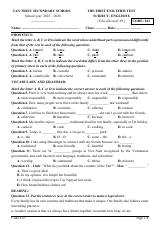
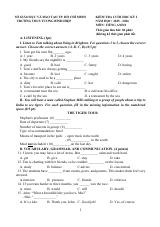
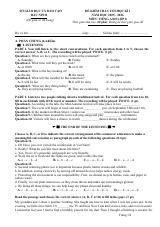
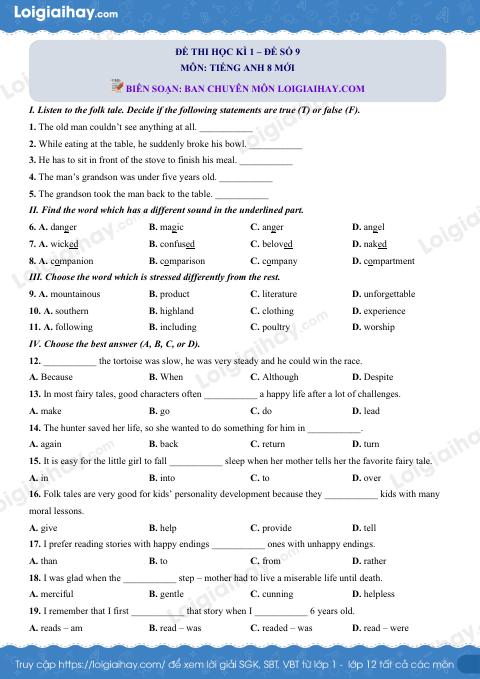
I. Listen to the folk tale. Decide if the following statements are true (T) or false (F).
1. The old man couldn’t see anything at all. ___________
2. While eating at the table, he suddenly broke his bowl. ___________
3. He has to sit in front of the stove to finish his meal. ___________
4. The man’s grandson was under five years old. ___________
5. The grandson took the man back to the table. ___________
II. Find the word which has a different sound in the underlined part.
6. A. danger B. magic C. anger D. angel
7. A. wicked B. confused C. beloved D. naked
8. A. companion B. comparison C. company D. compartment
III. Choose the word which is stressed differently from the rest.
9. A. mountainous B. product C. literature D. unforgettable
10. A. southern B. highland C. clothing D. experience
11. A. following B. including C. poultry D. worship
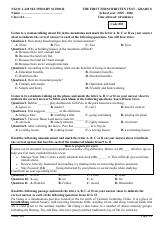
IV. Choose the best answer (A, B, C, or D).
12. ___________ the tortoise was slow, he was very steady and he could win the race.
A. Because B. When C. Although D. Despite
13. In most fairy tales, good characters often ___________ a happy life after a lot of challenges.
A. make B. go C. do D. lead
14. The hunter saved her life, so she wanted to do something for him in ___________.
A. again B. back C. return D. turn
15. It is easy for the little girl to fall ___________ sleep when her mother tells her the favorite fairy tale.
A. in B. into C. to D. over
16. Folk tales are very good for kids’ personality development because they ___________ kids with many
moral lessons.
A. give B. help C. provide D. tell
17. I prefer reading stories with happy endings ___________ ones with unhappy endings.
A. than B. to C. from D. rather
18. I was glad when the ___________ step – mother had to live a miserable life until death.
A. merciful B. gentle C. cunning D. helpless
19. I remember that I first ___________ that story when I ___________ 6 years old.
A. reads – am B. read – was C. readed – was D. read – were
ĐỀ THI HỌC KÌ 1 – ĐỀ SỐ 9
MÔN: TIẾNG ANH 8 MỚI
BIÊN SOẠN: BAN CHUYÊN MÔN LOIGIAIHAY.COM
20. In his last week’s business trip, my Dad ___________ a collection of folk tales for me.
A. bought B. was buying C. buys D. had bought
21. When our elder brother ___________ us a frightening story, suddenly there ___________ a big knock
on the door.
A. was telling – was B. were telling – was C. told – was D. tells – is
22. The Giong festival is held to ___________ Saint Giong who defeated the invaders.
A. remember B. commemorate C. miss D. remind
23. Hue is very famous for its royal court ___________.
A. dances B. stories C. music D. songs
24. The lion and dragon dances performed at the opening ceremony of the festival was very ___________.
A. impressed B. impress C. impressive D. impressing
25. This American man has tried only two traditional dishes of Vietnam, ___________ he strongly believes
that Vietnamese foods are very suitable for him.
A. however B. although C. so D. but
V. Read the passage. And decide if the statements are true (T) or false (F).
The dragon dance and the lion dance was originated from China, and it has been introduced to many parts of
the world. The dragon dance and lion dance are also popular in some traditional festivals in Vietnam. Dragons
symbolize wisdom, power and wealth, and they are believed to bring good luck to people. The origin of the
dragon dance can be dated back to the Han Dunasty (206 BC – 220 AD). It was then used in a ceremony for
worshiping ancestors and praying for rain, and it gradually developed into an entertainment activity. By the
Tang Dynasty (618-907) and the Song Dynasty (960-1279), it had become a common ceremonial activity in
festival like Chinese New Year.
The dragon body is woven in a round shape of thin bamboo strips, segment-by-segment, and covered with a
huge red cloth with dragon scales decorating it. The whole dragon is usually up to 30 meters in length – and
people hold rods every 1 to 2 meters …
Trên đây là phần đầu tài liệu — bấm Đọc sách để xem đầy đủ.