
Đề thi Giữa kì 2 Tiếng Anh 11 năm 2025-2026 trường THPT Hùng Vương (Đà Nẵng)
Xem trước nội dung
Mã đề 1101 Page 1/4
SỞ GD & ĐT TP ĐÀ NẴNG TRƯỜNG THPT HÙNG VƯƠNG
-------------------- (Đề thi có 4 trang)
KIỂM TRA GIỮA HỌC KỲ II
NĂM HỌC 2025 - 2026
MÔN: ANH VĂN 11 Thời gian làm bài: 60 PHÚT
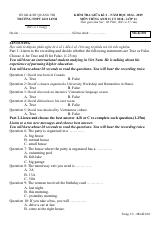
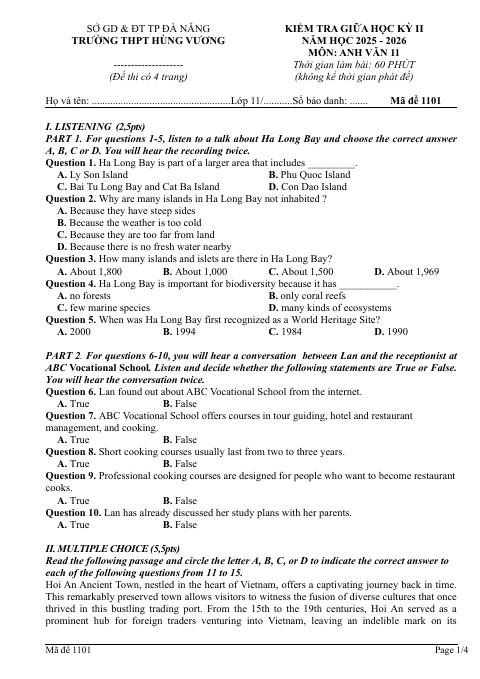
(không kể thời gian phát đề) Họ và tên: .....................................................Lớp 11/........... Số báo danh: ....... Mã đề 1101 I. LISTENING (2,5pts) PART 1. For questions 1-5, listen to a talk about Ha Long Bay and choose the correct answer A, B, C or D. You will hear the recording twice. Question 1. Ha Long Bay is part of a larger area that includes _________. A. Ly Son Island B. Phu Quoc Island C. Bai Tu Long Bay and Cat Ba Island D. Con Dao Island Question 2. Why are many islands in Ha Long Bay not inhabited ? A. Because they have steep sides B. Because the weather is too cold C. Because they are too far from land D. Because there is no fresh water nearby Question 3. How many islands and islets are there in Ha Long Bay? A. About 1,800 B. About 1,000 C. About 1,500 D. About 1,969 Question 4. Ha Long Bay is important for biodiversity because it has ___________. A. no forests B. only coral reefs C. few marine species D. many kinds of ecosystems Question 5. When was Ha Long Bay first recognized as a World Heritage Site? A. 2000 B. 1994 C. 1984 D. 1990 PART 2. For questions 6-10, you will hear a conversation between Lan and the receptionist at ABC Vocational School. Listen and decide whether the following statements are True or False. You will hear the conversation twice. Question 6. Lan found out about ABC Vocational School from the internet. A. True B. False Question 7. ABC Vocational School offers courses in tour guiding, hotel and restaurant management, and cooking. A. True B. False Question 8. Short cooking courses usually last from two to three years. A. True B. False Question 9. Professional cooking courses are designed for people who want to become restaurant cooks. A. True B. False Question 10. Lan has already discussed her study plans with her parents. A. True B. False II. MULTIPLE CHOICE (5,5pts) Read the following passage and circle the letter A, B, C, or D to indicate the correct answer to each of the following questions from 11 to 15. Hoi An Ancient Town, nestled in the heart of Vietnam, offers a captivating journey back in time. This remarkably preserved town allows visitors to witness the fusion of diverse cultures that once thrived in this bustling trading port. From the 15th to the 19th centuries, Hoi An served as a prominent hub for foreign traders venturing into Vietnam, leaving an indelible mark on its
Mã đề 1101 Page 2/4
architectural landscape and cultural fabric. Even today, the city retains much of its old-world charm, inviting exploration and discovery. The historic heart of Hoi An is a treasure trove of history, boasting over a thousand well- preserved buildings and monuments. Among these architectural gems are traditional houses, ornate temples, and the iconic 18th-century Japanese Covered Bridge, a testament to the town's multicultural past. Recognizing its exceptional historical and cultural significance, UNESCO designated Hoi An a World Heritage Site in 1999, acknowledging its importance to global heritage. This prestigious recognition underscores the town's unique value and the need for its continued preservation. Strategically situated on land near the Thu Bon River, south of Da Nang, Hoi An's history stretches back centuries. The area was once part of the Sa Huỳnh culture and later became integrated into the Kingdom of Champa. The Cham people recognized the area's potential and transformed Hoi An into a vital trading port, strategically positioned along the maritime Silk Road. This sea route facilitated trade between various countries, connecting Hoi An to a vast network of global commerce. The 15th century marked a significant shift as more Vietnamese people migrated to Hoi An, gradually bringing the area under the control of the Nguyễn clan. By the 17th century, Hoi An had …
Trên đây là phần đầu tài liệu — bấm Đọc sách để xem đầy đủ.