
Đề cương ôn thi học kỳ 2 môn Tiếng Anh Lớp 7 - Năm học 2016-2017
Xem trước nội dung
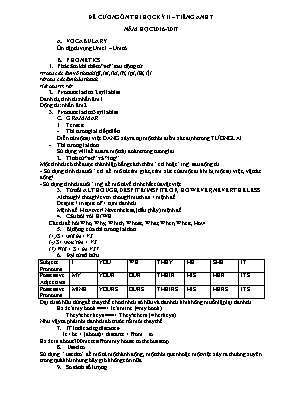
ĐỀ CƯƠNG ÔN THI HỌC KỲ II – TIẾNG ANH 7
NĂM HỌC 2016-2017
A. VOCABULARY Ôn tập từ vựng Unit 1 – Unit 6
B. PHONETICS 1. Phát âm khi thêm “ed” sau động từ /t/ sau các âm vô thanh /ʧ/, /s/, /k/, /f/, /p/, /θ/, /∫/ /d/ sau các âm hữu thanh /id/ sau /t/, /d/
2. Pronunciation 2 syllables Danh từ, tính từ: nhấn âm 1 Động từ: nhấn âm 2
3. Pronunciation 3 syllables
C. GRAMMAR 1. Tenses: - Thì tương lai tiếp diễn Diễn tả một sự việc ĐANG xảy ra tại một thời điểm xác định trong TƯƠNG LAI - Thì tương lai đơn Sử dụng will để đưa ra một dự đoán trong tương lai. 2. Tính từ “ed” và “ing” Một tính từ có thể được thành lập bằng cách thêm “ed” hoặc “ing” sau động từ - Sử dụng tính từ đuôi “ed” để mô tả cảm giác, cảm xúc của một ai khi bị một sự việc, vật tác động/ - Sử dụng tính từ đuôi “ing” để mô tả về tính chất của vật việc
3. Từ nối ALTHOUGH, DESPITE/INSPITE OF, HOWEVER, NEVERTHELESS Although/ though/ even though/ much as + mệnh đề Despite / in spite of + cụm danh từ Mệnh đề. However/ Nevertheless,(dấu phẩy) mệnh đề 4. Câu hỏi với H/WH Các từ để hỏi Who, Why, Which, Whose, What, When, Where, How
5. Bị động của thì tương lai đơn (+)S + will be+ V3 (-) S+ won’t be + V3 (?) Will + S + be V3?
6. Đại từ sỡ hữu Subject Pronouns
I YOU WE THEY HE SHE IT
Possessive Adjectives
MY YOUR OUR THEIR HIS HER ITS
Possessive Pronouns
MINE YOURS OURS THEIRS HIS HERS ITS
Đại từ sở hữu dùng để thay thế cho tính từ sở hữu và danh từ khi không muốn lặp lại danh từ.
Ex: It’s my book ===> It’s mine.(= my book) They're her keys ===> They're hers.(= her keys) Như vậy ta phải nói danh từ đó trước rồi mới thay thế.
7. IT indicating distance It + be + (about) + distance + from...to... Ex: It is about 300 meters from my house to the bus stop.
8. Used to Sử dụng “used to” để mô tả một hành động, một thói quen hoặc một việc xảy ra thường xuyên trong quá khứ nhưng bây giờ không còn nữa
9. So sánh số lượng
ThuVienDeThi.com
Little -> less Few -> Fewer Many ,much -> more Số lượng Ít hơn: S+ V+ less + N (không đếm được) S+ V+ fewer + N ( đếm được) Số lượng nhiều hơn: S+ V+ more ( danh từ đếm được và không đếm được)
10. Câu hỏi đuôi Lưu ý
1. Câu giới thiệu khẳng định, phần hỏi đuôi phủ định.
Câu giới thiệu phủ định, phần hỏi đuôi khẳng định 2. Phần đuôi chỉ sử dụng các đại từ : I, you, we, they, he, she, it, there 3. Phần đuôi luôn ở dạng viết tắt
D. PRACTICE
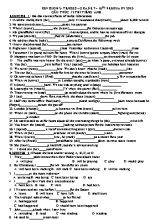
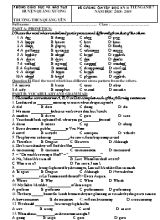
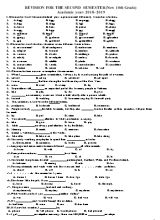
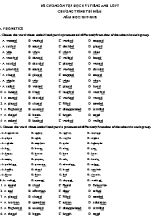
❖PHONETICS I. Choose the word having different stress from the others. 1. A. harvest B. parade C. music D. pumpkin 2. A. offer B. prefer C. abroad D. arrive 3. A. famous B. joyful C. usual D. alone 4. A. exist B. avoid C. support D. notice 5. A. hungry B. disease C. spacious D. danger 6. A. favourite B. pollution C. imagine D. exhausted 7. A. energy B. plentiful C. disappear D. celebrate 8. A. recycle B. description C. contribute D. atmosphere II. Find the word which has a different sound in the part underlined 1. A. perform B. end C. festival D. elephant 2. A. cake B. celebrate C. racing D. candle 3. A. desert B. held C. prefer D. celebrate 4. A. those B. they C. than D. Thanksgiving 5. A. cranberry B. lantern C. gather D. apricot
6. A. abundant B. travelling C. character D. biogas 7. A. diverse B. drive C. invention D. crime 8. A. designs B. sails C. pedals D. pollutes
❖VOCABULARY AND GRAMMAR III. Choose and circle the best answer. 1. Many (cultural/ romance/ disappointed/ annoyed) and artistic activities are held as the part of the flower festival in Da Lat. 2. Wind, hydro and solar are (modern/ renewable/ non-renewable/ new) energy sources. 3. Nick washes his hand a lot, (so/ and/ but/ although) he doesn’t have flu. 4. At a seasonal festival, people race down the hill to (break/ catch/ buy/ eat) cheese. 5. (When/ How/ Why/ Where) were you born? – In March 6. We will cut down on the use of natural gas because it is (plenty/ limited / available / abundant ) & harmful to the environment. 7. Some new energy-saving bulbs (will put /will be putting/will be put /will being put) in the dining-room. …
Trên đây là phần đầu tài liệu — bấm Đọc sách để xem đầy đủ.

 - Nam hoc 2019-2020.jpg "Đề cương ôn tập học kỳ 2 môn Tiếng Anh Lớp 7 (Chương trình thí điểm) - Năm học 2019-2020")