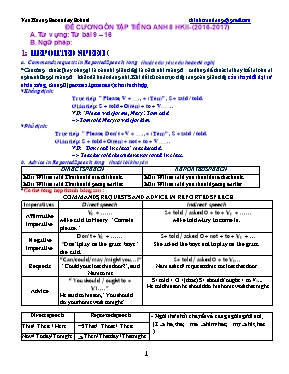

Đề cương ôn tập kiểm tra học kỳ II môn Tiếng Anh 8 - Năm học 2016-2017
Xem trước nội dung
Van Hoang Secondary School thinhtrandang@gmail.com
1
ĐỀ CƯƠNG ÔN TẬP TIẾNG ANH 8 HKII- (2016-2017) A. Từ vựng : Từ bài 9 – 16 B. Ngữ pháp:
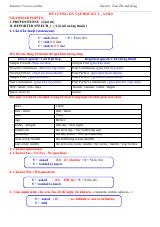
1: REPORTED SPEECH a. Commands, requests in Reported Speech: tường thuật câu yêu cầu hoặc đề nghị *Câu tường thuật (hay còn gọi là câu nói gián tiếp) là cách nói mà người ta dùng để thuật lại hay kể lại cho ai nghe những gì mà người khác đã hoặc đang nói. Khi đổi từ câu trực tiếp sang câu gián tiếp caàn thay ủoồi ủaùi tửứ nhaân xửng, tân ngữ (personal pronouns) cho thích hụùp. *Khẳng định: Trực tiếp: “Please, V + ……., + (Tên)” , S + said / told. Gián tiếp : S + told + O(tên) + to + V……….. VD: “Please wait for me, Mary”. Tom said =>Tom told Mary to wait for him. *Phủ định: Trực tiếp: “Please, Don’t + V + ……., + (Tên)” , S + said / told. Gián tiếp : S + told + O(tên) + not + to + V………..
VD: “Don’t talk in class!” teacher said. => Teacher told the students not to talk in class. b. Advice in Reported Speech: tường thuật lời khuyên
DIRECT SPEECH REPORTED SPEECH Miss Wilson said Tim should use this book. Miss Wilson said Tim should get up earlier.
Miss Wilson said you should use that book. Miss Wilson said you should get up earlier *Có thể tổng hợp thành bảng sau : COMMANDS, REQUESTS AND ADVICE IN REPORTED SPEECH Imperatives Direct speech Indirect speech
Affirmative Imperative
V1 + …… Mike said to Henry, “Come in, please.”
S+ told / asked O + to + V1 + ……
Mike told Mary to come in.
Negative Imperative
Don’t + V1 + …… "Don't play on the grass, boys," she said.
S+ told / asked O + not + to + V1 + … She asked the boys not to play on the grass.
Requests
“Can/could/ may /might you...?”
“Could you close this door?”, said Nam to me.
S+ told / asked O + to V1... Nam asked / requested me to close that door.
Advice
“ You should / ought to + V1….” He said to his son,” You should do your homework tonight.”
S+ told + O +(that) S+ should/ ought + to V1... He told his son he should do his homework that night.
Direct speech Reported speech
This / These / Here That / Those / There
Now/ Today/ Tonight Then /That day /That night
- Ngôi thứ nhất chuyển về cùng ngôi người nói. (I he, she; me him/ her; myhis, her )
ThuVienDeThi.com
Van Hoang Secondary School thinhtrandang@gmail.com
2
Tomorrow Yesterday Next week / year Last week / year
The next/ following day The day before The following week/ year The previous week / year
- Ngôi thứ hai chuyển về cùng ngôi người nghe (you I, we, he, she, they; you me, us, him, her, them; your my...) -Ngôi thứ ba không đổi ngôi (sh/she/ it/ they)
2: The simple present perfect tense 1-Công thức: (+) S + have/ has + V(3/-ed)................. (-) S + have / has + not + V(3/-ed)........... (?) Have/ Has + S + V-(3/-ed).................? -Yes, S + have/ has. -No, S + have/ hasn’t. Notes: Have: they, we, you, 2TR Has : I, she, he, it, 1TR 2- Cách dung: -Diễn tả 1 sự việc vừa mới xảy ra. Ex: She has just arrived at the airport. They have begun a new English class recently. - Diễn tả sự việc xảy ra không nhớ rõ thời gian. Ex: I have already seen that play. Have you ever been to New York? He has not repaired his car yet? - Diễn tả một sự việc đã xảy ra trong quá khứ và còn liên quan đến hiện tại Ex: I have lived in Lam Cot since 2004. I have lived in Lam Cot for 4 years. 3 – Các từ đi kèm: Just, since, for, recently, yet, never, ever, already, before, so far, it’s the first/ second time…, up to now, up to the present, till now(cho tới bây giờ), all + TTSH + life. * Vị trí của các từ: - Just, never, ever, already đứng ngay sau have/ has. - Yet, before đứng cuối câu. *Notes: yet: chỉ dung trong câu phủ định và câu hỏi. For + khoảng thời gian. Since + mốc thời gian ở quá khứ. Never: mang nghĩa phủ định.
3: PHRASE OF PURPOSE and ajectives
1-ADJECTIVE FOLLOWED BY AN INFINITIVE : It’s + adjective + to-V - It’s dangerous to swim in that river. ( Bơi ở con sông đó thật nguy hiểm.) - It’s easy to learn English. ( Rất dễ học tiếng Anh. / Học tiếng Anh …
Trên đây là phần đầu tài liệu — bấm Đọc sách để xem đầy đủ.