

.jpg)

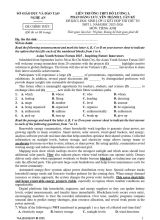
Đề thi thử THPT Quốc gia cho học sinh Lớp 12 THPT, BT THPT môn Tiếng Anh - Mã đề 218 - Năm học 2016-2017 - Sở GD & ĐT Ninh Bình (Có đáp án)
Xem trước nội dung
Trang 1/4 - Mã đề thi 218
SỞ GIÁO DỤC VÀ ĐÀO TẠO TỈNH NINH BÌNH
(Đề thi gồm có 04 trang)
ĐỀ THI THỬ THPT QUỐC GIA CHO HỌC SINH (HỌC VIÊN) LỚP 12 THPT, BT THPT
NĂM HỌC 2016-2017
Môn: TIẾNG ANH Thời gian làm bài: 60 phút, không kể thời gian phát đề
Họ tên thí sinh: ............................................; Số báo danh: ......................................
Read the following passage and mark the letter A, B, C, or D on your answer sheet to indicate the correct answer to each of the questions.
Aspirin’s origins go back at least as early as 1758. In that year, Englishman Edward Stone noticed a distinctive bitter flavor in the bark of the willow tree. To Stone, this particular bark seemed to have much in common with “Peruvian Bark”, which had been used medicinally since the 1640s to bring down fevers and to treat malaria. Stone decided to test the effectiveness of the willow bark. He obtained some, pulverized it into tiny pieces, and conducted experiments on its properties. His tests demonstrated that this pulverized willow bark was effective both in reducing high temperatures and in relieving aches and pains. In 1763, Stone presented his findings to the British Royal Society.
Several decades later, further studies on the medicinal value of the willow bark were being conducted by two Italian scientists. These chemists, Brugnatelli and Fontana, determined that the active chemical that was responsible for the medicinal characteristics in the willow bark was the chemical salicin, which is the active ingredient of today’s aspirin.
The name “aspirin” is the trade name of the drug based on the chemical salicin, properly known as acetylsalicylic acid. The trade name “aspirin” was invented for the drug in the 1890s by the Bayer Drug Company in Germany. The first bottles of aspirin actually went on sale to the public just prior to the turn of the century, in 1899. Question 1: According to the passage, aspirin originated_________.
A. no later than 1758 B. sometime after 1758 C. no earlier than 1978 D. definitely sometime in 1758 Question 2: The pronoun “it” in the first passage refers to _________.
A. willow bark B. malaria C. the British Royal Society D. effectiveness Question 3: The word “properties” in the first paragraph could best be replaced by_________.
A. characteristics B. body C. materials D. ownership Question 4: What did the willow bark look like after Stone prepared it for his experiments?
A. it was a thick liquid. B. It was in large chunks. C. it was a rough powder. D. It was in strips of bark. Question 5: The Italian chemists mentioned in the passage most probably conducted their studies on willow bark.
A. in the 1750s B. in the 1770s C. in the 1780s D. in the 1760s Question 6: What is true about Brugnatelli and Fontana?
A. They added a chemical to the pillow bark. B. They conducted studies on the willow bark. C. They were not from Italy. D. They were medical doctors. Question 7: The word “turn” in the last paragraph could best be replaced by_________.
A. reversal B. corner C. change D. spin
Mark the letter A, B, C, or D on your answer sheet to indicate the word whose pronunciation is different from the others in each of the following questions. Question 8: A. booked B. matched C. caused D. pushed Question 9: A. balance B. station C. brave D. bake
Read the following passage and mark the letter A, B, C, or D on your answer sheet to indicate the correct word or phrase that best fits each of the numbered blanks.
Michael Faraday During the last 400 years, most scientists have (10)_________on mathematics in their development of their inventions or discoveries. However, one great British scientist, Michael Faraday,
Mã đề thi 218
ĐỀ THI CHÍNH THỨC
ThuVienDeThi.com
Trên đây là phần đầu tài liệu — bấm Đọc sách để xem đầy đủ.

.jpg "Bộ đề thi thử môn Tiếng Anh THPT 2026 mới nhất (Có lời giải)")



 file word Co Dap An.jpg "Đề thi thử Tốt nghiệp THPT 2026 Tiếng Anh Bắc Giang (Form Mới) file word Có Đáp Án")
.jpg "Đề Thi Thử Tốt Nghiệp THPT 2026 Tiếng Anh THPT Yên Dũng 2, Bắc Ninh (Có Đáp Án)")
