
Tài liệu ôn tập cuối học kì II Tiếng anh lớp 5
Xem trước nội dung
` Lesson plans 9
Teacher: KREMLIN NGUYEN - Page 1 -
Week: 1 Period: 1
I/ VERB TENSES: 1.The simple present tense: Ex: They go to church every Sundays
Positive form: (ES o, s, x, sh, ch, z) Negative form: S + don’t / doesn’t + Vinf + O
Do / Does + S + Vinf + O ? Yes, S + do /does Interrogative form: No, S + don’t / doesn’t Wh-question + do /does + S + Vinf ... ? S + V1(s/es) + O
Use: Diễn tả 1 sự việc hay 1 hành động thường xuyên xảy ra ở hiện tại hoặc 1 sự thật hiển nhiên. Adv: always, often, usually, sometimes, never @Notes: to be is / are / am -The simple present with to have have / has
2.The present progressive tense: Ex: He is writing a novel at the moment
Positive form: Negative form: S + isn’t / aren’t / am not +V-ing + O
Is / Are / Am + S + Ving + O ? Yes, S + is / are / am Interrogative form: No, S + isn’t / aren’t / am not Wh-question + is / are / am + S + Ving ... ? S + is / are / am +V-ing + O Use: Diễn tả 1 sự việc hay 1 hành động đang xảy ra ở hiện tại Adv: Now, at present, at the moment, right now, look!, listen! 3.The present perfect tense: Ex: My father has worked for his company since 1989.
Positive form: Negative form: S + haven’t / hasn’t +V3ed + O Have / Has + S + V3ed + O ? Yes, S + have / has
No, S + haven’t / hasn’t Interrogative form: Wh-question + have / has + S + V3ed... ? S + have / has + V3ed + O
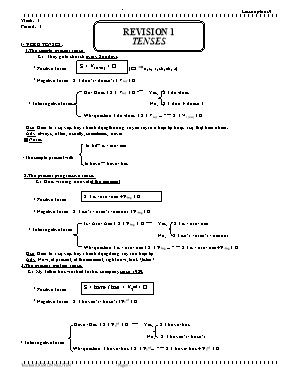
REVISION 1 TENSES
S + V1(s/es) + O
S + is / are / am +V-ing + O
S + have / has + V3ed + O
ThuVienDeThi.com
` Lesson plans 9
Teacher: KREMLIN NGUYEN - Page 2 -
Use: Diễn tả 1 sự việc hay 1 hành động đã xảy ra trong quá khứ nhưng vẫn còn tiếp diễn đến hiện tại Adv: just, already, for, since, ever, never, recently, lately, not …yet , … @Notes :
Since + point of time ( since January)
For + period of time ( for 5 years)
II/EXERCISES: 1.Multiple choice: 1.Ho Chi Minh City ______ the largest city in Viet Nam a. is b. are c. was d. was being 2. Look ! Our teacher ______ . a. come b. comes c. are coming d. is coming 3. Where is your father ? _ He ____ trees in the garden. a. plants b. is planting c. planted d. will plant 4. Peter and Alice ______ English since June a. learn b. has learned c. have learned d.learned 5. I _____ that book three or four times before. a. read b. is reading c. has read d. have read 6. My sister always ______ her hands bofore meals a. washes b. wash c. is washing d. has washed 7. My uncle _____ in Ho Chi Minh City since last year a. live b. lived c. has lived d. have lived 8. I _____ her for a very long time. a. know b. knewc. have known d. have knew 9. Listen ! I think someone _______ at the door a. knock b. is knocking c. knocked d. will knock 10.We ______ fooball together since last summer a. don’t play b. didn’t play c.won’t play d. haven’t play 11. They _______ in Hue _______ a long time a. were living – for b. were living – since c. have lived – for d. have lived – since 12. She ______ her homework yet. She _____ more time. a. has finished – doesn’t need b. hasn’t finished – needs c. didn’t finish – needed d. hasn’t finished – needed 13. A new apartment building ________ in the surburd now. a. was built b. has been built c. is built d. is being built
HOMEWORK
9. The pupils ___ this lesson when he came.
a. learn b. learned c. are learning d. were learning 10. When I ______ them , they were writing some words on the wall.
a. see b. saw c. am seeing d. was seen 11. My sister always ______ her hands before meals
a. washes b. wash c. is washing d. has washed 12. My uncle _____ in Ho Chi Minh City since last year. a. live b. lived c. has lived d. have lived 13. Tomorrow we ____ our presents on that table.
a. will put b. put c. puts d. have put 14. They _____ a lot of furniture next month.
a. make b. maked c. will make d. were making 15. Those boys _______ their homework yet. a. don’t finish b. didn’t finish c. hasn’t finished d. haven’t finished
ThuVienDeThi.com
Trên đây là phần đầu tài liệu — bấm Đọc sách để xem đầy đủ.