


Giáo án Tiếng Anh Lớp 10 - Unit 13 Films and cinema - Nguyễn Văn Tạo
Xem trước nội dung
Teacher in-charge: Nguyễn Văn Tạo
Date: March 3rd, 2009 Period 78
Unit 13 FILMS AND CINEMA
Lesson READING
I. Objectives: By the end of this lesson, students will be able to:
- Develop such reading micro-skills as skimming for main ideas, summarising main ideas, scanning for specific ideas, and guessing meaning in context. - Use the grammatical structure “It was not until . . . . that . . . .” and cinema vocabulary. II. Language Focus:
- Grammar: the grammatical structure “It was not until . . . . that . . . .” - New words: silent films, screen, character . . . III. Teaching Aids: overhead projector, cassette player, textbook . . . IV. Procedures:
Stages/
Time Teacher’s Activities Students’ Activities
Warm – up
(5 minutes)
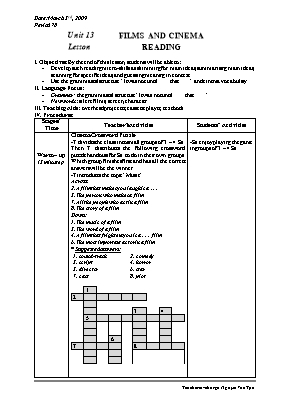
Cinema Crossword Puzzle -T divides the class into small groups of 3 – 4 Ss. Then T distributes the following crossword puzzle handouts for Ss to do in their own groups. Which group finishes first and has all the correct answers will be the winner. -T introduces the topic “Music” Across: 2. A film that makes you laugh is a . . . 5. The person who makes a film. 7. All the people who act in a film. 8. The story of a film. Down: 1. The music of a film. 3. The word of a film. 4. A film that frightens you is a . . . film. 6. The most important actor in a film. * Suggested answers: 1. sound-track 2. comedy 3. script 4. horror 5. director 6. star 7. cast 8. plot
1 2
3 4 5
6 7 8
-Ss enjoy playing the game in groups of 3 – 4 Ss.
ThuVienDeThi.com
Teacher in-charge: Nguyễn Văn Tạo
Pre – reading
7 minutes
-T draws a network on the board and elicits cinema vocabulary from Ss. The key word is “Cinema”. -T makes sure Ss understand the meaning of these words and teaches their prounciation, if necessary. -Then T guides Ss to discuss the following questions in pairs: 1.Do you want to see a film at the cinema or on TV? Why? 2.Can you name some of the films you have seen? 3.What kinds of films do you want to see? Why? Pre-teaching vocabulary and structure +motion (n): the act of moving, or changing place or position. +set something in motion = move something +still (a): silent +audience (n): viewers +spread (v): to extend over a place +replace (v):
[ It was not until TIME that CLAUSE] -This structure means the same as not . . . before. It refers to the commencement point of an action or event in the past. Ex: It was not until last year that we began this program = We didn’t begin this program before last year = We began this program last year. -T may ask Ss to make some sentences with the new structure.
-Ss work in pairs and do the task.
-Ss listen to T’s explanation and take notes new vocabulary.
While – reading
7 minutes
Task 1 – Find the correct words in the passage to match with the definition -T gets Ss to read the passage individually and do the task. -T goes around to help Ss when necessary. -T calls Ss to present and explain their answers. -T gives the correct answers. * Expected answers: 1. Cinema 2. Sequence 3. Decade 4. Rapidly 5. Scene 6. Character
-Ss work individually and do the task.
-Ss present their answers in front of the class
-Ss take note the correct answers.
7 minutes
Task 2 – Answering questions. -T asks Ss to work individually to do the task. -T asks Ss to discuss their answers with their peers. -T calls on some Ss to give their answers and asks them to explain their choices. -T comments and gives the suggested answers.
* Suggested answers: 1. In the early 19th century. 2. At that time the scientists discovered that when a sequence of still pictures was set in motion, they could give the feeling of movement. 3. No, they didn’t. 4. In the early 1910s.
-Ss work individually and do the task. -Ss work in pairs. -Ss present their answers in front of the class.
-Ss listen T’s comment and write down the correct answers.
ThuVienDeThi.com
Trên đây là phần đầu tài liệu — bấm Đọc sách để xem đầy đủ.
 - Review 4 Unit 9+10 - Nam hoc 2022-2023.jpg "Giáo án Tiếng Anh Lớp 10 (Global review) - Review 4 Unit 9+10 - Năm học 2022-2023")
 - Unit 10 Ecotourism - Nam hoc 2022-2023.jpg "Giáo án Tiếng Anh Lớp 10 (Global review) - Unit 10 Ecotourism - Năm học 2022-2023")
 - Unit 9 Protecting the environment - Nam hoc 2022-2023.jpg "Giáo án Tiếng Anh Lớp 10 (Global review) - Unit 9 Protecting the environment - Năm học 2022-2023")
 - Review 3 Unit 6+7+8 - Nam hoc 2022-2023.jpg "Giáo án Tiếng Anh Lớp 10 (Global review) - Review 3 Unit 6+7+8 - Năm học 2022-2023")
 - Unit 8 New ways to learn - Nam hoc 2022-2023.jpg "Giáo án Tiếng Anh Lớp 10 (Global review) - Unit 8 New ways to learn - Năm học 2022-2023")
 - Unit 7 Viet Nam and international organisations - Nam ho.jpg "Giáo án Tiếng Anh Lớp 10 (Global review) - Unit 7 Viet Nam and international organisations - Năm học 2022-2023")
 - Unit 6 Gender equality - Nam hoc 2022-2023.jpg "Giáo án Tiếng Anh Lớp 10 (Global review) - Unit 6 Gender equality - Năm học 2022-2023")
 - Review 2 - Nam hoc 2022-2023.jpg "Giáo án Tiếng Anh Lớp 10 (Global review) - Review 2 - Năm học 2022-2023")
 - Unit 5 Inventions - Nam hoc 2022-2023.jpg "Giáo án Tiếng Anh Lớp 10 (Global review) - Unit 5 Inventions - Năm học 2022-2023")
 - Review 1 - Nam hoc 2022-2023.jpg "Giáo án Tiếng Anh Lớp 10 (Global review) - Review 1 - Năm học 2022-2023")
 - Unit 4 For a better community - Nam hoc 2022-2023.jpg "Giáo án Tiếng Anh Lớp 10 (Global review) - Unit 4 For a better community - Năm học 2022-2023")
 - Unit 3 Music - Nam hoc 2022-2023.jpg "Giáo án Tiếng Anh Lớp 10 (Global review) - Unit 3 Music - Năm học 2022-2023")