
Giáo án Tiếng anh lớp 8 - Học kì I - Năm học 2012-2013
Xem trước nội dung
1
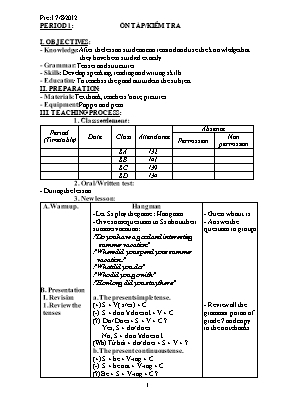
Pre:17/8/2012 Period 1: ôn tâp/kiểm tra
I. Objectives: - Knowledge: After the lesson students can remind and use the knowledge that they have been studied exactly - Grammar: Tenses and structures - Skills: Develop speaking, reading and writing skills - Education: To teach ss the good attitude to the subject II. Preparation: - Materials: Textbook, teachers’ note, pictures. - Equipment: Papper and pens III. Teaching process:
1. Class settlement:
Absence Period (Timetable) Date Class Attendance Permission Non permission 8A /32 8B /41 8C /39 8D /34 2. Oral/ Written test: - During the lesson
3. New lesson: A.Warm up.
B. Presentation
I. Revision 1. Review the tenses
Hangman - Let Ss play the game : Hangman - Give some questions to Ss about their summer vacation: ?Do you have a good and interesting summer vacation? ?Where did you spend your summer vacation ? ?What did you do? ?Who did you go with? ?How long did you stay there?
a. The present simple tense. (+) S + V( s/es ) + C. (-) S + don’t/ doesn’t + V + C (?) Do/ Does + S + V + C ? Yes, S + do/ does. No, S + don’t/ doesn’t. (Wh) Từ hỏi + do/ does + S + V + ? b. The present continuous tense. (+) S + be + V-ing + C. (-) S + be not + V-ing + C. (?) Be + S + V-ing + C ?
- Guess what it is. - Answer the questions in groups
- Review all the grammar points of grade 7 and copy in the notebooks.
ThuVienDeThi.com
2
2. Modal verbs.
3. Verbs and the structures that followed by V-ing.
II. Test
Yes, S + be. No, S + be not. (Wh) Từ hỏi + be + S + V-ing + C ? c. The simple past tense. (+) S + Vqk + C. (-) S + didn’t + V + C. (?) Did + S + V + C ? Yes, S + did. No, S + didn’t. (Wh) Từ hỏi + did + S + V + C ? d. The simple future tense. (+) S + will/ shall + V + C. (-) S + won’t/ shan’t + V + C. (?) Will/ Shall + S + V + C ? Yes, S + will/ shall. No, S + won’t/ shan’t. (Wh) Từ hỏi + will/ shall + S + V + C ? e. The near future tense. (+) S + be + going to + V + C. (-) S + be not + going to + V + C. (?) Be + S + going to + V + C ? Yes, S + be. No, S + be not. (Wh) Từ hỏi + be + S + going to + V + C? - Ask Ss to name the modal they have learnt. Eg: can, could, may, should…… - Review the form: (+) S + modal + V + C (-) S + modal + not + V + C. (?) Modal + S + V + C ? Yes, S + modal. No, S + modal not. - Ask Ss to review the verbs and structures they have learnt . a. Verbs: like, dislike, hate, enjoy, prefer…… b. Structures : + be interested in + V-ing + be good at + V-ing + be font of + V-ing + be/ get used to + V-ing + spend time + V-ing… + be scared/ afraid of + V-ing - Ask Ss to do the test in 20 minutes 1. Odd one out. 1. a. books b. chairs
- Name some of the modal verbs they have learnt.
- Review the verbs and the structures they have learnt .
- Do the test in 20
ThuVienDeThi.com
3
c. stools d. tables 2. a. washed b. brushed c. planted d. watched 3. a. lives b. gets c. takes d. walks 4. a. buses b. goes c. boxes d. couches 5. a. rises b. plants c. makes d. talks 2. Give the correct form of the verbs in brackets 1. Thanks for the gift you ( give ) me yesterday. 2. On my way home I often ( meet ) many children who ( go ) to school. 3. What do you enjoy ( do ) ? 4. There are a lot of dark clouds in the sky. I think it ( rain ). 5. I ( pay ) you this book as soon as I finish it. 6. My brother is interested in ( collect ) stamps 7. I hope Hoa soon gets used to ( go ) to school by bus. 8. Nam could ( swim ) when he ( be ) 6 years old. 3. Correct the mistakes 1. He playing football yesterday. 2. They is from Japan. 3. He don't know the answer. 4. Does she has two sons? 5. Jack have two sisters and a brother 6. Does she enjoys lives in a house or a flat? 7. Peter works with he's father. 8. In the evening my mother go for a walk.
minutes - Work in groups 1.a 2.c 3.a 4.b 5.a
1. gave
2. meet/ are going
3. doing 4. is going to rain
5. will pay
6. collecting
7. going
8. swim/ was - Write down in the book. 1. playing-> played 2. is-> are 3. don’t-> didn’t 4. has-> have 5. …
Trên đây là phần đầu tài liệu — bấm Đọc sách để xem đầy đủ.
 - Tiet 1 d.jpg "Giáo án Tiếng Anh Lớp 8 (Thí điểm) - Tiết 1 đến 25 - Năm học 2016-2017")