
Đề cương ôn tập học kì II Tiếng anh lớp 6 - Trường THCS Minh Long
Xem trước nội dung
TRƯƠNG THCS MINH LONG ĐỀ CƯƠNG ÔN THI HỌC KỲ II
1
ĐỀ CƯƠNG ÔN TẬP HỌC KÌ II
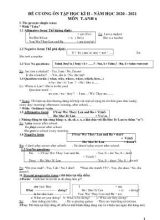
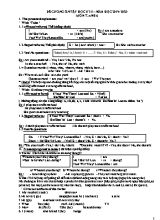
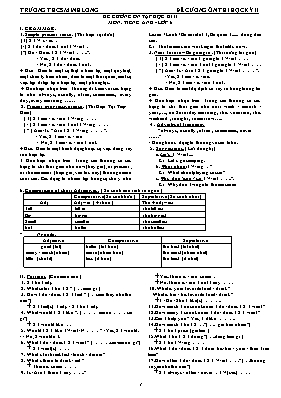
MÔN: TIẾNG ANH - LỚP 6 I. GRAMMAR : 1. Simple present tense : (Thì hiện tại đơn) (+) S + V s / es … (-) S + do / does + not + V-inf… (?) Do / Does + S + V-inf……..?.
- Yes , S + do / does - No, S + do / does + not . + Use: Diễn tả một sự thật ở hiên tại, một quy luật, một chân lý hiển nhiên, diễn tả một thói quen, môt sự việc lập đi lập lại ở hiện tại, một phong tục. + Dấu hiệu nhận biết: Thường đi kèm với các trạng từ như: always, usually, often, sometimes, every day, every morning …… 2. Present progressive tense: (Thì Hiện Tại Tiếp Diễn) ( +) S + am / is / are + V-ing ……. ( - ) S + am / is / are + not + V-ing ……. ( ? ) Am / Is ? Are + S + V-ing ………?. - Yes, S + am / is / are
- No, S + am / is / are + not . + Use: Diễn tả một hành động hoặc sự việc đang xảy ra ở hiện tại. + Dấu hiệu nhận biết: Trong câu thường có các trạng từ chỉ thời gian như now (bây giờ), at present, at the moment (hiện giờ, vào lúc này) thường nằm ở cuối câu. Các động từ nhằm tập trung sự chú ý như:
Listen! Look! Be careful !, Be quiet !...... đứng đầu câu. Ex: The farmers are working in the fields now. 3. Near future – Be going to :(Thì tương lai gần) ( +) S + am / is / are + going to + V-inf……. ( - ) S + am / is / are + not + going to + V-inf……. ( ? ) Am / Is / Are + S + going to + V-inf………?. -Yes, S + am / is / are.
- No, S + am / is / are + not . + Use: Diễn tả môt dự định sẽ xảy ra trong tương lai gần. + Dấu hiệu nhận biết: Trong câu thường có các trạng từ chỉ thời gian như next week / month / year,…., on Saturday morning, this vacation , this weekend , tonight , tomorrow….. 4 . Adverbs of frequency : “always , usually , often , sometimes, never ……” - Đứng trước động từ thường và sau tobe . 5. Suggestions: ( Lời đề nghị ) a. Let’s + V-inf.... Ex: Let’s go camping. b. What about + V-ing …? Ex: What about playing soccer? c. Why don’t you / we + V-inf……..?. Ex: Why don’t we go to the museum 6. Comparision of short Adjectives : ( So sánh của tính từ ngắn )
Comparative (So sánh hơn ) Superlative (So sánh nhất) Adj Adj – er ( + than ) The + adj – est Tall taller the tallest Big bigger the biggest Small smaller the smallest hot hotter the hottest Ngoại lệ:
Adjective Comparative Superlative good (tốt) many / much (nhiều) little (chút ít)
better (tốt hơn) more (nhiều hơn) less (ít hơn)
the best (tốt nhất) the most (nhiều nhất) the least (ít nhất)
II. Patterns: (Các mẫu câu ) 1. S + be + adj. 2. What color + be + S ? (…. màu gì ) 3. How + do / does + S + feel ? (… cảm thấy như thế nào?) S + feel(s) + adj. / S + be + adj. 4. What would + S + like ?. (……… muốn ………cái gì?) S + would like …. 5. Would + S + like +V-inf/ N………? -Yes, S + would. / - No, S wouldn’t. 6. What + do / does + S + want ? ( ……….cần/muốn gì?) S + want(s) ……. 7. What’s for breakfast / lunch / dinner? 8. What’s there to drink / eat ? There is some ……… 9. Is / Are + there + any ……..?
Yes.There is / are some … No.There is / are + not + any ……. 10. What is your favorite food / drink ? What is her / his favorite food / drink? I / He / She + like(s) ……….. 11. How much + uncount. noun + do / does + S + want ? 12. How many + count. noun + do / does + S + want ? 13. Can I help you ? Yes, I’d like ……….. 14. How much + be + S ….?(….. giá bao nhiêu?) S + be + price (gía tiền ) 15. What + be + S + doing? (…..đang làm gì ) S + be + V-ing ……… 16. What + do / does + S + do in his/ her / your / their free time? 17. How often + do / does + S + V-inf…….? (….thường xuyên như thế nào ?) S + always / often / never …+ V(s/es) …….
ThuVienDeThi.com
Trên đây là phần đầu tài liệu — bấm Đọc sách để xem đầy đủ.








 - Nam hoc 2021-2022.jpg "Đề cương ôn tập học kỳ 2 Tiếng Anh 6 (Chương trình thí điểm) - Năm học 2021-2022")