
Đề cương ôn tập học kì I Tiếng anh khối 7
Xem trước nội dung
1
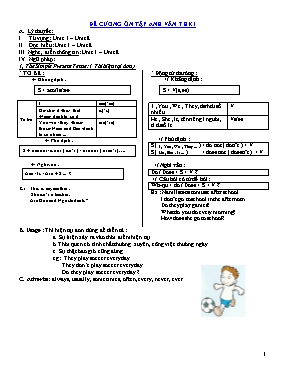
ĐỀ CƯƠNG ÔN TẬP ANH VĂN 7 HKI A. Lý thuyết: I. Từ vựng: Unit 1 – Unit 8 II. Đọc hiểu: Unit 1 – Unit 8 III. Nghe, điền thông tin: Unit 1 – Unit 8 IV. Ngữ pháp: 1, The Simple Present Tense : ( Thì hiện tại đơn ) * TO BE : +/ Khẳng định :
I am(‘m) He/ she/ it /this/ that /Nam/ danh từ số ít
is(‘s)
To be You /we / they /these/ those/ Nam and Bao /danh từ số nhiều ...
are(‘re)
+/ Phủ định :
+/ Nghi vấn :
Ex : This is my mother . She isn’t a teacher. Are Hoa and Nga students ?
* Động từ thường : +/ Khẳng định :
I , You , We , They,danh từ số nhiều ....
V
He , She , It, tên riêng 1 người, d.từ số ít .....
Vs/es
+/ Phủ định : S ( I , You , We , They ... ) + do not ( don’t ) + V S ( He , She . It ... ) + does not ( doesn’t ) + V +/ Nghi vấn : Do / Does + S + V ? +/ Câu hỏi có từ để hỏi: Wh-qu + do / Does + S + V ? Ex : Nam listens to music after school . I don’t go to school in the afternoon. Do they play games? What do you do every morning? How does she go to school?
B. Usage: Thì hiện tại đơn dùng để diễn tả :
a. Sự kiện xảy ra vào thời điểm hiện tại b.Thói quen có tính chất thường xuyên, công việc thường ngày c. Sự thật bao giờ cũng đúng eg: They play soccer everyday. They don’t play soccer everyday. Do they play soccer everyday ? C. Adverbs: always, usually, sometimes, often, every, never, ever……
S + am/is/are …
S + am not/ is not ( isn’t ) / are not ( aren’t)….
Am / Is / Are + S ... ?
S + V(s,es)
ThuVienDeThi.com
2
A, Form:
2. The present progressive tense:
(+) S + is / am / are + V- ING. (-) S + is / am / are + V- ING. (?) S + is / am / are + V- ING ?
Yes, S + am / is / are / No, S + am/ is/ are not
B, Usage: - Thì hiện tại tiếp diễn được sử dụng để diễn tả một hành động đang diễn ra tại một thời điểm nói.
Eg: I am learning English now. C, Adverbs: now, at the moment, at present, right now.
3. The simple future tense: A, Form: (+) S + Will + V( infinitive without to) (-) S + Will not (won’t) + V( infinitive without to) (?) Will + S + V( infinitive without to)?
Yes, S + will / No, S + won’t B, Usage: - Tương lai đơn dùng để chỉ hành động hay sự việc xảy ra trong tương lai Eg: I will finish my task soon. He will call you tomorrow. C., Adverbs: tomorrow: ngày mai
Next week / month / year…. Tuần tới/ tháng tới / năm tới….. Soon: ngay , sớm, chẳng bao lâu nữa
4. Much, many, a lot of, lots of
a, Much + N (không đếm được) eg: There isn’t much milk in the glass. b, Many + N( đếm được số nhiều) eg: There are many oranges in the basket. c, A lot of / lots of + N(không đếm được) N(đếm được số nhiều) eg: A lot of / lots of students like him.
5. a, Comparative : ( so sánh hơn)
Be + Adj ( ngắn ) + ER THAN. Be + more + Adj ( dài ) THAN b, Superlative: (so sánh nhất) Đối với Adj ngắn : Be + the + Adj-EST Đối với Adj dài : Be + the most + Adj 6. How + do/does + S + Infinitive ? ( Hỏi về phương tiện ) 7. Hỏi về khoảng cách: How far is it from A to B ? It is about ……… 8. Câu hỏi: Why … ? Because … 9. Đại từ chỉ định : This, That…
ThuVienDeThi.com
Trên đây là phần đầu tài liệu — bấm Đọc sách để xem đầy đủ.