


Giáo án Tiếng anh lớp 3 - Unit 2Whats your name - Nguyễn Thị Phương An
Xem trước nội dung
English 3 Tan Phu Tay Primary School
Nguyen Thi Phuong An Page 1
Week: Date of teaching: Period:
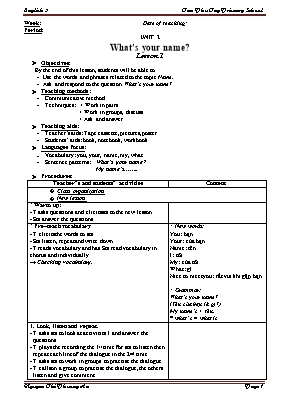
UNIT 2 What’s your name?
Lesson 1 Objectives: By the end of this lesson, students will be able to
- Use the words and phrases related to the topic Name. - Ask and respond to the question What’s your name? Teaching methods:
- Communicative method. - Techniques: + Work in pairs + Work in groups, discuss. + Ask and answer.
Teaching aids:
- Teacher’s aids: Tape cassette, pictures, poster. - Students’ aids: book, notebook, workbook. Languages focus:
- Vocabulary: you, your, name, my, what - Sentence patterns: What’s your name?
My name’s........ Procedures:
Teacher’ s and students’ activities Content Class organization New lesson * Warm up: - T asks questions and elicits sts to the new lesson. - Sts answer the questions. * Pre–teach vocabulary. - T elicits the words to sts - Sts listen, repeat and write down. - T reads vocabulary and has Sts read vocabulary in chorus and individually. → Checking vocabulary.
* New words: You: bạn Your: của bạn Name: tên I: tôi My: của tôi What: gì Nice to meet you: rất vui khi gặp bạn
* Grammar: What’s your name? (Tên của bạn là gì?) My name’s + tên. * what’ s = what is 1. Look, listen and repeat. - T asks sts to look at activities 1 and answer the questions. - T plays the recording the 1st time for sts to listen then repeat each line of the dialogue in the 2nd time. - T asks sts to work in groups to practise the dialogue. - T calls on a group to practise the dialogue, the others listen and give comment.
ThuVienDeThi.com
English 3 Tan Phu Tay Primary School
Nguyen Thi Phuong An Page 2
2. Point and say. - T asks sts to look at the pictures in activity 2 and answer the questions. - T gives example as a modal. - T says: “What’s your name? / My name’s ....” - Sts listen and repeat. - T listens and corrects if necessary. - T divides class into 2 groups to practise the sentence patterns. - T corrects the mistakes. - T asks sts to practise with their partners. - Sts work in pairs.
* Example: What’s your name? My name’s Peter.
3. Let’s talk.
- T guides sts how to practise activity 3. - Sts work in pairs to practise and talk in front of class.
What’s your name? My name’s Peter.
4. Listen and tick. - T asks sts to recall the names of the characters. - Sts look at, identify the characters. - T tells them that they are going listen to the recording in order to tick. - T plays the recording twice for sts to choose. - T replays the recording for sts to checks their answers and compair with their friends.
* Answer: 1. a 2. b
5. Look and write.
- T guides sts how to do this task. - Sts do it individually. - Sts has sts show their answers on the board. - T gives feedback.
* Answer: 1. My name’ s 2. Mai My name’s 6. Let’s sing. The alphabet song - T gets sts to read the lyrics or the texts in silence. Checks their comprehension. Explains the new words if necessary. - T plays the recording for sts to listen a few times. - Sts listen and repeat each line of the lyrics a few time until they can remember. - T asks some sts to practise individually and in groups. * Consolidate the content of lesson * Homework - Practise new strucrures. - Prepare new lesson.
Experiences: ........................................................................................................................................................... ........................................................................................................................................................... ........................................................................................................................................................... ........................................................................................................................................................... …
Trên đây là phần đầu tài liệu — bấm Đọc sách để xem đầy đủ.
 - Tuan 14 - Nam hoc 2022-2023.jpg "Giáo án Tiếng Anh Lớp 3 (Global success) - Tuần 14 - Năm học 2022-2023")
 - Tuan 19 - Nam hoc 2022-2023.jpg "Giáo án Tiếng Anh Lớp 3 (Global success) - Tuần 19 - Năm học 2022-2023")
 - Tuan 18 - Nam hoc 2022-2023.jpg "Giáo án Tiếng Anh Lớp 3 (Global success) - Tuần 18 - Năm học 2022-2023")
 - Tuan 17 - Nam hoc 2022-2023.jpg "Giáo án Tiếng Anh Lớp 3 (Global success) - Tuần 17 - Năm học 2022-2023")
 - Tuan 16 - Nam hoc 2022-2023.jpg "Giáo án Tiếng Anh Lớp 3 (Global success) - Tuần 16 - Năm học 2022-2023")
 - Tuan 15 - Nam hoc 2022-2023.jpg "Giáo án Tiếng Anh Lớp 3 (Global success) - Tuần 15 - Năm học 2022-2023")
 - Tuan 13 - Nam hoc 2022-2023.jpg "Giáo án Tiếng Anh Lớp 3 (Global success) - Tuần 13 - Năm học 2022-2023")
 - Tuan 12 - Nam hoc 2022-2023.jpg "Giáo án Tiếng Anh Lớp 3 (Global success) - Tuần 12 - Năm học 2022-2023")
 - Tuan 11 - Nam hoc 2022-2023.jpg "Giáo án Tiếng Anh Lớp 3 (Global success) - Tuần 11 - Năm học 2022-2023")
 - Tuan 10 - Nam hoc 2022-2023.jpg "Giáo án Tiếng Anh Lớp 3 (Global success) - Tuần 10 - Năm học 2022-2023")
 - Tuan 9 - Nam hoc 2022-2023.jpg "Giáo án Tiếng Anh Lớp 3 (Global success) - Tuần 9 - Năm học 2022-2023")
 - Tuan 8 - Nam hoc 2022-2023.jpg "Giáo án Tiếng Anh Lớp 3 (Global success) - Tuần 8 - Năm học 2022-2023")