.jpg)

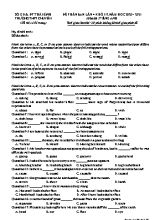
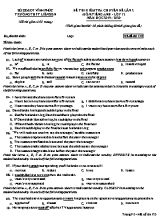
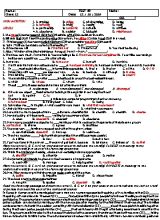
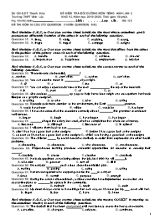
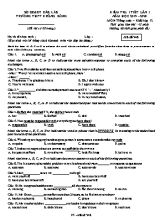
Đề thi thử Đại học đợt 2 môn Tiếng Anh - Năm học 2012-2013 - Đại học Sư phạm Hà Nội (Có đáp án)
Xem trước nội dung
BỘ GIÁO DỤC VÀ ĐÀO TẠO
TRƯỜNG ĐẠI HỌC SƯ PHẠM HÀ NỘI
TRƯỜNG THPT CHUYÊN
ĐỀ THI THỬ ĐẠI HỌC ĐỢT 2
Tháng 03/2013
Môn thi: tiếng anh, khối D
Thời gian làm bài: 90 phút
I. Read the following passage and mark the letter A, B, C or D to indicate the correct
answer to each of the question from1 to 10.
Level of vocabulary
Most languages have several levels of vocabulary that may be used by the same speakers. In
English, at least three have been identified and described.
Standard usage of those word and expressions understood, listed and accepted by a majority of
the speakers of a language in any situation regardless of the level of formality. As such these words
and expressions are well defined and listed in standard dictionaries. Colloquialism, on the other
hand, is familiar words and idioms that are understood by almost all speakers of a language
and used in informal speech or writing, but not considered acceptable for more formal
situations. Almost all idiomatic expressions are colloquial language. Slang, however, refers to
words and expressions understood by a large number of speakers but not accepted as an
appropriate formal usage by the majority. Colloquial expressions and even slang maybe found in
standard dictionaries but will be so identified. Both colloquial usage and slang are more common in
speech than in writing.
Colloquial speech often passes into standard speech, some slang also passes into standard
speech, but other slang expressions enjoy momentary popularity followed by obscurity. In some
cases, the majority never accepts certain slang phrases but nevertheless retains them in their
collective memories. Every generation seem to require its own set of words to describe familiar
objects and events.
It has been pointed out by a number of linguists that three cultural conditions are necessary for
the creation of a large body of slang expressions. First, the introduction and acceptance of new
objects and situations in the society; second, a diverse population with a large number of subgroups;
third, the association among the subgroups and the majority population.
Finally, it is worth noticing that the terms “standard”, “colloquial”, and “slang” exist only as
abstract labels for scholars who study language. Only a tiny number of the speakers of any language
http://megabook.vn/ DeThi.edu.vn
will be aware that they are using colloquial or slang expressions. Most speakers of English will,
during appropriate situations, select and use all three types of expressions.
1. The word “appropriate” in paragraph 2 is closest meaning to
A. Large B. important C. old D. correct
2. How slang defined by the author?
A. Words and phrases that are understood by restricted groups of speakers.
B. Words and phrases understood by a large number of speakers but not accepted as formal
usage
C. Words and phrases understood by the majority but not found in standard dictionaries.
D. Words and phrases accepted but the majority for formal usage.
3. It can be inferred from the passage that the author
A. Approves of slang and colloquial speech in appropriate situations.
B. Approve of colloquial speech in some situations, but not slang
C. Doesn’t approve of either slang or colloquial speech in any situation.
D. Does not approve of colloquial usage in writing.
4. What does the author mean by the statement in paragraph 2 : “Colloquialism, on the other
hand, is familiar words and idioms that are understood by almost all speakers of a language
and used in informal speech or writing, but not considered acceptable for more formal
situations”?
A. Familiar words and phrases are found in in both speech and writing in formal setting.
B. Familiar situations that are experienced by most people are call colloquialism.
C. Informal language contains colloquialisms, which are not found in more formal language.
D. Most the speakers of a language use both informal and formal speech in appropriate
situations.
5. The …
Trên đây là phần đầu tài liệu — bấm Đọc sách để xem đầy đủ.