
Giáo án global học kì 2 môn Anh Lớp 6 - Peroid 94, Unit 12 Robots - Lesson 1 Getting started
Xem trước nội dung
Date of planning:………….. Date of teaching: ………..… WEEK:
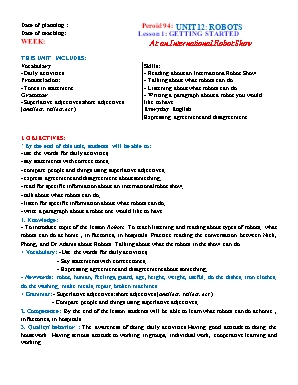
Peroid 94: UNIT 12: ROBOTS Lesson 1: GETTING STARTED At an International Robot Show THIS UNIT INCLUDES: Vocabulary - Daily activities Pronunciation: - Tones in statement. Grammar - Superlative adjectives: short adjectives (smallest, tallest, ect )
Skills: - Reading about an Internationa Robot Show. - Talking about what robots can do. - Listening about what robots can do. - Writing a paragraph about a robot you would like to have. Everyday English Expressing agreement and disagreement.
I. OBJECTIVES: * By the end of this unit, students will be able to: - use the words for daily activities; - say statements with correct tones; - compare people and things using superlative adjectives; - express agreement and disagreement about something; - read for specific information about an international robot show; - talk about what robots can do; - listen for specific information about what robots can do; - write a paragraph about a robot one would like to have 1. Knowledge: - To introduce topic of the lesson Robots. To teach listening and reading about types of robots; what robots can do at home , in factories, in hospitals. Practice reading the conversation between Nick, Phong, and Dr Adams about Robots. Talking about what the robots in the show can do. + Vocabulary: - Use the words for daily activities; - Say statements with correct tones; - Expressing agreement and disagreement about something; - Newwords: robot, human, feelings, guard, age, height, weight, useful; do the dishes; iron clothes; do the washing; make meals; repair; broken machines… + Grammar: - Superlative adjectives: short adjectives (smallest, tallest, ect ) - Compare people and things using superlative adjectives; 2. Competence: By the end of the lesson students will be able to learn what robots can do at home , in factories, in hospitals. 3. Quality/ behavior : The awareness of doing daily activities. Having good attitude to doing the housework. Having serious attitude to working in groups, individual work, cooperative learning and working.
DeThi.edu.vn
II. TEACHING AIDS: - Teacher: Text book, laptop, louspeaker, projector… - Students : Text books, studying equipments…. - Work Arrangements: T_Ss , group works; individual …… III. PROCEDURE:
I. WARM UP & INTRODUCTION (5’) Aims: - To create an active atmosphere in the class before the lesson; - To lead into the new unit. * Content: Review the previous lesson . Tmay organize a short vocabulary game, e.g. Alphabet Race or Slap the Board, etc. to revise the words Ss have learnt in Unit 11. * Outcome: Having a chance to speak English and focus on the topic of the lesson.. * Organisation : Teacher’s instructions…
Teacher’s & Student’s activities Content + Greeting + Revision - Teacher (T) asks Ss some questions about the previous lessons. Review the previous unit before Ss open their books. T may organize a short vocabulary game, e.g. Alphabet Race or Slap the Board, etc. to revise the words Ss have learnt in Unit 11. - Lead to the new unit. Write the unit title Robots on the board. Ask Ss to guess what they are going to learn about in this unit. After Ss respond, ask them to open their books to page 58. Draw their attention to the This Unit includes... box and introduce what they are going to learn in Unit 12. * T may introduce some warm-up activities to creat a friendly and relaxed atmostphere to inspire Ss to warm up to the new lesson. - Have Ss open their books and start the lesson.
+ Greeting + Revision - T_ Ss - (Ss) listen and learn how to do it .
- Open their book and write .
2. PRESENTATION (12’) ACTIVITY 1: Aims: - To set the context for the introductory text; - To introduce the topic of the unit. * Content: Listen and read conversation to get used to the vocabulary; new grammar points. * Outcome: Reading. Ss learn some new words; become familiar with the new language items. * Organisation :Teacher’s instructions…
1. Listen and read. *) Pre- teach …
Trên đây là phần đầu tài liệu — bấm Đọc sách để xem đầy đủ.