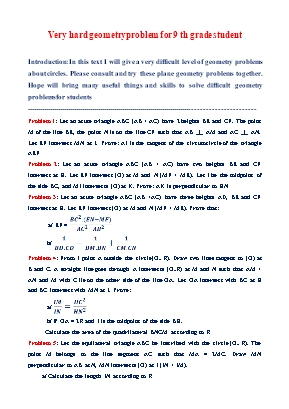

Very hard geometry problem for 9 th grade student
Xem trước nội dung
Very hard geometry problem for 9 th grade student
Introduction: In this text I will give a very difficult level of geometry problems
about circles. Please consult and try these plane geometry problems together.
Hope will bring many useful things and skills to solve difficult geometry
problems for students
-------------------------------------------------------------------------------------------------------
Problem 1: Let an acute triangle ABC (AB < AC) have 2 heights BE and CF. The point
M of the line BE, the point N is on the line CF such that AB _|_ AM and AC _|_ AN.
Let EF intersect MN at I. Prove: AI is the tangent of the circumcircle of the triangle
AEF
Problem 2: Let an acute triangle ABC (AB < AC) have two heights BE and CF
intersect at H. Let EF intersect (O) at M and N (MF < ME). Let I be the midpoint of
the side BC, and MI intersects (O) at K. Prove: AK is perpendicular to HN
Problem 3: Let an acute triangle ABC (AB <AC) have three heights AD, BE and CF
intersect at H. Let EF intersect (O) at M and N (MF < ME). Prove that:
a/ EF =
b/
Problem 4: From 1 point A outside the circle (O; R). Draw two lines tangent to (O) at
B and C. A straight line goes through A intersects (O;R) at M and N such that AM <
AN and M with C lie on the other side of the line OA. Let OA intersect with BC at H
and BC intersect with MN at I. Prove:
a/
b/ If OA = 2R and I is the midpoint of the side BH.
Calculate the area of the quadrilateral BNCM according to R
Problem 5: Let the equilateral triangle ABC be inscribed with the circle (O; R). The
point M belongs to the line segment AC such that MA = 2MC. Draw MN
perpendicular to AB at N, MN intersects (O) at I (IN < IM).
a/ Calculate the length IN according to R
DeThi.edu.vn
b/ Calculate the area of triangles AOI and IBC according to R
Problem 6: The acute-pointed triangle ABC is inscribed in a circle (O; R) with AB
<AC. The tangents at B and C intersect at D, AD intersect with BC at E and intersect
circle (O) at I. The circumcircle of the triangle AEC intersects with AB at the second
point is N. Let M be the symmetry point N through E. Prove: The quadrilateral ANIM
is inscribed in a circle
Problem 7: Point A is outside the circle (O). From A draw two lines tangent to (O) at B
and C. Any point M belongs to the small arc of the circle BC of (O). The line through
A parallel to BC intersects CM and BM at E and F. Prove: When M is move on the
small arc circle BC, the orthocentre of the triangle OEF is a fixed point
Problem 8: Given an acute triangle ABC (AB <AC) inscribed in a circle (O; R) with 2
heights BE and CF intersecting at H, AH intersects (O) at point D. The line through H
parallel to EF intersects the line BC at I. Let AI intersect (O) at S. Draw the diameter
AK. Prove: 3 lines BC, OD, SK are concurrent
Problem 9: Let an acute triangle ABC (AB <AC) inscribed in a circle (O; R) have 2
heights AD and BE. Let K be the midpoint of side BC and I is the symmetry point E
across the line BC. The line going through I and perpendicular to IK intersects the line
AD at point S. Prove: OK = DA – DS
Problem 10: From a point A outside the circle (O; R), draw 2 lines tangent to (O) at B
and C. Draw the diameter CD, AD intersect (O) at E. Let I be the midpoint next to DE,
BD intersects with EC at point F, IF intersects with OA at point S.
Prove: SD is tangent to circle (O)
Problem 11: From a point A outside the circle (O; R), draw 2 lines tangent to (O) at B
and C. Draw the diameter CD, AD intersect (O) at E. The line passing through A and
parallel to BE intersects the line BC at K. Let OA intersect BC at H, the line HN is
perpendicular to CD at N and KM is perpendicular to AD at M.
Prove: The quadrilateral BMNH is a parallelogram
Problem 12: From a point A outside the circle (O; R), draw 2 lines tangent to (O) at B
and C. Draw the diameter CD, OA intersect BC at H, AD intersect (O) at I, DH
intersect AC at N, AC intersect BD at E. Prove: The …
Trên đây là phần đầu tài liệu — bấm Đọc sách để xem đầy đủ.



 -.jpg "Các dạng bài toán có khả năng có trong đề thi vào Lớp 10 môn Toán - Năm học 2019- 2020 (Tham khảo) - Nguyễn Thanh Hưng")