


Tài liệu ôn tập môn Tiếng Anh Khối 9 và thi vào Lớp 10 THPT
Xem trước nội dung
PHẦN A : CÁC CHUYÊN ĐỀ NGỮ PHÁP
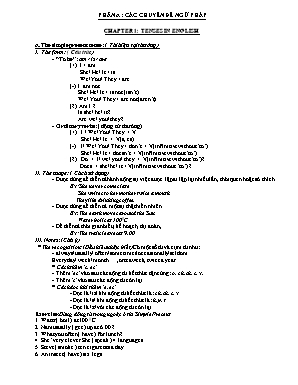
Chapter 1: tenses in english
A.The simple present tense: ( Thì hiện tại thường ) I. The form: ( CÊu tróc)
- “To be”: am / is / are
(+) I + am She/ He/ It + is We/ You/ They + are (-) I am not She/ He/ It + is not (isn’t) We/ You/ They + are not (aren’t) (?) Am I ? Is she/ he/ it ? Are we/ you/ they? - Ordinary verbs: ( động từ thường)
(+) I / We/ You/ They + V She/ He/ It + V(s, es) (-) I/ We/ You/ They + don’t + V(infinitive without ‘to’) She/ He/ It + doesn’t + V(infinitive without ‘to’) (?) Do + I/ we/ you/ they + V(infinitive without ‘to’)? Does + she/ he/ it + V(infinitive without ‘to’) ? II. The usage: ( Cách sử dụng)
- Được dùng để diễn tả hành động sự việc được lặp đi lặp lại nhiều lần, thói quen hoặc sở thích.
Ex: She never comes late She writes to her mother twice a month They like drinking coffee. - Được dùng để diễn tả một sự thật hiển nhiên
Ex: The earth moves around the Sun Water boils at 1000C - Để diễn tả thời gian biểu, kế hoạch, dự đoán,…….
Ex: The train leaves at 9.00 III. Notes: (Chú ý) * The recognition: (Dấu hiệu nhận biết) Có một số từ và cụm từ như:
- always/ usually/ often/ sometimes/ occasionally/ seldom…. Everyday/ week/ month….,once aweek, twice a year… * Cách thêm ‘s, es’ - Thêm ‘es’ vào sau các động từ kết thúc tận cùng: o, ch, sh, s, x. - Thêm ‘s’ vào sau các động từ còn lại * Cách đọc khi thêm ‘e, es’ - Đọc là /iz/ khi động từ kết thúc là: ch, sh, s, x - Đọc là /s/ khi động từ kết thúc là: k, p, t - Đọc là /z/ với các động từ còn lại. Exercise: Dùng động từ trong ngoặc ở thì Simple Present 1. Water ( boil ) at 100 0 C. 2. Nam usually ( get ) up at 6.00 ? 3. What you often ( have ) for lunch ? 4. She’ very clever. She ( speak ) 4 languages. 5. Steve ( smoke ) ten cigarettes a day. 6. An insect ( have ) six legs.
DeThi.edu.vn
7. She often ( visit ) you at weekend ? 8. Mary ( wash ) her teeth twice a day. 9. You often ( watch ) film in the evening ? 10. Mary ( swim ) very well ? 11. She ( not/like ) watching T.V. 12. She ( get ) at 6. o’clock, and ( go ) to school at 7 o’clock. 13. He ( not/ usually/ drive ) to work. He usually ( walk ). 14. Kangaroo ( see ) everywhere in Australia. 15. My father ( drink ) coffee every morning. 16. At Christmas, people often ( decorate ) a tree. 17. It ( not rain ) in the dry season. 18. Nam often ( visit ) you on Sunday ? - No. He ( visit ) me on Saturday 19. What time she ( finish ) work everyday ?- She ( finish ) it at 16.00 20. My mother ( take ) Jim to the dentist many times. 21. My little sister ( drink ) milk everyday. 22. Long ( like ) tennis ? - No. He ( like ) badminton. 23. The Earth ( move ) around the Sun 24. The Sun ( rise ) in the East and ( set ) in the West 25. What you often ( do ) in your free time? B. The present progressive tense: ( Thì hiện tại tiếp diễn )
I. The form:(cÊu tróc )
(+) I + am + V-ing We/ You/ They + are + V-ing He/ She/ It + is + V-ing (-) I + am not + V-ing We/ You/ They + are not ( aren’t) + V-ing He/ She/ It + is not (isn’t) + V-ing (?) Am + I + V-ing ? Are + we/ you/ they + V-ing ? Is + she/ he/ it + V-ing ? II. The usage: (Cách sử dụng) a/ Được sử dụng để diễn tả hành động hoặc sự việc đang sảy ra tại thời điểm nói
They are watching TV at the moment b/ Hành động nói chung đang diễn ra nhưng không nhất thiết phảI thực sự diễn ra ngay lúc nói. Ex: I am writing a novel now. III. Notes: (Chú ý ) * The recognition: (Dấu hiệu nhận biết) Có một số từ và cụm từ như: - now/ at present/ at this time/ at the moment. * Các động từ kết thúc tận cùng là: ‘e’ ta phải bỏ ‘e’ trước khi thêm ING Come - Coming * Một số động từ kết thúc tận cùng là: ‘ie’ phải chuyển thành ‘y’ trước khi thêm đuôi ‘ing’: Lie - Lying * Nhân đôi phụ âm cuối khi động từ kết thúc bằng: Phụ - Nguyên - Phụ ( dùng cho động từ một âm tiết, hai âm tiết thì trọng âm phải ở âm tiết thứ hai )
( getting, running, having, writing, dying, lying,…) * Một số động từ thường hay không sử dụng ở dạng hiện tại tiếp diễn:
be/ see/ …
Trên đây là phần đầu tài liệu — bấm Đọc sách để xem đầy đủ.

.jpg "Ôn tập Tiếng Anh Lớp 9 - Part 1 Dạng từ (Word form)")