
Summary chart of modal verbs and similar expressions
Xem trước nội dung
Collected and composed by Miss.Trang. Email: tranghandsome95@gmail.com
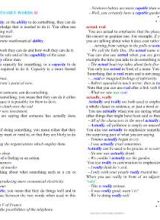
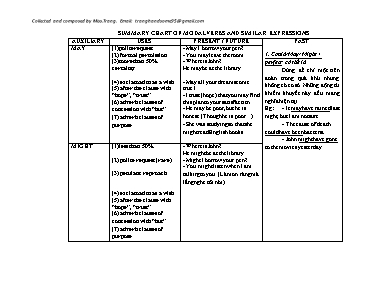
SUMMARY CHART OF MODAL VERBS AND SIMILAR EXPRESSIONS AUXILIARY USES PRESENT / FUTURE MAY (1)polite request (2) formal permission (3)more than 50% certainty
(4) exclamation as a wish (5) after the clause with “hope”, “trust” (6) adverb clauses of concession with “but” (7) adverb clauses of purpose
- May I borrow your pen? - You may leave the room. - Where is John? He may be at the library.
- May all your dreams come true! - I trust (hope) that you may find this plan to your satisfaction. - He may be poor, but he is honest. (Though he is poor...) - She was studying so that she might read English books.
MIGHT (1)less than 50%
(2) polite request (rare)
(3) petulant reproach
(4) exclamation as a wish (5) after the clause with “hope”, “trust” (6) adverb clauses of concession with “but” (7) adverb clauses of purpose
- Where is John? He might be at the library. - Might I borrow your pen? - You might listen when I am talking to you. (Làm ơn ráng mà lắng nghe tôi nói)
PAST
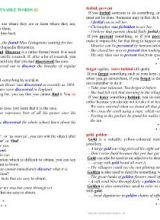
1. Could/ May/ Might + perfect: có thể là
Dùng để chỉ một tiên đoán trong quá khứ nhưng không có cơ sở. Những động từ khiếm khuyết này đều mang nghĩa hiện tại. Eg: - It may have rained last night, but I am not sure.
- The cause of death could have been bacteria.
- John might have gone to the movies yesterday.
DeThi.edu.vn
Collected and composed by Miss.Trang. Email: tranghandsome95@gmail.com
COULD (1)Past ability (2)polite request (3)suggestion
(4)less than 50 % certainty (5)impossibility (negative only)
- Could I borrow your pen? - Could you help me? -I need help in math. You could talk to your teacher. Where is John? He could be at home. That couldn’t be true.
CAN (1)ability/ possibility (2)informal permission (colloquial speech) (3)informal polite request (4) impossibility (negative only) (5) = Continuous Tense when using with verbs of perception
- I can run fast. - You can use my car tomorrow.
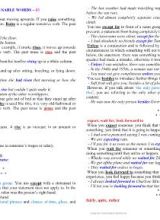
- Can I borrow your pen? - That can’t be true. Listen! I think I can hear the sound of the sea. (không dùng I am hearing)
MUST (1)strong necessity (from speaker) -> needn’t (negative)
(2)prohibition(negative) (3)95 % certainty-> can’t (negative)
- I must go to class today. - Must I do it now? - No, you needn’t. Tomorrow will be soon enough. - You must not open that door. Mary isn’t in class. She must be sick. ( present only) If he said that, he can’t be telling the truth.
1. Must have and can't have Diễn đạt một ý kiến của mình theo suy luận logic.(về 1 hành động trong quá khứ) I must have left my wallet in the car.( I am sure I did ) Jim can't have noticed you.( I am sure he didn't )
2. Must + Perfect: Dùng để nói về một tiên đoán xảy ra trong quá khứ nhưng dựa trên những cơ sở rõ ràng Eg: - I have lost one of my gloves. I must have dropped it somewhere.
- My wacth says only ten past six. It must have stopped. HAVE TO (1)necessity ( from external circumstances) (2)lack of necessity ( negative)
- I have to go to class today. - I don’t have to go to class today.
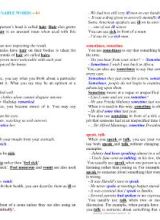
Had to Must không có dạng quá khứ, nên chúng ta dùng had to để
DeThi.edu.vn
Trên đây là phần đầu tài liệu — bấm Đọc sách để xem đầy đủ.