


Listening practice for 9 - Graders - Thấm Tâm Vy
Xem trước nội dung
Thẩm Tâm Vy, June 5th, 2019 LISTENING PRACTICE FOR 9-GRADERS - 001
LISTENING PRACTICE FOR 9-GRADERS
1. WEARING UNIFORMS?
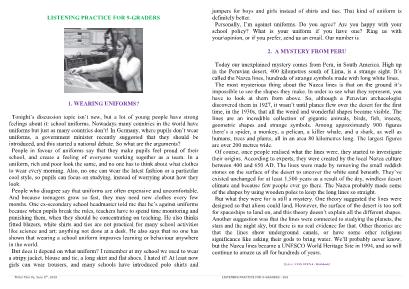
Tonight’s discussion topic isn’t new, but a lot of young people have strong feelings about it: school uniforms. Nowadays many countries in the world have uniforms but just as many countries don’t! In Germany, where pupils don’t wear uniforms, a government minister recently suggested that they should be introduced, and this started a national debate. So what are the arguments? People in favour of uniforms say that they make pupils feel proud of their school, and create a feeling of everyone working together as a team. In a uniform, rich and poor look the same, and no one has to think about what clothes to wear every morning. Also, no one can wear the latest fashion or a particular cool style, so pupils can focus on studying, instead of worrying about how they look. People who disagree say that uniforms are often expensive and uncomfortable. And because teenagers grow so fast, they may need new clothes every few months. One ex-secondary school headmaster told me that he’s against uniforms because when pupils break the rules, teachers have to spend time monitoring and punishing them, when they should be concentrating on teaching. He also thinks fitted blazers, white shirts and ties are not practical for many school activities like science and art: anything not done at a desk. He also says that no one has shown that wearing a school uniform improves learning or behaviour anywhere in the world. But does it depend on what uniform? I remember at my school we used to wear a stripy jacket, blouse and tie, a long skirt and flat shoes. I hated it! At least now girls can wear trousers, and many schools have introduced polo shirts and
jumpers for boys and girls instead of shirts and ties. That kind of uniform is definitely better. Personally, I’m against uniforms. Do you agree? Are you happy with your school policy? What is your uniform if you have one? Ring us with your\opinion, or if you prefer, send us an email. Our number is
2. A MYSTERY FROM PERU Today our unexplained mystery comes from Peru, in South America. High up in the Peruvian desert, 400 kilometres south of Lima, is a strange sight. It’s called the Nazca lines, hundreds of strange symbols made with long white lines. The most mysterious thing about the Nazca lines is that on the ground it’s impossible to see the shapes they make. In order to see what they represent, you have to look at them from above. So, although a Peruvian archaeologist discovered them in 1927, it wasn’t until planes flew over the desert for the first time, in the 1930s, that all the weird and wonderful shapes became visible. The lines are an incredible collection of gigantic animals, birds, fish, insects, geometric shapes and strange symbols. Among approximately 900 figures there’s a spider, a monkey, a pelican, a killer whale, and a shark, as well as humans, trees and plants, all in an area 80 kilometres long. The largest figures are over 200 metres wide. Of course, once people realised what the lines were, they started to investigate their origins. According to experts, they were created by the local Nazca culture between 400 and 650 AD. The lines were made by removing the small reddish stones on the surface of the desert to uncover the white sand beneath. They’ve existed unchanged for at least 1,500 years as a result of the dry, windless desert climate and because few people ever go there. The Nazca probably made some of the shapes by using wooden poles to keep the long lines so straight. But what they were for is still a mystery. One theory suggested the lines were designed so that aliens could land. However, the surface of the desert is too soft for spaceships to land on, and this theory doesn’t explain all the different shapes. Another suggestion was that the lines were connected to studying the planets, the stars and the night sky, but there is no real evidence for that. …
Trên đây là phần đầu tài liệu — bấm Đọc sách để xem đầy đủ.


.jpg "Ôn tập Tiếng Anh Lớp 9 - Part 1 Dạng từ (Word form)")