
Practise Listening 29 - Facebook - Thấm Tâm Vy
Xem trước nội dung
Thẩm Tâm Vy’s Archives, 2019 PRACTISE LISTENING 29
Facebook MARK ZUCKERBERG’S WECHAT MOMENT
MENLO PARKAND SAN JOSE The social network’s boss has a plan to overpower his opponents
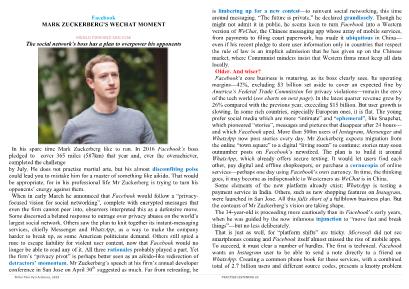
In his spare time Mark Zuckerberg like to run. In 2016 Facebook’s boss pledged to cover 365 miles (587km) that year and, ever the overachiever, completed the challenge by July. He does not practise martial arts, but his almost discomfiting poise could lead you to mistake him for a master of something like aikido. That would be appropriate, for in his professional life Mr Zuckerberg is trying to turn his opponents’ energy against them. When in early March he announced that Facebook would follow a “privacy- focused vision for social networking”, complete with encrypted messages that even the firm cannot peer into, observers interpreted this as a defensive move. Some discerned a belated response to outrage over privacy abuses on the world’s largest social network. Others saw the plan to knit together its instant-messaging services, chiefly Messenger and WhatsApp, as a way to make the company harder to break up, as some American politicians demand. Others still spied a ruse to escape liability for violent user content, now that Facebook would no longer be able to read any of it. All three rationales probably played a part. Yet the firm’s “privacy pivot” is perhaps better seen as an aikido-like redirection of detractors’ momentum. Mr Zuckerberg’s speech at his firm’s annual developer conference in San Jose on April 30th suggested as much. Far from retreating, he
is limbering up for a new contest—to reinvent social networking, this time around messaging. “The future is private,” he declared grandiosely. Though he might not admit it in public, he seems keen to turn Facebook into a Western version of WeChat, the Chinese messaging app whose array of mobile services, from payments to filing court paperwork, has made it ubiquitous in China— even if his recent pledge to store user information only in countries that respect the rule of law is an implicit admission that he has given up on the Chinese market, where Communist minders insist that Western firms must keep all data locally. Older. And wiser? Facebook’s core business is maturing, as its boss clearly sees. Its operating margins—42%, excluding $3 billion set aside to cover an expected fine by America’s Federal Trade Commission for privacy violations—remain the envy of the tech world (see charts on next page). In the latest quarter revenue grew by 26% compared with the previous year, exceeding $15 billion. But user growth is slowing. In some rich countries, especially European ones, it is flat. The young prefer social media which are more “intimate” and “ephemeral”, like Snapchat, which pioneered “stories”, messages and pictures that disappear after 24 hours— and which Facebook aped. More than 500m users of Instagram, Messenger and WhatsApp now post stories every day. Mr Zuckerberg expects migration from the online “town square” to a digital “living room” to continue; stories may soon outnumber posts on Facebook’s newsfeed. The plan is to build it around WhatsApp, which already offers secure texting. It would let users find each other, pay digital and offline shopkeepers, or purchase a cornucopia of online services—perhaps one day using Facebook’s own currency. In time, the thinking goes, it may become as indispensable to Westerners as WeChat is in China. Some elements of the new platform already exist; WhatsApp is testing a payment service in India. Others, such as new shopping features on Instagram, were launched in San Jose. All this falls short of a fullblown business plan. But the contours of Mr Zuckerberg’s vision are taking shape. The 34-year-old is proceeding more cautiously than in Facebook’s early years, when he was guided by the now infamous injunction to “move fast and break things”—but no less deliberately. That is just as well, for “platform shifts” are tricky. Microsoft did not see …
Trên đây là phần đầu tài liệu — bấm Đọc sách để xem đầy đủ.