
Đề cương ôn tập học kì I môn Tiếng Anh Lớp 8
Xem trước nội dung
REVISION FOR THE FIRST TERM TEST – ENGLISH 8
1
ĐỀ CƯƠNG ÔN TẬP HỌC KÌ I MÔN TIẾNG ANH 8 A. LÝ THUYẾT
* GRAMMAR & STRUCTURES 1-Trạng từ chỉ mức độ “ENOUGH” (adv): đủ để
a) The house is big enough for us to live in. b) She is beautiful enough to become Miss World.
2- Trạng từ chỉ mức độ “TOO” (adv) : quá
a) He is too young to ride a motorbike. b) The weather was too cold for us to go out.
S + be + TOO + adj + (for + O) + to-infinitive
Quá ………không thể 3 - Trạng từ chỉ thể cách: ( badly / happily / beautifully / softly / quickly / carefully / …..) * Vị trí : - Đứng ngay sau nội động từ ( động từ không có tân ngữ )
- Đứng sau tân ngữ của ngoại động từ ( động từ có tân ngữ phía sau) eg: She swam very quickly. / My sister worked very hard. They speak English well. / I read the letter carefully. 3- BE GOING TO : sẽ , dự định , sắp sửa
a) I am going to buy a new hat for my sister. b)They are going to go fishing this afternoon.
S + am / is / are + going to + infinitive 4 - Present simple tense with future meaning: Thì hiện tại đơn với nghĩa tương lai. a. When do they clean up the streets? - They clean them on Sunday 8th. b. What time do you water flowers? - I water them about 5pm. 5 - Thì quá khứ đơn với động từ “USED TO”:
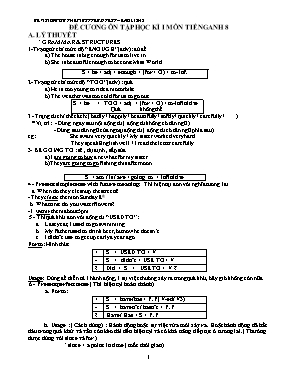
a. Last year, I used to go swimming . b. My father used to drink beer,but now he doesn’t. c. I didn’t use to get up early a year ago . Form : Hình thức
Usage: Dùng để diễn tả 1 hành động, 1 sự việc thường xảy ra trong quá khứ, bây giờ không còn nữa. 6 - Present perfect tense ( Thì hiện tại hoàn thành)
a. Form:
b. Usage : ( Cách dùng) : Hành động hoặc sự việc vừa mới xảy ra. Hoặc hành động đã bắt đàu trong quá khứ và vẫn còn kéo dài đến hiện tại và có khả năng tiếp tục ở tương lai. ( Thường được dùng với since và for ) * since + a point in time ( mốc thời gian)
S + be + adj + enough + (for + O) + to- inf.
+ S + USED TO + V - S + didn’t + USE TO + V ? Did + S + USE TO + V ?
+ S + have/has + P.P ( V-ed/ V3) - S + haven’t / hasn’t + P.P ? Have / Has + S + P.P
DeThi.edu.vn
REVISION FOR THE FIRST TERM TEST – ENGLISH 8
2
* for + a period of time ( khoảng thời gian) 7 - MODAL VERBS : must , have to , ought to , should. a) must : phải
We must go now. (sự cần thiết) You mustn’t talk in class. (sự bắt buộc) There are big clouds. It must rain soon. Có những đám mây lớn. Trời có thể mưa ngay.(sự suy luận) b) have to : phải
I have to do my homework. c) ought to
You ought to obey your parents. You ought to study harder. d) should
You should study harder. You shouldn’t stay up late. 8 - SO AS(not) TO = IN ORDER (not)TO : (cụm giới từ) để mà
SO THAT (liên từ): để mà
S + V + so as (not) to – infinitive S + V + so that + S + can (not) / could(not) + V Ex : We study hard so as to get good marks. We study hard in order to get good marks. We study hard so that we can get good marks. 9- REPORTED SPEECH : Câu tường thuật.Câu tường thuật là câu kể lại lời người khác nói. A- Câu tường thuật với yêu cầu và mệnh lệnh :( Requests & Commands)
asked / told / warned S + ordered / requested + O (not) + to-V. inf a) She asked her son ,”Do your exercices carefully”. She asked her son to do his exercices carefully. b) He said to me, “Don’ make so much noise”. He asked me not to make so noise. B- Câu tường thuật với lời khuyên: (Advice)
S1 + said (that) + S2+ should / shouldn’t + V told + O
S + advised + O (not) + to-V.inf a) My mother said to me,”You should go to bed early”. My mother said that I should go to bed early. b) The police said to him , “ You shouldn’t ride your bike too fast”. ) The police said that he shouldn’t ride his bike too fast. = The police advised him not to ride his bike too fast. 10- Comparison with like; (not) as …..as; (not) the same as; different from a. As …as ( bằng): được dùng để so sánh, diễn đạt sự bằng nhau
S +V+as + Adj / Adv + as + noun / pronoun eg: He is as strong as his father. b. The same (…) as ( giống như , như nhau ): Được dùng để so sánh, diễn đạt giống nhau hoặc sự đồng …
Trên đây là phần đầu tài liệu — bấm Đọc sách để xem đầy đủ.