
Những từ gây nhầm lần trong Tiếng Anh - Phần 2 - Thấm Tâm Vy
Xem trước nội dung
Thẩm Tâm Vy, 2020 ENGLISH CONFUSABLE WORDS - 02
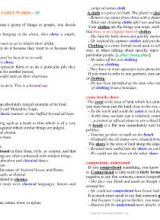
ENGLISH CONFUSABLE WORDS 02 find, discover, find out If you find someone or something, you see where they are or learn where they are, especially when you have been looking for them. - I want you to find himfor me and bring him back. - They found the body in a dustbin. - When Mrs Oliver returned to the house, she found Miss Livingstone waiting for her. - It took him ten minutes to find the Encyclopaedia Britannica. Discover is sometimes used instead of find. Discover is a rather formal word. It is used especially in formal investigations and scientific research. If, after a lot of research, you found a cure for the common cold, you would say that you had discovered the cure. - A great deal of research is being carried out to discover the benefits of regular exercise. - The two men were discovered dead. You can also use discover when you find something by accident - It is amazing to think that this well-known flower was discovered as recently as 1903. - Just before the war two hoards of treasure were discovered in England. If you cannot see the thing you are looking for, you say that you cannot find it You do not use ‘discover’ in this way. - I think I’m lost - I can’t find the bridge. discover, or find out that something is the case, you learn that it is the case. - The very young child finds that noise expresses best of all his power over his environment. - He was surprised and alarmed when he discovered the whole school knew about his efforts. - We found out that she was wrong. In clauses beginning with ‘when’ ‘before’, or ‘as soon as’, you can omt the object after find out. You cannot do this with ‘discover’ or ‘find’. - When your wife finds out, she’ll divorce you. - You want it to end before апyoпе finds out. - As soon as I found out, I jumped into the car. If you succeed in obtaining some information which is difficult to obtain, you can say that you discover or find out what you want to know. - He has some reason for crying even ifyou cannot immediately discover what it is. - Have you found out who killed my husband? You can also say that someone finds out facts that are easy to obtain. - I found out the train times. - I want to find out ịf the authorization for my visa has come through yet. You do not say that you ‘discover’ facts that are easy to obtain.
* * *
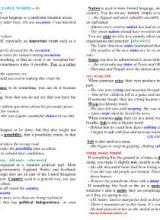
forbid, prevent If you forbid someone to do something, or if you forbid an activity, you order that it must not be done. Someone may in fact do it despite what you say. - I forbid you to tell her. - Christopher was forbidden to see her. - I believe that parents should flatly forbid programmes that go in for violence. If you prevent something, or if you prevent someone from doing something, you make it impossible for that thing to happen or to be done. - Measles can be prevented by immunization at 1 year of age. - She closed her eyes to prevent him looking into them. - My only idea was to prevent him from speaking.
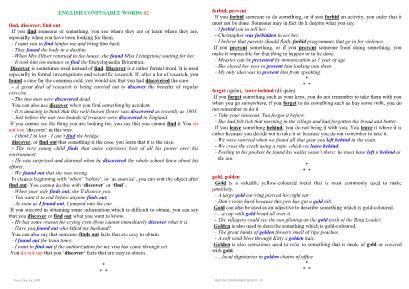
* * * forget (quên), leave behind (để quên) If you forget something such as your keys, you do not remember to take them with you when you go somewhere, tf you forget to do something such as buy some milk, you do not remember to do it - Take your raincoat. You forgot it before. - She had felt sick that morning in the village and had forgotten the bread and butter. If you leave something behind, you do not bring it with you. You leave it where it is either because you decide not to take it or because you do not remember to take it. - We were worried when we found all that gear you left behind in the train. - We cross the creek using a rope, which we leave behind. - Feeling in his pockets he found his wallet wasn’t there; he must have left it behind at the inn.
* * * gold, golden Gold is a valuable yellow-coloured metal that is most commonly used to make jewellery. - A large gold ear-ring pierced his right ear. - Don’t write hard because this pen has got a gold nib. Gold can also be used as an …
Trên đây là phần đầu tài liệu — bấm Đọc sách để xem đầy đủ.