
Những cặp gây nhầm lần trong Tiếng Anh - Phần 3 - Thấm Tâm Vy
Xem trước nội dung
Thẩm Tâm Vy, August 17th, 2020 ENGLISH CONFUSABLE WORDS 03.
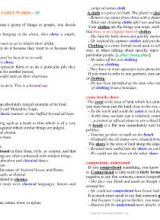
ENGLISH CONFUSABLE WORDS ~ 03 raise, rise, arise You use raise, rise, and arise to talk about moving upwards. If you raise something, you move it so that it is in a higher position. Raise is a regular transitive verb. The past tense and past participle are raised. - He began to raise a massive fist. - Raise the legs, trying to lift the thighs off the floor. - Hooper raised his camera and pressed the button. If something rises, it moves upwards. For example, if smoke rises, it moves up towards the sky. Rise is an irregular intransitive verb. The past tense is rose and the past participle is risen. - In the distance he could see the smoke from his bonfire rising up in a white column. - Clouds of birds rose from the tree-tops. If you rise, you get out of bed or you stand up after sitting, kneeling, or lying down. This is a formal use. - She could not have told you at what time she had risen that morning or how she made her way to the station. - When he saw us arrive, he attempted to rise but couldn’t quite make it. - Ash had bowed, knelt and risen in imitation of the other worshippers. Arise can also be used to say that someone gets out of bed or that they stand up after sitting, kneeling, or lying down. When arise is used like this, it is very old-fashioned or literary. Arise is an irregular intransitive verb. The past tense is arose and the past participle is arisen. - I arose at six. - He arose to greet her. • Raise and rise can also be used as nouns. A rise is an increase in an amount or quantity. - ...price rises. - ...the rise in crime. In British English, a rise is also an increase in someone’s wages or salary. - He went to ask for a rise. In American English, this is called a raise. - He thought about asking his boss for a raise.
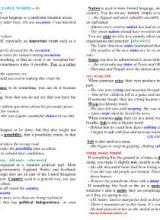
* * * except, except for, unless, besides Except is normally followed by a noun group. You use except with a statement to introduce the only things, people, or ideas that your statement does not apply to. In the example below, the only thing that did not relax was the person’s right hand. - All of his body relaxed except his right hand. Except can also be followed by prepositional phrases and clauses of time, place, and manner.
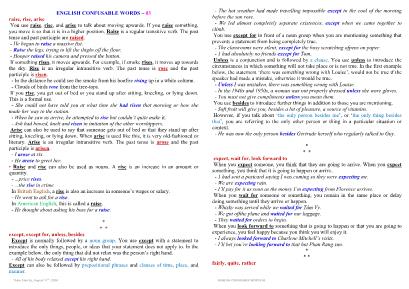
- The hot weather had made travelling impossible except in the cool of the morning before the sun rose. - We led almost completely separate existences, except when we came together to climb. You use except for in front of a noun group when you are mentioning something that prevents a statement from being completely true. - The classrooms were silent, except for the busy scratching ofpens on paper. - 1 had absolutely no friends except for Tom. Unless is a conjunction and is followed by a clause. You use unless to introduce the circumstances in which something will not take place or is not true. In the first example below, the statement ‘there was something wrong with Louise’, would not be true tf the speaker had made a mistake, otherwise it would be true. - Unless I was mistaken, there was something wrong with Louise. - In the 1940s and 1950s, a woman was not properly dressed unless she wore gloves. - You must not give compliments unless you mean them. You use besides to introduce further things in addition to those you are mentioning. - Soft fruit will give you, besides a lot of pleasure, a source of vitamins. However, if you talk about ‘the only person besides me’, or ‘the only thing besides that’, you are referring to the only other person or thing in a particular situation or context. - He was now the only person besides Gertrude herself who regularly talked to Guy.
* * * expect, wait for, look forward to When you expect someone, you think that they are going to arrive. When you expect something, you think that it is going to happen or arrive. - 1 had sent a postcard saying I was coming so they were expecting me. - We are expecting rain. - I’ll pay for it as soon as the money I’m expecting from Florence …
Trên đây là phần đầu tài liệu — bấm Đọc sách để xem đầy đủ.