
Những từ gây nhầm lần trong Tiếng Anh - Phần 4 - Thấm Tâm Vy
Xem trước nội dung
Thẩm Tâm Vy, August 18, 2020 ENGLISH CONFUSABLE WORDS - 04
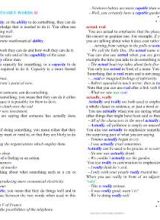
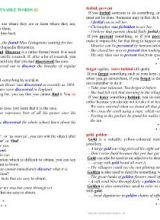
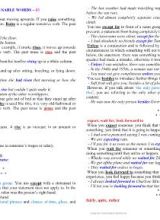
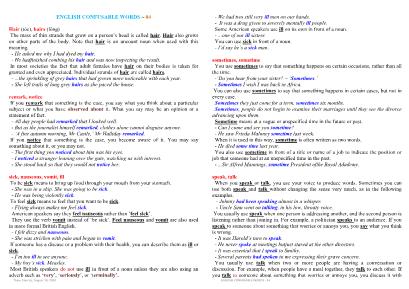
ENGLISH CONFUSABLE WORDS ~ 04 Hair (tóc), hairs (lông) The mass of thin strands that grow on a person’s head is called hair. Hair also grows on other parts of the body. Note that hair is an uncount noun when used with this meaning. - He asked me why I had dyed my hair. - He hadfinished combing his hair and was now inspecting the result. In most societies the fact that adult females have hair on their bodies is taken for granted and even appreciated. Individual strands of hair are called hairs. - ...the sprinkling of grey hairs that had grown more noticeable with each year. - She left trails of long grey hairs as she paced the house. remark, notice If you remark that something is the case, you say what you think about a particular subject or what you have observed about it. What you say may be an opinion or a statement of fact. - All day people had remarked that I looked well. - But as the journalist himself remarked, clothes alone cannot disguise anyone. - ‘A fine autumn morning, Mr Castle,’ Mr Halliday remarked. If you notice that something is the case, you become aware of it. You may say something about it, or you may not. - The first thing you noticed about him was his eyes. - I noticed a stranger leaning over the gate, watching us with interest. - She stood back so that they would not notice her. sick, nauseous, vomit, ill To be sick means to bring up food through your mouth from your stomach. - She was in a ship. She was going to be sick. - He was being violently sick. To feel sick means to feel that you want to be sick. - Flying always makes me feel sick. American speakers say they feel nauseous rather than ’feel sick’. They use the verb vomit instead of ‘be sick’. Feel nauseous and vomit are also used in more formal British English. - I felt dizzy and nauseous. - She was stricken with pain and began to vomit. If someone has a disease or a problem with their health, you can describe them as ill or sick. - I’m too ill to see anyone. - My boy’s sick. Measles. Most British speakers do not use ill in front of a noun unless they are also using an adverb such as ‘very’, ‘seriously’, or ‘terminally’.
- We had two still very ill men on our hands. - It was a drug given to severely mentally ill people. Some American speakers use ill on its own in front of a noun. - ...one of our ill sisters You can use sick in front of a noun. - I’d say he’s a sick man. sometimes, sometime You use sometimes to say that something happens on certain occasions, rather than all the time. -‘Do you hear from your sister? ~ ‘Sometimes.’ - Sometimes I wish I was back in Africa. You can also use sometimes to say that something happens in certain cases, but not in every case. Sometimes they just come for a term, sometimes six months. Sometimes, people do not begin to examine their marriages until they see the divorce advancing upon them. Sometime means at a vague or unspecified time in the future or past. - Can I come and see you sometime? - He saw Frieda Maloney sometime last week. When it is used in this way, sometime is often written as two words. - He died some time last year. You also use sometime in front of a title or name of a job to indicate the position or job that someone had at an unspecified time in the past. - ...Sir Alfred Mannings, sometime President ofthe Royal Adademy. speak, talk When you speak or talk, you use your voice to produce words. Sometimes you can use both speak and talk without changing the sense very much, as in the following examples. - Johnny had been speaking almost in a whisper. - Uncle Sam went on talking, in his low, throaty voice. You usually use speak when one person is addressing another, and the second person is listening rather than joining in. For example, a politician speaks to an audience. If you speak to someone about something that worries or annoys you, you say what you think is wrong. - It was Harold’s turn to speak. - He never spoke at meetings …
Trên đây là phần đầu tài liệu — bấm Đọc sách để xem đầy đủ.