
Những từ gây nhầm lần trong Tiếng Anh - Phần 7 - Thấm Tâm Vy
Xem trước nội dung
Thẩm Tâm Vy, August 20th, 2020 ENGLISH CONFUSABLE WORDS - 07
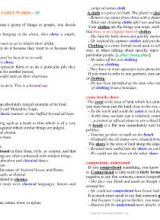
ENGLISH CONFUSABLE WORDS – 07 after all, at last, finally, in the end, lastly, last of all You use after all when you are mentioning an additional pointwhich confirms or supports what you have just said, - Thẹy did not expect heavy losses in the air; after all, they had superb aircraft. - They didn’t bother to tie me up. After all, there werefour, five, six of them there, mostly with handguns. You also use after all to say that something is the case or may be the case in spite of what had previously been thought. - Could it be true, after all, that money dùi not bring happiness? - Perhaps it isn’t such a bad village after all. Yoa do not use ‘after all’ to talk about what happens at the end of a long period. You use at last, finally, in the end, or last of all. You use at last or finally to say that something happens after you have been waiting for it or expecting it for a long time. You can use at last at the end of a sentence. - The storm that had threatened for so long broke at last. Finally usually comes either at the beginning of a sentence or in front of a verb. - After another search on the map they finally located it. You also use finally to talk about an act or result that is last in a series of things. - Gorky lived in turn in Turkey, France, Norway, and finally Mexico. - Let’s come finally to the question ofpensions. You use in the end when you are talking about a situation that comes about after a long time or after a long process. - Perhaps the police got him in the end, ’ Sam said. - The performance was quite a success in the end. - In the end, Peter seemed quite happy and so did I. You use lastly to talk about the last of a series of people or things. - Then I went through the bathroom and lastly the bed-sitting room. - Lastly he jabbed the knife hard into the trunk ofthe tree. You use last of all to emphasize that there is nobody or nothing else after the person or thing you mention. - In rapid succession hisfriends’ faces appear and disappear; last of all he sees Lewis Seidel’s maddening smile. - Last of all came the cat. ago, before, for, since You use ago to connect a time in the past with the moment of speaking. If you are speaking on Friday and you say that something happened two days ago, you mean that it happened on Wednesday. - The land was acquired by the University two years ago. - I discovered afew days ago that Weiss was Houdini's real name.
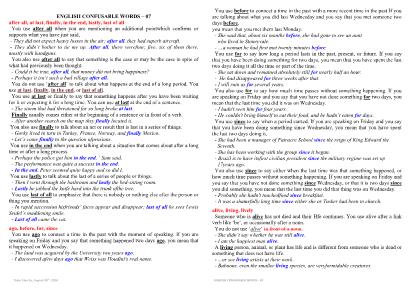
You use before to connect a time in the past with a more recent time in the past If you are talking about what you did last Wednesday and you say that you met someone two days before, you mean that you met them last Monday. - She said that, about six months before, she had gone to see an aunt who lived in Stoneyvale. - …a woman he had first met twenty minutes before. You use for to say how long a period lasts in the past, present, or future. If you say that you have been doing something for two days, you mean that you have spent the last two days doing it all the time or part of the time. - She sat down and remained absolutely still for nearly half an hour. - He had disappeared for three weeks after that. - I will ruin us for several years. You also use for to say how much time passes without something happening. If you are speaking on Friday and you say that you have not done something for two days, you mean that the last time you did it was on Wednesday. - Ỉ hadn't seen him for four years. - He couldn't bring himself to eat their food, and he hadn’t eaten for days. You use since to say when a period started. If you are speaking on Friday and you say that you have been doing something since Wednesday, you mean that you have spent the last two days doing it. - She had been a manager of Fairacre School since the reign of King Edward the Seventh. - She has been working with the group since it began. - Brazil is to have itsfirst civilian president since the military regime was set up 17years ago. You …
Trên đây là phần đầu tài liệu — bấm Đọc sách để xem đầy đủ.