
Những từ gây nhầm lần trong Tiếng Anh - Phần 8 - Thấm Tâm Vy
Xem trước nội dung
Thẩm Tâm Vy, August 21st, 2020 ENGLISH CONFUSABLE WORDS - 08
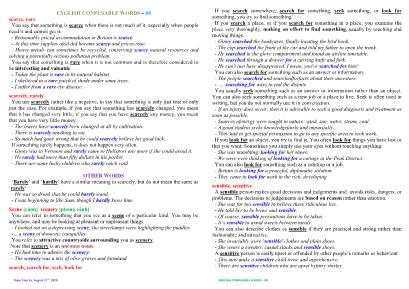
ENGLISH CONFUSABLE WORDS – 08 scarce, rare You say that something is scarce when there is not much of it, especially when people need it and cannot get it. - Reasonably priced accommodation in Britain is scarce. - At this time supplies ofoil did become scarce and prices rose. - Heavy metals can sometimes be recycled, conserving scarce natural resources and solving a potentially serious pollution problem. You say that something is rare when it is not common and is therefore considered to be interesting and valuable. - Today the plant is rare in its natural habitat - I sheltered in a rare patch of shade under some trees. - I suffer from a rare eye disease. scarcely, rarely You use scarcely rather like a negative, to say that something is only just true or only just the case. For example, if you say that something has scarcely changed, you mean that it has changed very little; tf you say that you have scarcely any money, you mean that you have very little money. - The leaves have scarcely been changed at all by cultivation. - There is scarcely anything to eat. - So much had gone wrong that he could scarcely believe his good luck. If something rarely happens, it does not happen very often. - Ginny was in Vermont and rarely came to Hullsport any more if she could avoid it. - He rarely had more than fifty dollars in his pocket. - There are some lucky children who rarely catch cold
OTHER WORDS ‘Barely’ and ‘hardly’ have a similar meaning to scarcely, but do not mean the same as ‘rarely’. - He was so drunk that he could barely stand. - I was beginning to like Sam, though I hardly knew him. Scene [cảnh] scenery [phong cảnh] You can refer to something that you see as a scene of a particular kind. You may be anywhere, and may be looking at pleasant or unpleasant things. - I looked out on a depressing scene; the streetlamps were highlighting the puddles. - ...a scene of domestic tranquillity. You refer to attractive countryside surrounding you as scenery. Note that scenery is an uncount noun. - He had time to admire the scenery. - The scenery was a mix of olive groves and farmland. search, search for, seek, look for
If you search somewhere, search for something, seek something, or look for something, you try to find something. If you search a place, or if you search for something in a place, you examine the place very thoroughly, making an effort to find something, usually by touching and moving things. - Ginny searched the bookcases, finally locating the bird book. - The cop searched the front of the car and told my father to open the trunk. - He searched in the glove compartment and found an airline timetable. - He searched through a drawer for a carving knife and fork. - He can't just have disappeared. I mean, you've searched for him? You can also search for something such as an answer or information. - The people searched and searchedforfacts about their ancestors. - …. searching for ways to end the dispute. You usually seek something such as an answer or information rather than an object. You can also seek something such as a new job or a place to live. Seek is often used in writing, but you do not normally use it in conversation. - If an injury does occur, then it is advisable to seek a good diagnosis and treatment as soon as possible. - Sources ofenergy were sought in nature: wind, sun, water, steam, coal. - A good student seeks knowledgefairly and impartially. - They had to get special permission to go to any specific area to seek work. If you look for an object, you try to find it. You often look for things you have lost or that you want. Sometimes you simply use your eyes without touching anything. - She was mumbling, looking for her shoes. - We were even thinking of looking for a cottage in the Peak District. You can also look for something such as a solution or a job. - Britain is looking for a peaceful, diplomatic solution. - They came to look for work in the …
Trên đây là phần đầu tài liệu — bấm Đọc sách để xem đầy đủ.