
Những từ gây nhầm lần trong Tiếng Anh - Phần 10 - Thấm Tâm Vy
Xem trước nội dung
Thẩm Tâm Vy, August 23, 2020 ENGLISH CONFUSABLE WORDS - 10
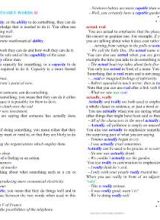
ENGLISH CONFUSABLE WORDS – 10 admission, admittance If you want to get into a private building or part of a building, you seek admittance. Admittance is a formal word and is sometimes used on signs. - How then was he to gain admittance? - Bernstein opened a door marked NO ADMITTANCE. Admission has the same meaning, but is less formal. You do not usually use ‘admission’ on signs. - Marsha was insisting on admission to David’s office. - To gain admission, one had to ring that bell at the main gate. You always use admission when you want to talk about going into public places such as theatres and museums, or into a hospital as a patient, or being allowed into a university as a student. - ..free admission to all national museums and galleries. - ...priority casesfor admission to hospital. - He applied for admission to Harvard. • An admission is a confession, usually made rather reluctantly, that you have done something bad, unpleasant, or embarrassing. - The admission of guilt is hard. - They made no admission that the newspaper had been fooling the public. advocate, recommend If someone advocates a particular action or plan, they say publicly that it is the right action or plan and that other people should adopt it. They are usually discussing a serious question that they know a lot about and that can affect many people. Advocate is pronounced /’ædvəkeit/. - The socialist policies he advocates would mean a major reform of the Common Market. - The only positive step he took at this time was to advocate Winston Churchill’s return to government as a Minister. - The report advocates a massive programme ofaid to developing countries. If someone recommends a particular action or plan, they suggest that it is the best action or plan. They may be discussing a serious question or a minor one, and they may be giving advice to one person, a few people, or many people. - He suffered severe headaches as a result of this injury, and his doctor recommended a rest. - The steps we’ve recommended above will help you get a view of your firm’s interests. - They recommend that no more than one egg a day should be eaten. - We recommend that you take an adequate supply ofcurrency and traveller's cheques. after, afterwards, later You use after, afterwards, and later to talk about things that happen at a time following the time of speaking or following a particular event.
You can use after as a preposition. - After dinner she got hold of the President and spoke to him. - He resigned after allegations that he was involved in drug-trafficking. You can also use after as a conjunction. - I returned to England only recently, after spending two months in India. - His fame grew after he left the hospital. In expressions like ‘shortly after’ and ‘not long after’, you can use after as an adverb. - Douglas came round to see me, and soon after I met him again at a friend's. - Shortly after, Fania called me. Afterwards can also be used as an adverb when you do not need to mention the particular time or event. - Afterwards we went to a night club. - You’d better come up to my room afterwards and show me what you've got. You can use later as an adverb to refer to a time or situation that is after the one that you have been talking about, or following the time of speaking. - I returned some three or four weeks later. - I’ll go round and see Nell later. You can use all these words after a phrase which mentions a period of time to say when something happens. - She wrote about it six years afterwards. - Ten minutes later Sutherland grabbed a microphone. - ..five hundred years after his death. • The words ‘shortly’, ‘soon’, and ‘long’ can be used with both after and afterwards. - He was back in the hotel shortly after six. - Soon afterwards, Ira came storming into the clinic. - ...under a tree known long afterwards as the Queen’s Oak. • ‘A little’, ‘much’, and ‘not much’ can be used with later. - A little later, …
Trên đây là phần đầu tài liệu — bấm Đọc sách để xem đầy đủ.