
Những từ gây nhầm lần trong Tiếng Anh - Phần 13 - Thấm Tâm Vy
Xem trước nội dung
Thẩm Tâm Vy, September 3rd, 2020 ENGLISH CONFUSABLE WORDS 13
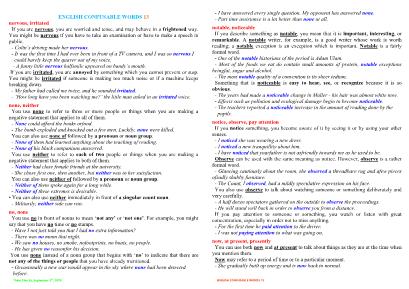
ENGLISH CONFUSABLE WORDS 13 nervous, irritated If you are nervous, you are worried and tense, and may behave in a frightened way. You might be nervous tf you have to take an examination or have to make a speech in public. - Colin’s driving made her nervous. - It was the first time I had ever been in front of a TV camera, and I was so nervous I could barely keep the quaver out of my voice. - A funny little nervous halfsmile appeared on bandy’s mouth. If you are irritated, you are annoyed by something which you cannot prevent or stop. You might be irritated if someone is making too much noise or if a machine keeps breaking down. - My father had called me twice, and he sounded irritated. - ‘How long have you been watching me?’ the little man asked in an irritated voice.
none, neither You use none to refer to three or more people or things when you are making a negative statement that applies to all of them. - None could afford the books orfood. - The bomb exploded and knocked out a few men. Luckily, none were killed. You can also use none of followed by a pronoun or noun group. - None of them had learned anything about the teaching of reading. - None of his black companions answered. You use neither to refer to each of two people or things when you are making a negative statement that applies to both of them. - Neither had close female friends at the university. - She chose first one, then another, but neither was to her satisfaction. You can also use neither of followed by a pronoun or noun group. - Neither of them spoke again for a long while. - Neither of these extremes is desirable. • You can also use neither immediately in front of a singular count noun. - Militarily, neither side can win.
no, none You use no in front of nouns to mean ‘not any’ or ‘not one’. For example, you might say that you have no time or no stamps. - Have I not just told you that I had no extra information? - There was no moon that night. - We saw no houses, no smoke, nofootprints, no boats, no people. - He has given no reasonfor his decision. You use none instead of a noun group that begins with ‘no’ to indicate that there are not any of the things or people that you have already mentioned. - Occasionally a new star would appear in the sky where none had been detected before.
- I have answered every single question. My opponent has answered none. - Part time assistance is a lot better than none at all.
notable, noticeable If you describe something as notable, you mean that it is important, interesting, or remarkable. A notable writer, for example, is a good writer whose work is worth reading; a notable exception is an exception which is important. Notable is a fairly formal word. - One of the notable historians of the period is Adam Ulam. - Most of the foods we eat do contain small amounts of protein, notable exceptions beingfat, sugar and alcohol. - The most notable quality of a convention is its sheer tedium. Something that is noticeable is easy to hear, see, or recognize because it is so obvious. - The years had made a noticeable change in Muller - his hair was almost white now. - Effects such as pollution and ecological damage begin to become noticeable. - The teachers reported а noticeable increase in the amount of reading done by the pupils.
notice, observe, pay attention If you notice something, you become aware of it by seeing it or by using your other senses. - I noticed she was wearing a new dress. - I noticed a new tranquillity about him. - I have noticed that yourfather is not asfriendly towards me as he used to be. Observe can be used with the same meaning as notice. However, observe is a rather formal word. - Glancing cautiously about the room, she observed a threadbare rug and afew pieces ofsadly shabby furniture. - The Count, I observed, had a mildly speculative expression on his face. You also use observe to talk about watching someone or something deliberately and …
Trên đây là phần đầu tài liệu — bấm Đọc sách để xem đầy đủ.