
Grammar for advanced learners Adjectives - Thấm Tâm Vy
Xem trước nội dung
Thẩm Tâm Vy, July 23, 2019 GRAMMAR FOR ADVANCED LEARNERS
GRAMMAR FOR ADVANCED LEARNERS 11
ADJECTIVES Adjectives in English seem straightforward as they do not change their form except when they are comparatives or superlatives. But the different positions of adjectives, e.g. concerned residents or residents concerned, and the sequence of groups of adjectives can cause difficulty. Here we look at these areas and at the use of participle and compound adjectives.
ADJECTIVE PATTERNS A. Form and use. Adjectives are words which give extra information about nouns. They do not changetheir form to show number or gender: - The hero was played bg a young boy. - Several young girls took the secondary roles. Many adjectives are formed from other words; notice the spelling changes:
+IC +(I)AL +ABLE +FUL +ENT +IVE history historic
politics political
fashion fashionable
beauty beautiful
depend dependent
effect effective +OUS +LESS PARTICIPLE COMPOUNDS danger dangerous
hope hopeless
interesting interested
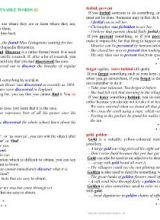
home-made red-hot Adjectives can sometimes act as nouns when they describe a particular group or characteristic. We usually use the definite article and a plural verb: - Old people are becoming more numerous. = The old are becoming more numerous. We cannot use the possessive ‘s with adjectives used as nouns or make them plural: - The governiment is looking at the disabled’s problems. => The government is looking at the problems of the disabled. - The Japaneses enjoy a high standard of living. => The Japanese (or Japanese people) enjoy a high standard of living. When we make a brief comment in conversation we often use what + adjective + noun or how + adjective: - What an amazing story! - What arnazing! => How amazing! B. Attributive Verb Position. Most adjectives can be used in front of a noun (attributive position), or after a linking verb e.g. be (predicative position): * Attributive: - We've just seen an exciting film. * Predicative: - That film was exciting. But there are some adjectives which we usually only use in one position. Some classifying adjectives (which describe what type of thing something is) and emphasising adjectives are mainly used before a noun (see the table below): - The plant they are building outside the town is chemical. => They're building a chemical plant outside the town. Adjectives usually used in attributive position: * classifying adjectives: chemical, chief, criminal, elder, entire, eventual, former, industrial, local, lone, main, maximum, medical, national, nuclear, only, outdoorlindoor, principal, social, sole, underlying, whole
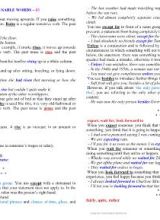
* emphasising adjectives: mere, sheer, utter C. Predicative Position. Adjectives in predicative position are usually the complement of a linking verb (e.g. be, become, feel , seem): - When she heard the noise Mary became very uneasy. However, after certain verbs of thinking and feeling (i.e. consider, find, think) we can omit the linking verb: - I consider / find him (to be) very reliable. Many adjectives beginning with the letter a and adjectives describing health and feelings are not usually used before nouns; we use them in predicative position: - Try not to disturb the asleep children. => Try not to disturb the children; they are asleep. * Adjectives usually used in predicative position: - beginning with a: ablaze, afloat, qfraid, alight, alike, alive, qlone, aloof, ashamed, askew, asleep, awake, aware - health and feelings content: fine, glad, ill, pleased, poorlg, readg, sorry, sure, upset, (un)well There are some fixed phrases/idioms in which we use normally predicative adjectives before a noun with a special meaning, e.g. glad tidings, an ill wind, a ready wit, a sorry state, an upset stomach. Some predicative adjectives have equivalent words which can be used before a noun: - They are doing experiments on live animals / animals which are alive. * predicative: alive, afraid, alike, asleep, ill * attributive: live / living, frightened, …
Trên đây là phần đầu tài liệu — bấm Đọc sách để xem đầy đủ.