
Grammar for advanced learners Confusing verbs - Thấm Tâm Vy
Xem trước nội dung
Thẩm Tâm Vy, March 15th, 2020 GRAMMAR FOR ADVANCED LEARNERS CONFUSING VERBS
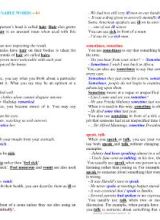
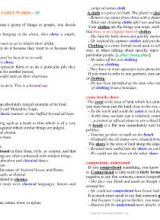
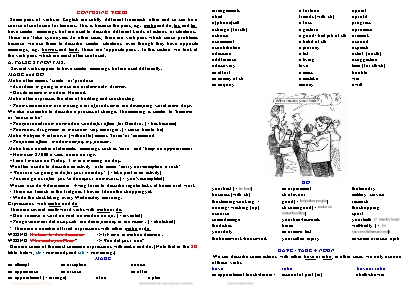
CONFUSING VERBS Some pairs of verbs in English are subtly different from each other and so can be a source of confusion for learners. This is because the pairs, e.g. make and do, lay and lie, have similar meanings but are used to describe different kinds of actions or situations. These are ‘false synonyms’. In other cases, there are verb pairs which cause problems because we use them to describe similar situations even though they have opposite meanings, e.g. borrow and lend. These are ‘opposite pairs’. In this section we look at the verb pairs which are most often confused. A. FALSE SYNONYMS. Several verbs appear to have similar meanings but are used differently. MAKE and DO Make often means ‘create’ or ‘produce’: - Aunt Alice is going to make the bridesmaids’ dresses. - Gouda cheese is made in Holland. Make often expresses the idea of building and constructing: - The multinationals are making a lot of products in the developing world these days. We also use make to describe a process of change. The meaning is similar to ‘become’ or ’cause to be’: - The spare bedroom has made a wonderful office for Deirdre. (= has become) - Those new drugs seem to make him very lethargic. (= cause him to be) Make + object + infinitive (without to) means 'force' or ‘command’: - The police officer made me empty my pockets. Make has a number of idiomatic meanings such as ‘earn’ and ‘keep an appointment’: - He makes $1000 a week on the oil rigs. - I can't make it on Friday; I’m in a meeting all day. We often use do to describe an activity or to mean ‘carry out/complete a task': - What are we going to do for your birthday? (= take part in an activity) - You can go out after you've done your homework. (= you've completed) We can use do + determiner + -ing form to describe regular tasks at home or at work: - There isn’t much in the fridge as I haven’t done the shopping yet. - We do the stocktaking every Wednesday morning. Expressions with make and do There are several multi-word verbs with make or do. - Don’t believe a word he said, he made it all up. (= invented) - The government did away with the death penalty in the sixties. (= abolished) * There are a number of fixed expressions with either make or do; WRONG It’s time to do a decisiom => It's time to make a decision. WRONG Who made yout^hair? => Who did your hair? Here are some of the most common expressions with make and do. (Note that in the 2D table below, sb = somebody and sth = something.)
MAKE an attempt an exception a noise an appearance an excuse an offer an appointment (= arrange) a fire a plan
arrangements a fortune a point a bed friends (with sb) a profit a (phone) call a fuss progress a charge (for sth) a gesture a promise a choice a good / bad job of sth a remark a comment a habit of sth a sound a contribution a journey a speech a decision a list a start (on sth) a difference a living a suggestion a discovery love time (for sth/sb) an effort a mess trouble an enemy of sb a mistake war an enquiry money a will
DO your best (= try hard) an experiment the laundry business (with sb) sb a favour military service the cleaning/cooking / good (= help other people) research ironing / washing (up) sb some good (= make sb the shopping a course better/healthier) sport some damage your hair/face/nails your teeth (= brush/clean) the dishes harm well/badly (= be your duty an exam/a test successful/unsuccessful) the homework/housework yourself an injury an/some exercise a job
HAVE / TAKE + NOUN We can describe some actions with either have or take; in other cases we only use one of these verbs: have take have or take an appointment lunch/dinner / account of part (in) a bath/shower
DeThi.edu.vn
Trên đây là phần đầu tài liệu — bấm Đọc sách để xem đầy đủ.