
Grammar for advanced learners Gradable and ungradable adjectives - Thấm Tâm Vy
Xem trước nội dung
Thẩm Tâm Vy, july 27, 2019 GRAMMAR FOR ADVANCED LEARNERS 12
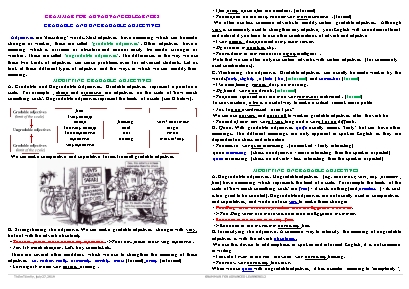
GRAMMAR FOR ADVADVANCED LEARNERS
GRADABLE AND UNGRADABLE ADJECTIVES
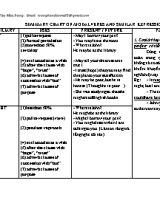
Adjectives are 'describing' words. Most adjectives have a meaning which can be made stronger or weaker; these are called 'gradable adjectives'. Other adjectives have a meaning which is extreme or absolute and cannot easily be made stronger or weaker. These are called 'ungradable adjectives'. The differences in the way we use these two kinds of adjectives can cause problems even for advanced students. Let us look at these different types of adjective and the ways in which we can modify their meaning.
MODIFYING GRADABLE ADJECTIVES A. Gradable and Ungradable Adjectives. Gradable adjectives represent a point on a scale. For example , cheap and expensive are adjectives on the scale of 'how much something costs'. Ungradable adjectives represent the limits of a scale (see B below).
Gradable adjectives (limit of the scale)
Ungradable adjectives
Gradable adjectives (limit of the scale)
free (very cheap)
cheap (not very cheap)
(a bit expensive
expensive very expensive
freezing
cold
hot boiling
vast / enormous
large small minute / tiny
We can make comparative and superlative forms from all gradable adjectives:
B. Strengthening the adjective. We can make gradable adjectives stronger with very, but not with the adverb absolutely: - That new jacket looks absolutely expensive.=>That new jacket looks verg expensive. - Yes. It's much cheaper. Let's buy some tickets. There are several other modifiers which we use to strengthen the meaning of these adjectives: so, rather, really, extremely, terribly, most (formal), pretty (informal): - Last night's match was terribly exciting.
- I felt pretty upset after the accident. (informal) - The chapter on the early sonnets was most instructive. (formal) We often use less common adverbs to modify certain gradable adjectives. Although very is commonly used to strengthen any adjective, your English will sound more fluent and natural if you learn to use other combinations of adverb and adjective: - I was bitterly disappointed at my exam results. - Mg brother is painfully shy. - The students in this school are highly intelligent. Note that we can often only use certain adverbs with certain adjectives (for commonly used combinations). C. Weakening the adjective. Gradable adjectives can usually be made weaker by the words fairly, slightly, a (little) bit, (informal) and somewhat (formal): - I've been feeling slightly dizzy all morning. - Mg friend was a bit drunk. (informal) - The police reported that the man was somewhat inebriated. (formal) In conversation, a bit is a useful way to make a critical remark more polite: - You're a bit overdressed, aren't you? We can use not very and not at all to weaken gradable adjectives after the verb be: - The end of term test wasn't very long and it wasn't at all difficult. D. Quite. With gradable adjectives quife usually means 'fairly' but can have other meanings. The different meanings are only apparent in spoken English as they are dependent on stress and intonation: - The lecture was quite interesting. (unmarked = fairly interesting) quite interesting (stress on adjective = more interesting than the speaker expected) quite interesting (stress on adverb = less interesting than the speaker expected)
MODIFYING UNCRADABLE ADJECTIVES A. Ungradable adjectives. Ungradable adjectives (e.g. enormous, vast, tiny, priceless, free) have a meaning which represents the limit of a scale. For example the limits of the scale of 'how much something costs' are free (= it costs nothing) and priceless (= its cost is too great to be counted). Ungradable adjectives are not usually used in comparatives and superlatives, and we do not use very to make them stronger: - The Ming vases are more priceless than the Egyptian mummies. => The Ming vases are more valuable than the Egyptian mummies. - Entrance to the museum is very free. => Entrance to the …
Trên đây là phần đầu tài liệu — bấm Đọc sách để xem đầy đủ.