
Listen and read 13 Quickening the countdown - Thấm Tâm Vy
Xem trước nội dung
Thẩm Tâm Vy, Dec 10, 2019 LISTEN AND READ 13
LISTEN AND READ 13
Warfare In Space
QUICKENING THE COUNTDOWN
Growing fears of conflict in space mean America’s officials
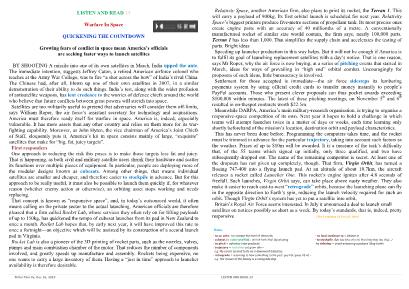
are seeking faster ways to launch satellites BY SHOOTING A missile into one of its own satellites in March, India upped the ante. The immediate intention, suggests Jeffrey Caton, a retired American airforce colonel who teaches at the Army War College, was to fire “a shot across the bow” of India’s rival China. The Chinese had, after all, blown up one of their own satellites in 2007, in a similar demonstration of their ability to do such things. India’s test, along with the wider profusion of antisatellite weapons, has lent credence to the worries of defence chiefs around the world who believe that future conflicts between great powers will stretch into space. Satellites are too militarily useful to pretend that adversaries will consider them off-limits, says William Roper, the air force’s assistant secretary for technology and acquisitions. America must therefore ready itself for warfare in space. America is, indeed, especially vulnerable. It has more assets than any other country and relies on them more for its war- fighting capability. Moreover, as John Hyten, the vice chairman of America’s Joint Chiefs of Staff, eloquently puts it, America’s kit in space consists mainly of large, “exquisite” satellites that make for “big, fat, juicy targets”. First responders One approach to reducing the risk this poses is to make those targets less fat and juicy. That is happening, as both civil and military satellite users shrink their hardware and scatter its functions over multiple pieces of equipment. In particular, people are deploying more of the modular designs known as cubesats. Among other things, that means individual satellites are smaller and cheaper, and therefore easier to stockpile in advance. But for this approach to be really useful, it must also be possible to launch them quickly if, for whatever reason (whether enemy action or otherwise), an orbiting asset stops working and needs replacing. That concept is known as “responsive space”, and, in today’s outsourced world, it often means calling on the private sector to the actual launching. American officials are therefore pleased that a firm called Rocket Lab, whose services they often rely on for lifting payloads of up to 150kg, has quickened the tempo of cubesat launches from its pad in New Zealand to once a month. Rocket Lab hopes that, by early next year, it will have improved this rate to once a fortnight—an objective which will be assisted by its construction of a second launch pad in Virginia. Rocket Lab is also a pioneer of the 3D printing of rocket parts, such as the nozzles, valves, pumps and main combustion chamber of the motor. That reduces the number of components involved, and greatly speeds up manufacture and assembly. Rockets being expensive, no one wants to carry a large inventory of them. Having a “just in time” approach to launcher availability is therefore desirable.
Relativity Space, another American firm, also plans to print its rocket, the Terran 1. This will carry a payload of 900kg. Its first orbital launch is scheduled for next year. Relativity Space’s biggest printers produce five-metre sections of propellant tank. Its most precise ones create engine parts with an accuracy of 40 millionths of a metre. A conventionally manufactured rocket of similar size would contain, the firm says, nearly 100,000 parts. Terran 1 has less than 1,000. That simplifies the supply chain and accelerates the testing of parts. Bright ideas Speeding up launcher production in this way helps. But it will not be enough if America is to fulfil its goal of launching replacement satellites with a day’s notice. That is one reason, says Mr Roper, why the air force is now buying, at a series of pitching events that started in March, ideas for ways of prevailing in “high end” orbital combat. Encouragingly for …
Trên đây là phần đầu tài liệu — bấm Đọc sách để xem đầy đủ.