.jpg)

Đề kiểm tra 1 tiết số 3+4 môn Tiếng Anh Lớp 9 - Năm học 2017-2018 (Có đáp án)
Xem trước nội dung
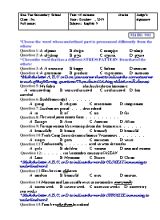
…………….………..Secondary School Name: ……….…..……..………………. Class: ………….………..………………
WRITTEN TEST 3 – ENGLISH 9
Time: 45 minutes School year: 2017 – 2018 Marks Teacher’s comments
PART A. LISTENING. (2.5ms) I/ Listen and choose the correct option to complete the sentences. (1.25ms) 1. The sun can be a(n) ……………..……..source of power.
A. effective B. uneffective C. safe D. unsafe 2. …………………….doesn’t cause pollution.
A. Nuclear power B. Solar energy C. Coal D. Oil 3. …………………….of solar energy is enough to provide power for the total population.
A. 4 percent B. 3 percent C. 2 percent D. 1 percent 4. Solar panels are ………………….….. on the roof of a house.
A. used B. installed C. stored D. heated 5. All buildings will be heated by solar energy by the year ……………………….
A. 2015 B. 2050 C. 2005 D. 2030 II/ Listen and answer the questions. (1.25ms)
1. Does solar energy cause pollution or waste natural resources? → …………………………………………………………………………………. 2. Is the solar energy that reaches the Earth enough for the world’s population? → …………………………………………………………………………………. 3. Where are solar panels placed? → …………………………………………………………………………………. 4. Which country has an advanced solar energy program? → …………………………………………………………………………………. 5. When will cars use solar power instead of gas in Sweden? → …………………………………………………………………………………. PART B. LANGUAGE FOCUS (2.5ms) I/ Choose the word whose underlined part is pronounced differently. (0.5m)
1. A. litter B. appliance C. dissolve D. innovate 2. A. protect B. conservation C. currency D. persuade II/ Choose the best answer to complete the sentences. (1.5ms) 1. Coal, oil, gas are ………………………resources. A. nature B. natural C. naturally D. unnaturally 2. She is very tired; ................, she has to finish her homework.
A. moreover B. so C. and D. however 3. They didn’t understand the matter ………….. they didn’t ask for help.
A. but B. however C. moreover D. and 4. The teacher suggests that the students ………….. English in class.
A. should speak B. speaking C. speak D. spoke 5. Can you ..............the light ? It's too dark to do homework .
A. turn off B. turn on C. turn down D. turn up 6. How about………………a bus? We have a lot of time.
A. take B. to take C. taking D. having taken III/ Give the correct form of the verbs in brackets. (0.5m)
1. They (smoke) ………………………. since last week. 2. Tuan (forget) ……………………….. to turn off the television when he left for school. PART C. READING (2.5ms)
DeThi.edu.vn
I/ Read the passage, then choose the best answer to complete the passage. (1.25ms)
Garbage ia a serious problem in the U.S. Every year, Americans produce about 308 billion pounds. All of the garbage goes to the (1) …………..…….... But many landfills do not have room for all the garbage. One answer to the garbage problem is (2) …………….…...Half of all the garbage in the U.S can be recycled (3) ……………………..use again. Recycling (4) ………………….the landfills problem and saves enough energy too. When people recycle newspapers, they save (5) …………............When they recycle glass, plastic, or cans, they save oil and electricity. Recycling is good for everything.
1. A. land B. city C. garbage D. landfills 2. A. talking B. telling C. recycling D. asking 3. A. or B. and C. but D. so 4. A. help B. helping C. to help D. helps 5. A. gas B. paper C. electricity D. water II/ Read the passage and write answers to the questions that follow. (1.25ms) About twenty percent of the world’s present energy comes from the sun in one form or another. Special devices have already been made available to put on the roofs of the houses and flats to catch the sun’s rays and thus heat water . Thousands of these devices are now being used to provide energy in homes throughout the United States while more than a million solar waterheating units have already been built in homes in Japan. Other purposes for which solar energy is at present being used include the removal of salt from seawater, irrigation and sewage disposal. For most people in developing countries, the …
Trên đây là phần đầu tài liệu — bấm Đọc sách để xem đầy đủ.