
Lý thuyết và bài tập Tiếng Anh Lớp 12 - Ngữ pháp Subordinate Clauses
Xem trước nội dung
S u b o r d i n a t e C l a u s e s
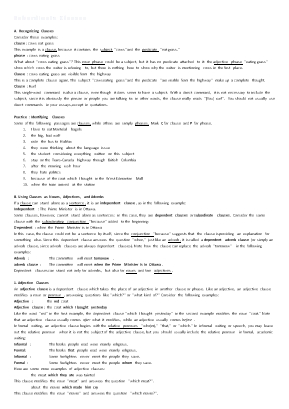
A. Recognizing Clauses Consider these examples: clause : cows eat grass This example is a clause, because it contains the subject "cows" and the predicate "eat grass." phrase : cows eating grass What about "cows eating grass"? This noun phrase could be a subject, but it has no predicate attached to it: the adjective phrase "eating grass" show which cows the writer is referring to, but there is nothing here to show why the writer is mentioning cows in the first place. Clause : cows eating grass are visible from the highway This is a complete clause again. The subject "cows eating grass" and the predicate "are visible from the highway" make up a complete thought. Clause : Run! This single-word command is also a clause, even though it does seem to have a subject. With a direct command, it is not necessary to include the subject, since it is obviously the person or people you are talking to: in other words, the clause really reads "[You] run!". You should not usually use direct commands in your essays, except in quotations.
Practice : Identifying Clauses Some of the following passages are clauses, while others are simply phrases. Mark C for clause and P for phrase.
1. I love to eat Montréal bagels 2. the big, bad wolf 3. rode the bus to Halifax 4. they were thinking about the language issue 5. the student considering everything written on this subject 6. stay on the Trans-Canada highway through British Columbia 7. after the morning rush hour 8. they hate politics 9. because of the coat which I bought in the West Edmonton Mall 10. when the train arrived at the station
B. Using Clauses as Nouns, Adjectives, and Adverbs If a clause can stand alone as a sentence, it is an independent clause, as in the following example: Independent : The Prime Minister is in Ottawa. Some clauses, however, cannot stand alone as sentences: in this case, they are dependent clauses or subordinate clauses. Consider the same clause with the subordinating conjunction "because" added to the beginning: Dependent : when the Prime Minister is in Ottawa In this case, the clause could not be a sentence by itself, since the conjunction "because" suggests that the clause is providing an explanation for something else. Since this dependent clause answers the question "when," just like an adverb, it is called a dependent adverb clause (or simply an adverb clause, since adverb clauses are always dependent clauses). Note how the clause can replace the adverb "tomorrow" in the following examples: Adverb : The committee will meet tomorrow. adverb clause : The committee will meet when the Prime Minister is in Ottawa. Dependent clauses can stand not only for adverbs, but also for nouns and fore adjectives.
1. Adjective Clauses An adjective clause is a dependent clause which takes the place of an adjective in another clause or phrase. Like an adjective, an adjective clause modifies a noun or pronoun, answering questions like "which?" or "what kind of?" Consider the following examples: Adjective : the red coat Adjective clause : the coat which I bought yesterday Like the word "red" in the first example, the dependent clause "which I bought yesterday" in the second example modifies the noun "coat." Note that an adjective clause usually comes after what it modifies, while an adjective usually comes before. In formal writing, an adjective clause begins with the relative pronouns "who(m)," "that," or "which." In informal writing or speech, you may leave out the relative pronoun when it is not the subject of the adjective clause, but you should usually include the relative pronoun in formal, academic writing: Informal : The books people read were mainly religious. Formal: The books that people read were mainly religious. Informal : Some firefighters never meet the people they save. Formal : Some firefighters never meet the people whom they save. Here are some more examples of adjective clauses:
the meat which they ate was tainted This …
Trên đây là phần đầu tài liệu — bấm Đọc sách để xem đầy đủ.