
Đề khảo sát chất lượng môn Tiếng Anh Lớp 12 - Mã đề 003 - Năm học 2018-2019 - Sở giáo dục và đào tạo Thanh Hóa
Xem trước nội dung
Trang 1/5 - Mã đề 003
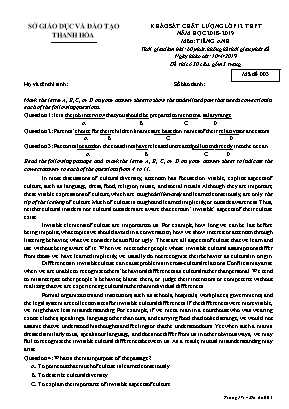
SỞ GIÁO DỤC VÀ ĐÀO TẠO THANH HÓA
KHẢO SÁT CHẤT LƯỢNG LỚP 12 THPT
NĂM HỌC 2018- 2019
Môn: TIẾNG ANH Thời gian làm bài: 60 phút, không kể thời gian phát đề
Ngày khảo sát: 10/4/2019 Đề thi có 50 câu, gồm 5 trang
Mã đề 003
Họ và tên thí sinh: ..................................................................... Số báo danh: ................................
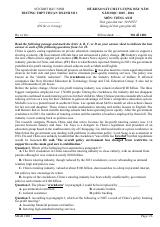
Mark the letter A, B, C, or D on your answer sheet to show the underlined part that needs correction in each of the following questions. Question 1: It is the job interview that you should be prepared to mention a salary range.
A B C D Question 2: Parents’ choice for their children’s names are based on names of their relatives or ancestors.
A B C D Question 3: Factories located on the coastlines have released untreated pollution directly into the ocean.
A B C D Read the following passage and mark the letter A, B, C, or D on your answer sheet to indicate the correct answer to each of the questions from 4 to 11.
In most discussions of cultural diversity, attention has focused on visible, explicit aspects of culture, such as language, dress, food, religion, music, and social rituals. Although they are important, these visible expressions of culture, which are taught deliberately and learned consciously, are only the tip of the iceberg of culture. Much of culture is taught and learned implicitly, or outside awareness. Thus, neither cultural insiders nor cultural outsiders are aware that certain “invisible” aspects of their culture exist. Invisible elements of culture are important to us. For example, how long we can be late before being impolite, what topics we should avoid in a conversation, how we show interest or attention through listening behavior, what we consider beautiful or ugly. These are all aspects of culture that we learn and use without being aware of it. When we meet other people whose invisible cultural assumptions differ from those we have learned implicitly, we usually do not recognize their behavior as cultural in origin. Differences in invisible culture can cause problems in cross-cultural relations. Conflicts may arise when we are unable to recognize others’ behavioral differences as cultural rather than personal. We tend to misinterpret other people’s behavior, blame them, or judge their intentions or competence without realizing that we are experiencing cultural rather than individual differences.
Formal organizations and institutions, such as schools, hospitals, workplaces, governments, and the legal system are collection sites for invisible cultural differences. If the differences were more visible, we might have less misunderstanding. For example, if we met a man in a courthouse who was wearing exotic clothes, speaking a language other than ours, and carrying food that looked strange, we would not assume that we understood his thoughts and feelings or that he understood ours. Yet when such a man is dressed similarly to us, speaks our language, and does not differ from us in other obvious ways, we may fail to recognize the invisible cultural differences between us. As a result, mutual misunderstanding may arise. Question 4: What is the main purpose of the passage?
A. To point out that much of culture is learned consciously. B. To describe cultural diversity. C. To explain the importance of invisible aspects of culture.
DeThi.edu.vn
Trên đây là phần đầu tài liệu — bấm Đọc sách để xem đầy đủ.